

Explore the region
About Zheng He Park
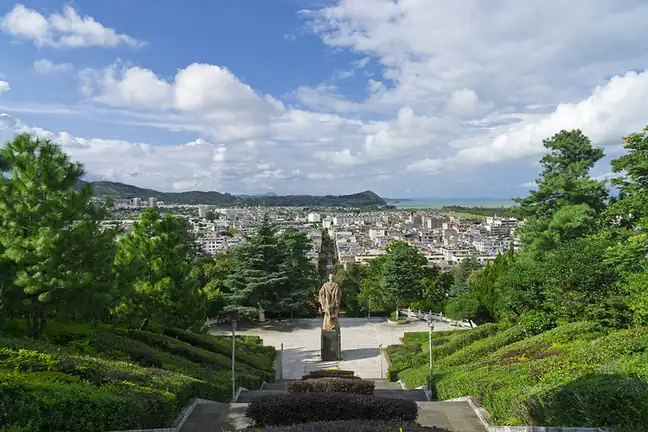
The district government lists the park at AA grade and counts it among the 'Kunming New Sixteen Scenes' under the name Yueshan Fanying, or Sails on Moon Hill; a Wenlv Toutiao report compiled from Zheng He Memorial Hall material dates its founding to 1978 and places it on the west slope of Yueshan by the shore of Lake Dian. Its named features include a Zheng He statue square, where a stone statue on a treasure-ship-shaped pedestal stands in a long robe; Sanbao Tower, a three-storey building on Yueshan built in the shape of Zheng He's treasure ship and holding displays of nautical charts, fleet models and material on Sino-foreign exchange; the Zheng He stele forest, gathering inscriptions composed by 64 named figures since the Ming dynasty; Zheng He's former residence, kept as a memorial hall; and Jinning Museum, a Ming-style building of 7.19 mu with three permanent halls, covering the remote past, Dian Kingdom civilisation and Zheng He culture, plus a hall of world maritime postage stamps.
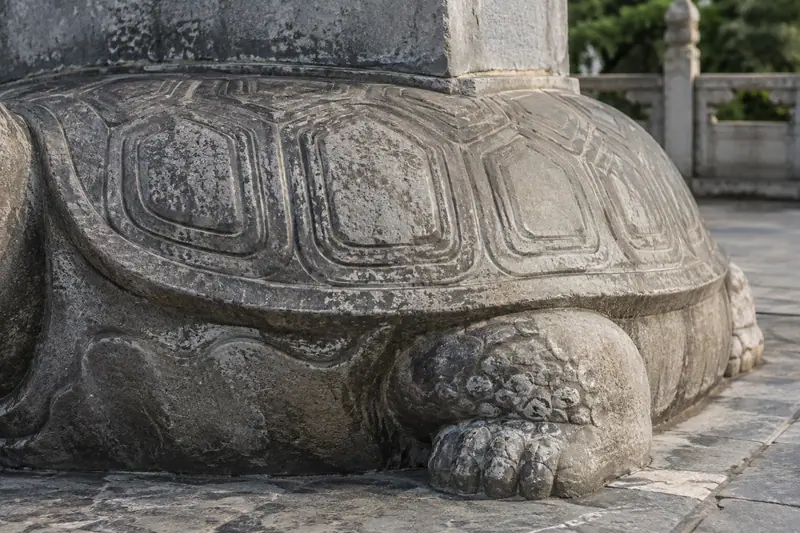
Within the park stands Maha Zhi's tombstone, a Ming-dynasty stone that the State Council listed in 2006 in the sixth batch of national key cultural relic protection units. It survives relatively complete at 1.66 metres tall and 0.94 metres wide, with a semicircular head reading 'Epitaph of the Late Mr Ma', scrollwork around the edges and a stone tortoise base. Its text gives an account of Zheng He's father as a Ma-family native of Kunyang, naming his two sons and four daughters and recording that the younger son, marked from youth by talent and ambition, served the emperor and was given the surname Zheng. Wenlv Toutiao records that Zheng He commissioned the epitaph in 1405 from Li Zhigang, president of the Board of Rites, before his first voyage, and had it carried home to be carved, and that he reached home himself only in the eleventh month of 1411, the ninth year of the Yongle reign, after the third voyage; on the back of the stele he had cut a note recording that visit to sweep and make offerings at the ancestral grave, which names him as the second son of the Ma family and his native place as Kunyang. The China News Service Yunnan-channel item gives that reverse note as 44 characters, and reports a photocopy of the Zheng He family genealogy, found in Yuxi in 1936 and now kept at Jinning Museum, as corroborating the tombstone's record of his Yunnan origin.
What to look for
- Maha Zhi's tombstone, the Ming-dynasty stone bearing the note Zheng He had cut on its back in 1411, listed since 2006 as a national key cultural relic protection unit
- Sanbao Tower on Yueshan, built in the shape of Zheng He's treasure ship and displaying nautical charts and fleet models
- The Zheng He stele forest, gathering inscriptions by 64 named figures since the Ming dynasty
- Jinning Museum, a Ming-style building inside the park with halls on the remote past, Dian Kingdom civilisation and Zheng He culture
- The 5.55-metre Zheng He statue, standing on a three-metre pedestal shaped like the prow of a treasure ship
Location & getting there
Getting to Zheng He Park
Check which interiors and courtyards are accessible. Active places of worship and protected monuments may have different visitor rules.
- Search for 郑和公园 with 昆明市 and 晋宁区.
Find Zheng He Park
郑和公园 · 晋宁区
No reliable map pin yet: search by the Chinese name.
Sources & visit information
The linked sources support the identity and background described in this introduction. Opening hours, admission, activity availability and exact arrival arrangements have not been comprehensively checked. Confirm current visitor information with the venue; the original catalogue locality and editorial review flag are retained.
Image credits & notes (1)
- Zheng He Park · 郑和公园Photo: Kcx36 · CC BY-SA 4.0Resized for the web; the photo itself has not been edited.
