

Photo adjustments
Proportionally resized and converted to WebP without cropping, retouching or changing the photographed subject.
Explore the region
About Liangzhu culture
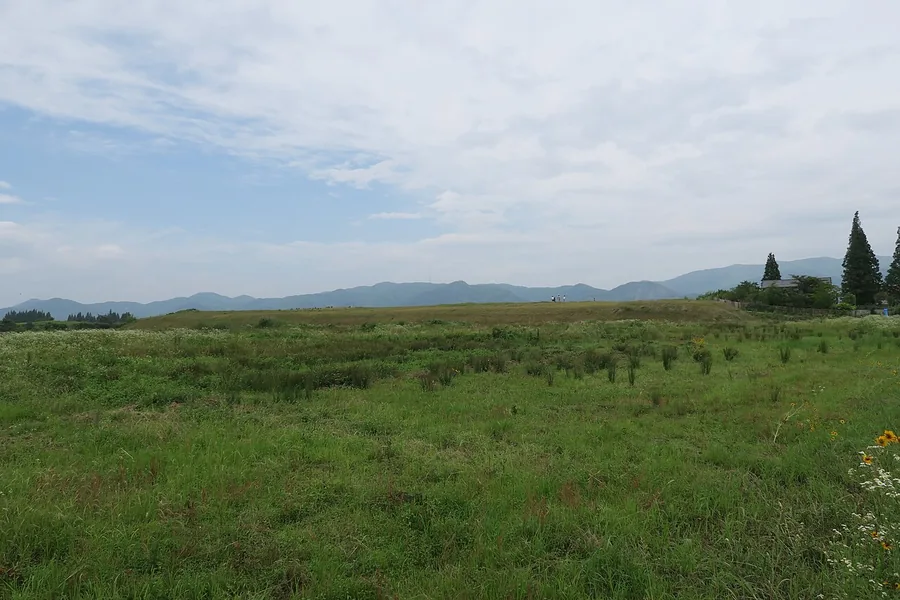
Mojiaoshan marks the raised palace area, while Fanshan is associated with elite burials and the jade objects that made Liangzhu famous. Most monumental structures survive as archaeological ground features rather than standing palaces. Read the interpretive signs and landforms together, then use the separate Liangzhu Museum to see the smaller objects in context.
The Liangzhu site covers 34 square kilometers and dates from about 3300 BCE to 2000 BCE, a late Neolithic cultural site centered on the Liangzhu City ruins. In 1959 the archaeologist Xia Nai (夏鼐) named this cultural type Liangzhu culture (良渚文化). The site entered China's tentative World Heritage list in 1994, was listed as a Major Historical and Cultural Site Protected at the National Level (全国重点文物保护单位) in 1996, and was inscribed on the World Heritage List on 6 July 2019.
The site lies in the transition zone between hills and plain, on the alluvial plain of the Dongtiao River (东苕溪); spurs of the eastern Tianmu Mountains (东天目山) extend around it to north and south. The Yaoshan site (瑶山遗址), about 5 kilometers northeast, covers 66.56 hectares and includes a high-status cemetery with a square, north-south altar used for sacrificial ceremonies, with burials in two rows to its south. An outer hydraulic system of low dams and a long embankment before the hills covered 349.24 hectares.
The site is presented as evidence of an early regional state based on rice agriculture and social stratification in the lower Yangtze during the late Neolithic, marking a transition from small communities to a large political entity with hierarchy, ritual and jade craftsmanship. Since 2020 Hangzhou has marked 6 July, the date of its World Heritage inscription, as 'Hangzhou Liangzhu Day.'
What to look for
- Mojiaoshan’s raised platform, the centre of the ancient palace area.
- The Fanshan burial area and interpretation of Liangzhu’s elite jade culture.
Location & getting there
Getting to Liangzhu culture
Use the Liangzhu Ancient City Ruins Park south visitor centre in Pingyao, approached from Fengdu Road and the National Highway 104 area. The museum at Meilizhou Road is a separate site. The south entrance and exit have separate functions, so follow current visitor-centre signs.
Combine your visit
A suggested sequence linking the specific features of this visit.
-
City-wall and entrance interpretation
Read the scale and organisation of the ancient settlement.
-
Mojiaoshan
See the elevated platform of the palace area.
-
Fanshan
Connect the settlement with its elite burial and jade traditions.
This order is editorial. Confirm access and any transfers between stops; it does not establish a walking route, same-day connection or common admission ticket.
Find Liangzhu culture
良渚古城遗址 · 余杭区
The pin marks the area, not the entrance.
More places nearby
Approximate straight-line distances between map pins, not travel distances.
Liangzhu Museum 良渚博物院
4 km awayLiangzhu Museum brings together jade, pottery, stone tools and other objects from the prehistoric culture whose city ruins lie nearby. Its long, stone-clad volumes, courtyards and water setting were designed by David…
View guide →Xixi National Wetland Park 西溪国家湿地公园
16 km awayXixi spreads through a network of creeks, ponds and marshes on Hangzhou’s western side. Water channels and planted banks preserve the shape of an agricultural wetland within the expanding city. Willows, persimmons and reeds…
View guide →China Knife, Scissors and Sword Museum 中国刀剪剑博物馆
17 km awayThe China Knife, Scissors and Sword Museum belongs to the Hangzhou Arts and Crafts Museum group in the Qiaoxi historic district. The buildings reuse textile factories and warehouses beside the Grand Canal.
View guide →Sources & visit information
The sources below support the place-specific description and arrival information. Suggested combinations are editorial planning ideas; confirm current opening, entry arrangements and transport services for your date.
- zh.wikipedia.org ↗
- www.lzmuseum.cn ↗
- www.lzmuseum.cn ↗
- Archaeological ruins of Liangzhu City ↗
- Chinese Wikipedia: 良渚遗址 (revision 93068391, 2026-06-14) ↗
Visitor information adapted and edited from Wikipedia contributors, “Archaeological ruins of Liangzhu City” · CC BY-SA 4.0. Source revision 1360481431.
Background paragraphs translated and condensed from Wikipedia contributors, "良渚遗址", Chinese Wikipedia · CC BY-SA 4.0. Source revision 93068391.