


Get to know Yuhang District
- Administrative area
- District · 市辖区
- Part of
- Hangzhou
- Chinese name
- 余杭区
- Local areas
- District guide
Area & population
- Area
- 1,228.41 km²
- Population · 2022
- 1,390,900
Source: English Wikipedia, as of the dates shown.
A district reshaped in 2021
The present Yuhang District is the western part of the former, larger district. In 2021 Hangzhou established a new Yuhang from Yuhang, Cangqian, Xianlin, Wuchang, Zhongtai, Renhe and Liangzhu subdistricts, together with Pingyao, Jingshan, Huanghu, Lǔniǎo and Baizhang; the former eastern communities and Tangqi became Linping District. So Tangqi and present-day Linping are not within Yuhang, despite their place in older descriptions of “Yuhang.”
For a first visit, concentrate on Liangzhu, then leave the hills and tea country of western Yuhang for a separate outing. The district is broad and multi-entry: no one station, address or taxi drop-off serves the whole area.
Read Liangzhu, then walk its landscape
Begin at Liangzhu Museum (良渚博物院), at No. 1 Meilizhou Road (美丽洲路1号). Its three core galleries—“Water Town,” “Civilization” and “Jade and the Soul of the Nation”—lead from the setting and archaeological evidence toward the jade objects and beliefs that shaped Liangzhu society. The museum itself is worth time: four long stone-clad volumes sit among courtyards, gardens and water, and the open connections between galleries make it easy to pause outside rather than hurry through a fixed sequence.
Then visit Liangzhu Ancient City Archaeological Site Park (良渚古城遗址公园), a separate site rather than the museum grounds. UNESCO describes a late-Neolithic regional centre, about 3300–2300 BCE, with earthen monuments, planned urban space, a water-conservation system and socially differentiated burials. In the park, look for the scale and placement of earthen platforms and walls, and imagine how waterways linked the settlement to the managed landscape. These are protected archaeological remains, not a rebuilt palace town. UNESCO’s property also includes other components, including dam and Yaoshan areas, so the public city park is not the entirety of the World Heritage property.
The museum and archaeological park are roughly 4 km apart. A useful order is museum first, then the site park: the exhibits give context for what can otherwise look like low mounds and stretches of open ground. The official museum guide lists a dedicated 1222M/428M connection between the museum and park.
A different side of Yuhang: Jingshan
Westward, Jingshan (径山) offers a very different day: wooded foothills, tea-growing villages and the historic Jingshan Temple (径山寺), also called Jingshan Wanshou Chan Temple. The temple’s story is tied to the region’s Chan Buddhist and tea traditions; allow time to absorb the mountain setting rather than treating it as a quick add-on to Liangzhu. Older official visitor material describes this heritage, but its bus details are dated and should not be used as a current timetable.
No reliable current first-party route and last-mile directions for Jingshan Temple were confirmed for this guide. If you choose the rural west, check the temple or local transit operator’s current visitor directions before setting out; no particular bus, departure time or fare is promised here.
Getting to the Liangzhu sites
For the museum, take Metro Line 2 to Liangzhu (良渚) station and transfer to bus 430M or 1223M for the Liangzhu Museum front-gate stop (良渚博物院正门公交站). The official guidance does not identify a subway exit number, so this guide does not guess one. The museum’s visitor guide also lists buses 257H, 372, 428M, 478, 1222M and 1223M to the front-gate stop.
For the archaeological park, take Metro Line 2 to Liangzhu and bus 7437M to Liangzhu Ruins Park South (良渚遗址公园南站). The official guide also lists a route from Hangzhou’s Line 19 to Line 10, then bus 313 or 313 Express to Fengdu Industrial Zone (凤都工业区), south of the park. The park has separate South, West, Fengshan Quarry and East visitor centres; use the entrance shown by the current reservation rather than assuming every bus stop serves every gate.
For a taxi, enter 良渚博物院, 美丽洲路1号 for the museum and use its entrance and official public parking information. For the archaeological park, enter 良渚古城遗址公园 and follow the current booking’s visitor-centre instructions; the official guide points drivers to its designated P1/P2 parking near the South Gate. Do not ask to be dropped at an arbitrary roadside entrance.
The museum’s published visitor notice gives a regular Tue–Sun schedule and reservation procedures, but operating rules can change. Confirm the current opening notice and reservation channel before travelling; do not rely on archived holiday hours or ticket details.
Guide sources
- Hangzhou Municipal Government notice on administrative adjustments
- Liangzhu Museum: transport and address
- David Chipperfield Architects: Liangzhu Museum
- UNESCO World Heritage Centre: Archaeological Ruins of Liangzhu City
- Liangzhu Museum: 2025 visitor guide and transport
- Liangzhu Museum: Jingshan scenic-area introduction
- Liangzhu Museum visitor notice, effective 7 April 2024
- Liangzhu Museum exhibition and archaeological landscape description
Explore Yuhang District
Core places to explore, with English and Chinese names.
Places to explore around Yuhang District
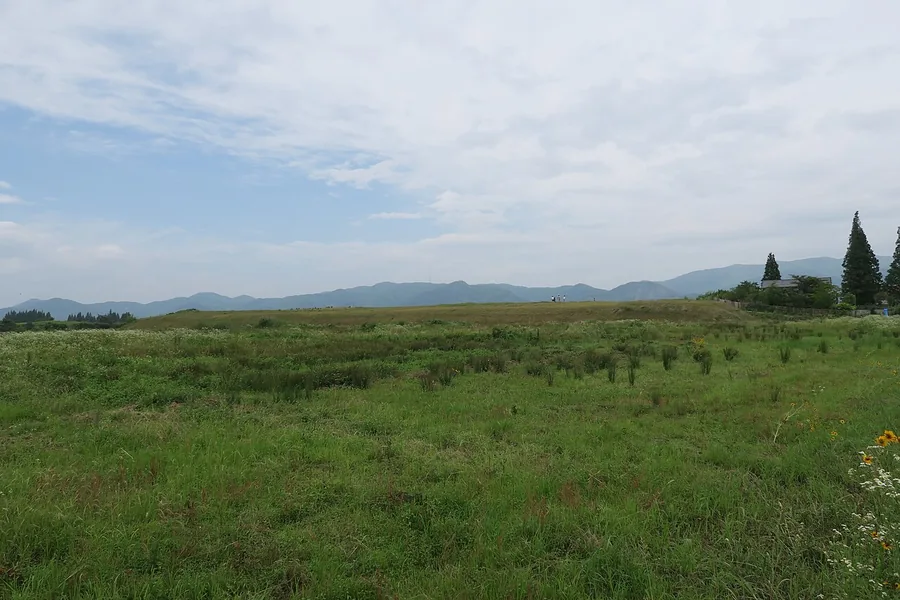 The Mojiaoshan earthen platform at Liangzhu Ancient City, June 2016.
Liangzhu Ancient City Archaeological Park良渚古城遗址
Walk through the exposed earthworks of a Neolithic city in Yuhang, reading its walls, raised palace platform, river channels and burial areas as a planned landscape rather than a set of standing ruins. The park covers the city-site area; the separate Liangzhu Museum is a different visit.
Read the place guide →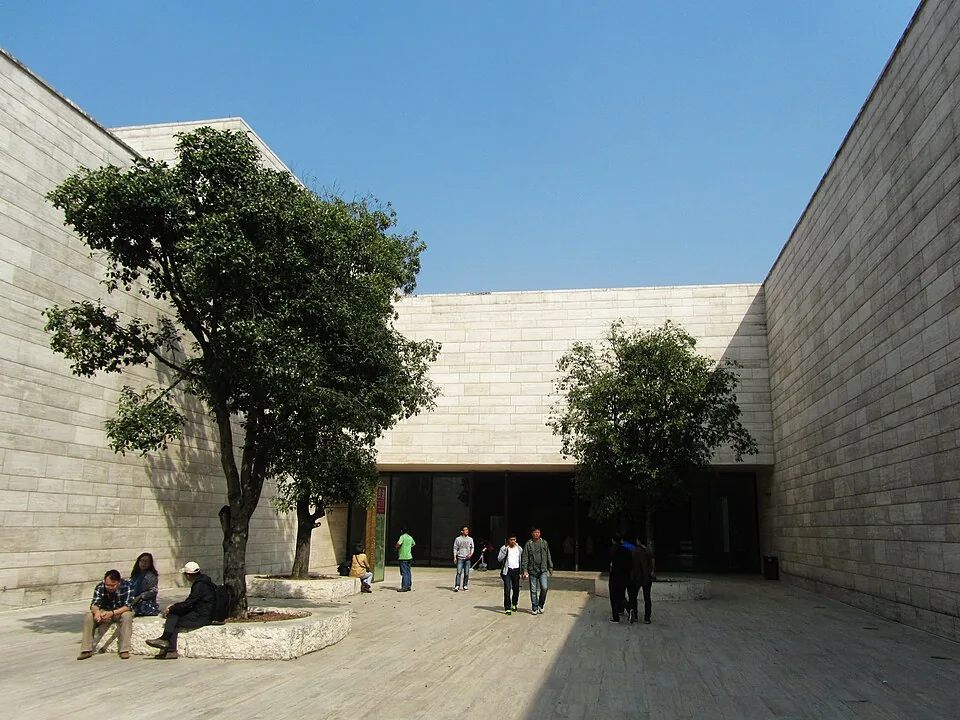 Liangzhu Museum · 良渚博物院. Photo: 2013-10-27 11:09:02.
Liangzhu Museum良渚博物院
A museum in Yuhang that brings Liangzhu’s Neolithic world into focus through archaeological finds, jade, and three themed galleries in a courtyard-rich building by David Chipperfield.
Read the place guide →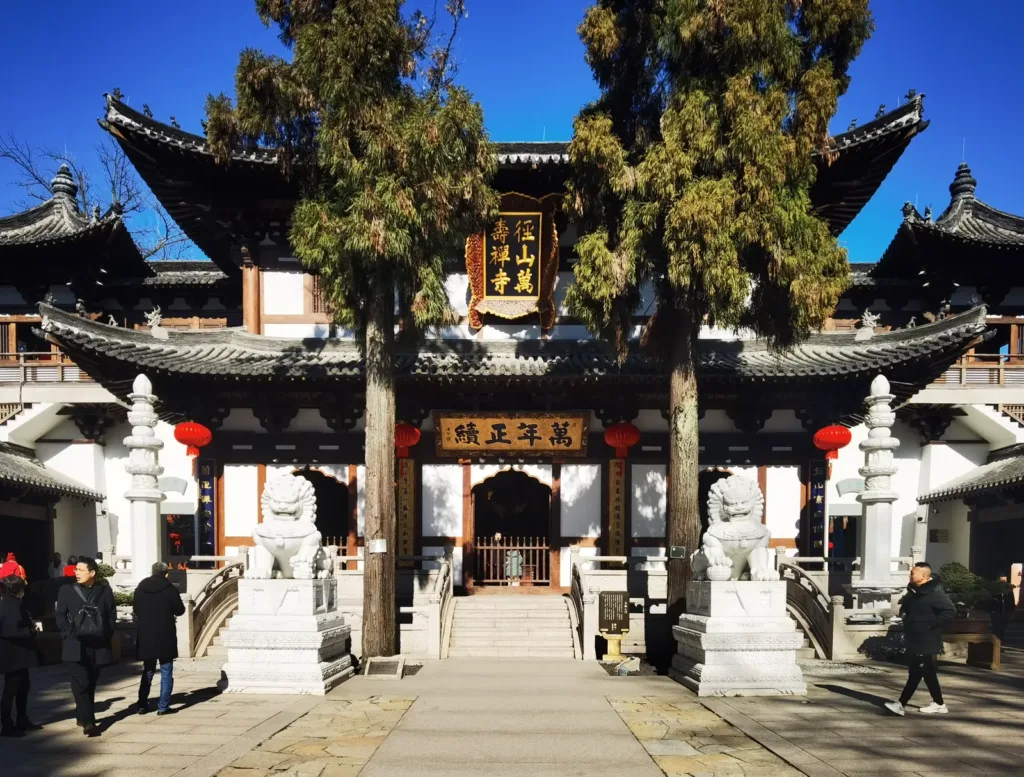 Main gate of Jingshan Temple, photographed 26 February 2023. Photo: User:CatOnMars · CC BY-SA 4.0
Jingshan Temple径山寺
A historic Chan Buddhist monastery on a wooded peak in Yuhang, Jingshan Temple is closely associated with the Jingshan Tea Banquet and the transmission of Chinese Buddhist and tea practices to Japan.
Read the place guide →Local life & food
Yuhang District local specialties
余杭区特色美食 · 1 specialties to discover
 Cangqian mixed-lamb pot 仓前掏羊锅AI dish illustration / AI 菜品示意图
A hearty autumn-and-winter lamb-and-offal pot associated specifically with Cangqian in Hangzhou’s Yuhang District, traditionally shared and eaten by reaching into the communal pot.
Source ↗Read the dish guide →All dish names · 全部菜名 (1)
More dishes from across Zhejiang are in the Zhejiang food guide.
Plan your visit
Getting there
Yuhang District is about 50 km (straight-line distance) from central Hangzhou. Search for 余杭区 in a map app to find stations and your accommodation.
Where to stay →Build your route
Liangzhu Ancient City Archaeological Park and Liangzhu Museum are about 4 km apart (straight-line distance). The linked place guides have entrance and visit details.
Continue with Hangzhou →More in Hangzhou
Sources & geographic information
Administrative names and parent areas: Official geographic directory (dmfw.mca.gov.cn) · Reference date 2026-09-06.
Background text adapted from Yuhang, Hangzhou — Wikipedia contributors, under CC BY-SA 4.0. Text has been shortened and reorganized; source revision 1353104453.
Photo: Liangzhu Ancient City Archaeological Park · Siyuwj · CC BY-SA 4.0. Resized for the web; the photo itself has not been edited.

Photo: Liangzhu Museum · 猫猫的日记本 · CC BY-SA 3.0. Resized for the web; the photo itself has not been edited.

Map data © OpenStreetMap contributors. Pins mark approximate centres, not entrances or boundaries.
Image credits & notes (1)
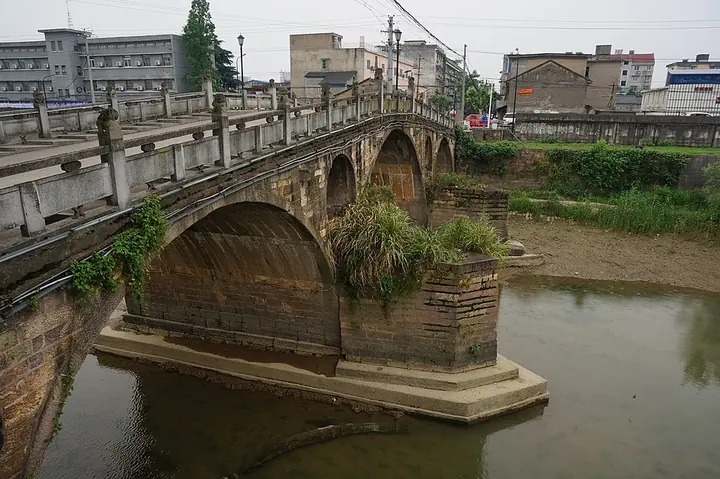
- Tongji Bridge in Yuhang District, Hangzhou. Photograph date recorded by the source: 2015-05-16 15:14:39.Photo: 猫猫的日记本 · CC BY-SA 4.0Resized for the web; the photo itself has not been edited. Thumbnails may show a cropped view.
