

Zhajiangmian 炸酱面
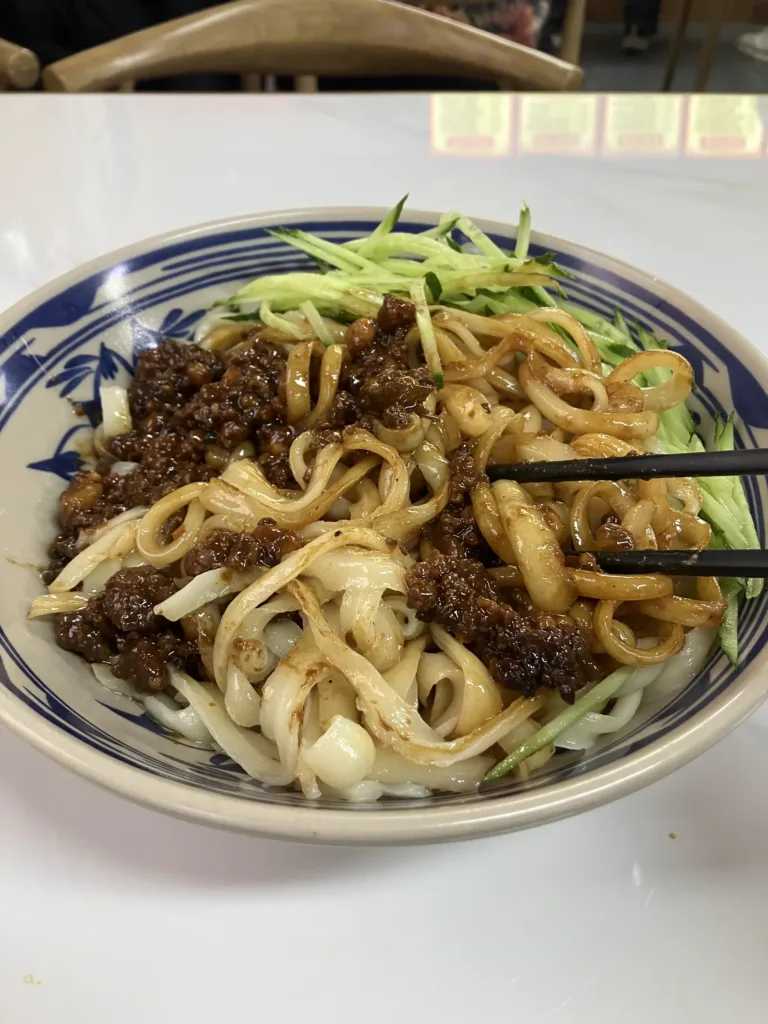
Zhajiangmian (炸酱面) is a Beijing-style bowl of cooked wheat noodles, a spoonful of dark fried sauce, and fresh or blanched vegetable accompaniments. Diners mix the parts themselves, balancing the savoury sauce with crisp cucumber, sprouts or other seasonal càimǎ toppings.
Tap any red Chinese text to hear it in Mandarin.
Zhajiangmian (炸酱面) is a Beijing-style bowl of cooked wheat noodles, a spoonful of dark fried sauce, and fresh or blanched vegetable accompaniments. Diners mix the parts themselves, balancing the savoury sauce with crisp cucumber, sprouts or other seasonal càimǎ toppings.
What you are ordering
Show the characters 炸酱面 and say zhá jiàng miàn. It is often translated as “fried sauce noodles,” but the noodles are not fried. The name refers to zhájiàng: a sauce cooked in oil with aromatics and paste, then spooned over separately boiled noodles. In Beijing accounts, the bowl is built from three elements—noodles, zhájiàng, and miànmǎ or càimǎ (the vegetable accompaniments).
This is a strongly Beijing-associated home-style noodle dish rather than a fixed one-bowl formula. Northern and Beijing families make it differently, including how salty or sweet they prefer the sauce. That variation is part of the dish: a restaurant may offer a small bowl of sauce beside the noodles, while another mixes or plates it differently.
The bowl, component by component
Noodles. Expect wheat noodles with some spring and chew. Hand-cut noodles are a traditional choice, but fresh or dried wheat noodles also appear in modern cooking. Some places serve the noodles hot and unrinsed, known as guōtiāor (锅挑); others rinse them after boiling for a cooler, silkier bite. One Beijing tourism listing describes the choice as seasonal and shop-specific, so it is reasonable to ask which style is being served rather than expect one universal version.
Sauce. The dark sauce commonly starts with yellow soybean paste (huángjiàng / 黄酱 or huángdòujiàng / 黄豆酱), sweet flour sauce (tiánmiànjiàng / 甜面酱), or a combination. The names are worth noticing: yellow bean paste is soybean-based, while tiánmiànjiàng is a fermented wheat-flour paste despite being called “sweet bean paste” in some English labels. Sources document both paste choices and family variations, so no single yellow-paste-to-sweet-paste ratio is a Beijing rule.
Diced or minced pork is common, especially a fatty cut whose rendered fat gives the sauce body and shine. Meatless versions also exist, and some kitchens use egg, tofu or mushrooms in their own versions; that does not make every bowl vegetarian or vegan. Check the specific sauce at the restaurant.
Vegetable accompaniments. These are not merely a garnish. Cucumber is common, but Beijing descriptions also name mung-bean sprouts, radish, celery, soybeans or edamame, peas, cabbage and garlic. They may be raw, or quickly blanched, and the selection can change with the season. Choose from what is offered; a long, fixed checklist of toppings is not a requirement for every legitimate bowl.
How the sauce gets its character
A typical cooking pattern is to heat oil with aromatics, fry the pork, stir in a loosened paste, then cook and stir the sauce over gentler heat until it thickens enough to coat noodles. The noodles are boiled separately. This is why “fried sauce” is a more useful translation than “fried noodles.” The precise paste blend, cut of pork, oil, and length of cooking vary by household and recipe author.
The finished sauce is usually glossy and dark reddish-brown to brown. Fermented paste brings salt and deep savouriness; tiánmiànjiàng, when used, adds a restrained sweet note. Rendered pork and hot oil carry a cooked, scallion-and-paste aroma, while cucumber, sprouts and radish contribute clean crunch. The contrast to look for is chewy noodle, clingy sauce, crisp vegetables—not a soup noodle.
How to eat it and how to ask
Start with a modest spoonful of sauce, then toss it through the noodles before adding more. Some Beijing service examples provide a concentrated, salty small bowl of sauce specifically to add little by little. Fold in the vegetable accompaniments as you go rather than treating them as decoration.
Useful questions are:
- 肉炸酱还是素炸酱? Ròu zhájiàng háishi sù zhájiàng? — Is the sauce meat-based or vegetarian?
- 酱里有猪肉、猪油或高汤吗? Jiàng lǐ yǒu zhūròu, zhūyóu huò gāotāng ma? — Does the sauce contain pork, lard, or meat stock?
- 面里有鸡蛋吗? Miàn lǐ yǒu jīdàn ma? — Do the noodles contain egg?
- 有不放肉的炸酱吗? Yǒu bú fàng ròu de zhájiàng ma? — Do you have a fried sauce without meat?
- 锅挑还是过水? Guōtiǎo háishi guòshuǐ? — Are the noodles served straight from the pot or rinsed?
These questions help with the individual bowl only. They are not a claim that a restaurant is allergen-free, vegetarian, vegan, halal, or free from cross-contact. If the answer is unclear, choose another dish rather than assume.
Essential dietary notes
Soy is a core concern because soybean paste is common. Wheat/gluten is also central: the noodles are usually wheat-based, and tiánmiànjiàng is fermented wheat flour. Pork is frequent in the sauce, and traditional descriptions may include lard or rendered pork fat. Egg can appear in an egg sauce or in some noodles, even if a sauce has no pork.
A no-meat sauce can be possible, but ask specifically about pork fat, stock and egg, and ask whether the noodles themselves suit your needs. Do not infer a whole-restaurant dietary guarantee from the label “vegetarian” or from a vegetable-heavy bowl.
Where to eat it
You can find Zhajiangmian all over Beijing, so there is no need to seek out one particular restaurant. To find one near you, search for “炸酱面” in Meituan (美团) or Amap (高德地图) and check recent reviews, distance and opening hours.
More dishes to compare
Explore related local specialties and compare their names, preparation notes and ordering guidance.
Peking duck 北京烤鸭 →
The duck is seasoned, air-dried and roasted until its skin becomes lacquered and crisp. Carved slices are brought out with thin pancakes, scallion and a sweet bean sauce; cucumber is a common additional accompaniment. The pleasure comes from brittle skin against tender meat, with fresh vegetables cutting through the rich fat.
Luzhu bread-and-offal stew 卤煮火烧 →
Pork intestine and other offal simmer in a seasoned broth with firm wheat bread and fried tofu. The bread is cut so its interior can soak up the cooking liquid. Expect a full-bodied, offal-forward bowl: soft bread, porous tofu and chewy meat contrast with the salty broth.
Sources & reading
Recipes and servings vary between kitchens.
Image credits & notes (1)
- A blue-and-white bowl of Beijing zhajiangmian: broad wheat noodles, glossy dark fried sauce with minced meat, and cucumber strips, with chopsticks resting at the rimPhoto: Air7538 · CC BY-SA 4.0