

Huizhou fermented mandarin fish 徽州臭鳜鱼
A whole mandarin fish salted and left to ferment for about a week, then braised with pork, ginger, garlic and soy until the flesh separates into firm garlic-clove flakes - Huangshan's signature Hui-cuisine dish, and one whose aroma arrives well before the first bite.
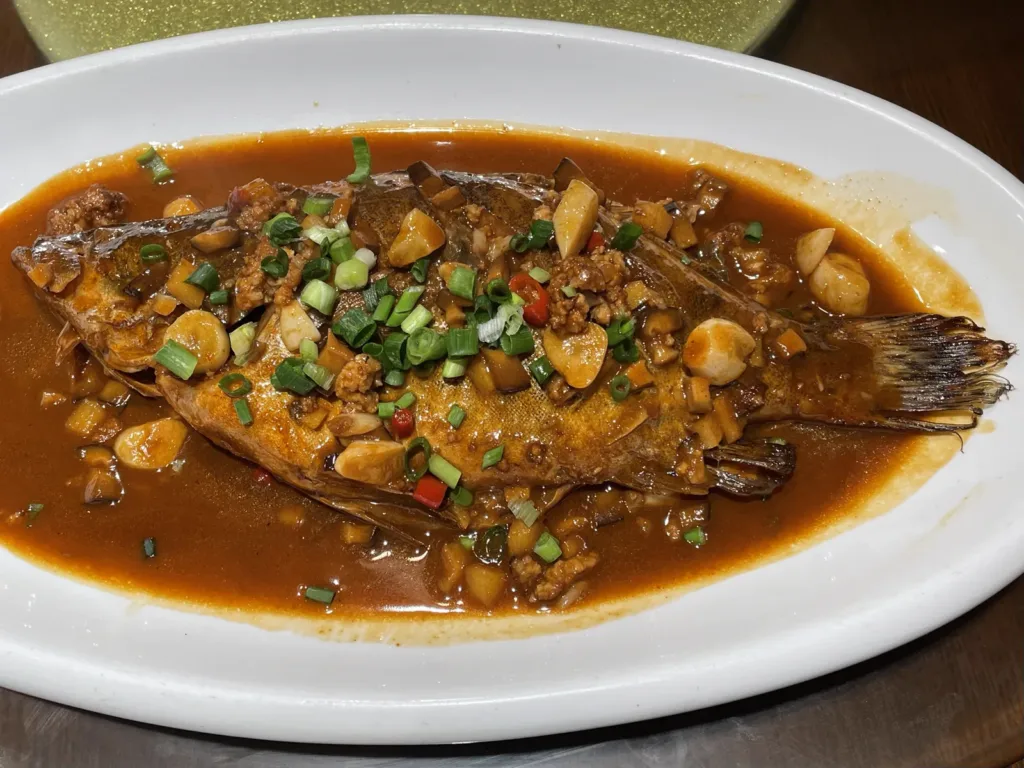
A whole mandarin fish salted and left to ferment for about a week, then braised with pork, ginger, garlic and soy sauce until the flesh lifts away in firm flakes — Huangshan’s signature Hui-cuisine dish, whose aroma reaches the table well before the first bite.
A whole mandarin fish is salted, pressed and left to ferment for about a week, then braised with pork, ginger, garlic and soy sauce until the flesh lifts away in firm flakes. The smell reaches the table before the plate does, and it is far stronger than the taste. This is the dish most closely tied to Huangshan and to Hui cuisine (徽菜), the cooking of the old Huizhou prefecture. The Anhui culture and tourism department’s 安徽美食·百城千味 campaign named it one of Anhui’s signature dishes (安徽招牌菜); that selection ran to 63 dishes at provincial level and several hundred more at city and county level, and 徽州臭鳜鱼 was among the names singled out in the announcement.
What the dish is, and what it is not
臭鳜鱼 (chòu guì yú) means, literally, “stinky mandarin fish”. The 鳜鱼 is Siniperca chuatsi, rendered in English as the mandarin fish — a freshwater species with dense white flesh and comparatively few bones, which is part of why it is worth curing. The smell is produced on purpose. Salt and roughly a week of cool, sealed storage let enzymes and microbes break the fish’s protein into free amino acids, nucleotides and other small molecules; those read as pungent to the nose and as savoury on the tongue.
Huizhou cooks treat the result as a fresh fish rather than a preserved one. In Xiuning County dialect the dish is still called 腌鲜鱼, “cured-fresh fish”, and restaurants in Huangshan sometimes print 腌鲜鳜鱼 beside the better-known name. It is not 咸鱼, the fully salted fish of the region: 臭鳜鱼 is salted at roughly half that strength — about 150–200 g of salt for 5 kg of fish, against 350–400 g for salt fish — because a heavier cure stops the fermentation and leaves a firm, merely salty fish.
The technique has been on Huangshan’s municipal intangible cultural heritage list since 2019 and entered Anhui’s provincial list of representative intangible heritage items in 2022, inside the wider, nationally listed 徽菜烹饪技艺 (Hui cuisine cooking technique, added to the national list in 2021).
From fresh fish to that aroma
The cure is short, controlled and physical. Traditional instructions run like this: choose a fresh fish of about 600 g, or up to 750 g (1.2–1.5 斤) — the size Huizhou kitchens consider standard for curing; gut the fish and leave it unwashed, so no fresh water carries spoilage organisms into the flesh; rub salt over the skin and pack extra into the belly and gills; then stack the fish in a fir-wood bucket or an earthen jar, salting between layers.
Weight comes next. The stack is pressed down under clean stones — river cobbles at home, heavy weights in commercial vats — which forces out blood and water, drives the salt inward and firms the flesh. The container is kept sealed and cool. A recent scientific review of the product describes commercial fermentation at 12–20 °C for 6–16 days; one provincial-level inheritor in Huangshan works at 5–12 °C for 7–9 days; a Xiuning account of warm-weather home curing gives about 25 °C for six or seven days; and an English-language description mentions a brine of about 28 °C for several days. The variation is the point rather than a contradiction: temperature and humidity decide the length, and Huizhou cooks say the two failure modes are curing too warm, which turns the fish rotten, and curing too cold, which turns it into salt fish.
Two routes exist. The traditional 干腌 rubs dry salt onto the fish; the 水腌 used in most factories immerses the fish in brine under weights, which evens out the result between batches and between workers. Trade markers of a properly cured fish are consistent across sources: gills and eyes still red, scales not fallen, flesh that springs back when pressed, a brine that has thickened, and a faint fermented smell rather than an aggressive one.
Almost no visitor meets the cure itself. Huangshan now has more than 100 stinky mandarin fish processing businesses, which handled about 55,000–59,000 tonnes and roughly 5.7 billion yuan of output in 2024 — about half of China’s output of the product — and the city has published local and group standards for processing and for frozen cured fish, with more than 90% of its larger plants working to standardised low-salt, lower-odour methods. Wild mandarin fish are now rare and farming supplies the trade; Huangshan’s own ponds and tanks produce only about 500 tonnes a year, so most raw fish arrives frozen from Guangdong, Jiangsu and Hunan.
In the kitchen
The default preparation is a red braise, 红烧. Oil is heated in a wok, diced pork belly or cured pork is fried until the fat runs, then ginger, garlic and sometimes chilli or pickled pepper go in. The cured fish, wiped dry and scored with diagonal cuts, is laid into the pan and fried to set its surface; soy sauce, rice wine and stock follow; the lid goes on for about 15 minutes, and the sauce is then reduced hard over high heat. Diced winter bamboo shoot and shiitake are common additions, and the finished dish is described in Chinese kitchens as 色如白雪,形如蒜瓣,肉质滑嫩 — white flesh, flakes like garlic cloves, tender but not soft.
Restaurant menus now stretch well past the classic braise: 清蒸 (steamed), 豆豉 (black bean), 辣制 (chilli), 干烧 and 干锅 (dry-fried, dry-pot), 酱香 (sauce-aroma), and, for younger diners, spinoffs such as a stinky-fish burger. Packaged versions of the cured raw fish and of the fully cooked dish are also common; a method for shelf-stable cooked stinky mandarin fish was granted a United States patent in 2025, and the first export shipment of the dish left Huangshan for Singapore in November of that year.
How to judge it, and how to eat it
The test is texture. Lift the flesh along the backbone with chopsticks: a good fish comes away in distinct flakes that hold their shape and give slightly when pressed; a fish that collapses and clings to the bone was over-cured or over-cooked. The flesh should look jade-white, and the sauce should coat the fish rather than swamp it. Locally, the two pieces of meat just below the gills are considered the best mouthful, and in a Xiuning family the head of the table took them first.
Eat it with rice, spooning a little sauce over both. It works best as the centre of a shared Hui table rather than as a dish on its own — 毛豆腐 (fermented tofu), 刀板香 (cured pork) and 问政山笋 (Wenzheng bamboo shoots) contrast with it, and the aroma recedes as the sauce and rice come into play.
Ordering and dietary notes
- It is a shared main, not a snack. The fish usually arrives whole, on a platter, and a table of two to four can share one. Traditional curing sizes run from about 600 g to 750 g.
- Ask how it is priced. Kitchens may charge by weight or by a fixed whole-fish portion, so confirm whether the price is per 斤 (500 g) or per portion, and confirm the total before cooking.
- Smell strength varies a lot. In recent years the industry has worked on 控盐降臭 — cutting salt and taming the odour — so a factory-supplied fish in a mid-range restaurant can be much milder than a home-cured one. For a first try, order the traditional 红烧 rather than the chilli versions, and ask whether 辣椒 or 泡椒 is used.
- Ingredients to check. The classic braise contains pork belly or cured pork, soy sauce and rice wine, and some kitchens add chilli. It is not vegetarian, not alcohol-free, and no kitchen can promise it is halal or free of a given allergen — ask directly about pork, soy and wheat, alcohol, and chilli.
- It is salty. This is a cured product and the sodium load is high; the standardisation drive exists partly because of health concerns about cured food.
- Bones. The fish is whole, so bones remain around the ribs and spine even though the species is not a bony one.
- If the aroma defeats you, share a small portion rather than committing a whole fish for two, and build the rest of the meal from other Hui dishes.
Practical tips
As a souvenir, packaged cured fish and ready-to-heat cooked fish are sold across the city. Since August 2026 the industry association’s collective trademark, registered in 2025, has been printed on packs together with a QR code that shows origin, quality grade, producer and batch test reports, which makes it easier to buy a traceable product. Check your own country’s rules on bringing fish products across the border before you pack one.
Names and variations
Show 徽州臭鳜鱼 when ordering, or the shorter 臭鳜鱼; both are understood throughout Huangshan and in Hui restaurants elsewhere. English menus may render it as “stinky mandarin fish”, “fermented mandarin fish”, “smelly mandarin fish” or “chouguiyu”. The dish has travelled well beyond Anhui: it appears in Hunan, Hubei and Jiangxi restaurants as well, sometimes with a much stronger smell and a thickened sauce, and one Huangshan producer credits Hunan restaurants with helping push the dish nationwide.
Image
Fermented mandarin fish, Anhui Province, photographed 30 April 2023. Photo: Zheng Zhou, CC BY-SA 4.0, via Wikimedia Commons.
Where to eat it
You can find Huizhou fermented mandarin fish all over Anhui, so there is no need to seek out one particular restaurant. To find one near you, search for “徽州臭鳜鱼” in Meituan (美团) or Amap (高德地图) and check recent reviews, distance and opening hours.
More dishes to compare
Explore related local specialties and compare their names, preparation notes and ordering guidance.
Cao Cao chicken 曹操鸡 →
A whole chicken is braised slowly with a mixture of aromatics until it is tender and evenly seasoned. Different Bozhou kitchens interpret the named preparation with their own spice blend. The skin becomes soft and flavorful, and the meat should separate readily from the bones. It is a rich savory poultry dish rather than a crisp roast.
Hu Shi's one-pot dish 胡适一品锅 →
Several ingredients are arranged in layers inside one pot and slowly cooked so their juices mingle. Meat, tofu products and vegetables may appear, but the exact combination is set by the kitchen. The upper layers stay distinct while lower ingredients absorb a rich, savory broth. The pleasure comes from comparing those textures within one serving.
Sources & reading
Recipes and servings vary between kitchens.
- 文化和旅游部:安徽美食·百城千味评选结果(徽州臭鳜鱼等被评为安徽招牌菜)
- 中国新闻网:寻味中华·徽菜头牌臭鳜鱼:臭恶犹美,皆有所以(2022-09-01)
- 三联生活周刊:让人欲罢不能的臭鳜鱼,为什么好吃?(《徽菜的腐鲜之美》)
- Journal of Food Science(Wiley)综述:Unveiling Chouguiyu: Flavor Development, Microbial Dynamics, and Texture Formation
- 安徽新闻网(合新闻):为了一条鱼,安徽拟建研究院!(2024-12-23)
- 中国非物质文化遗产网:徽菜烹饪技艺(国家级非遗,第五批,编号Ⅷ-270)
- 新华网安徽:安徽黄山——臭鳜鱼产业助推经济发展(2024-01-19)
- 光明日报:新工艺香了臭鳜鱼(2024-02-09)
- 新华网安徽(休宁县委宣传部):【休宁·有滋有味】鳜鱼臭时正当鲜(2023-08-11)
- China Daily:Smelly mandarin fish(臭鳜鱼,2019-07-05)
- 中国新闻网(农民日报):从徽州古味到百亿产业,臭鳜鱼何以一味风行?(2025-12-19)
- 安徽日报(安青网转载):徽州臭鳜鱼产业协会集体商标启用(2026-08-28)
- 中国国家旅游局新加坡办事处:美食中国|安徽臭鳜鱼:一闻难忘,一口见鲜
- 澎湃新闻(黄山日报):徽州臭鳜鱼烹饪大赛开赛!产业发展大数据发布(2021-12-30)
- 维基百科(中文):鳜鱼(Siniperca chuatsi)
Image credits & notes (1)
- Braised fermented mandarin fish, Anhui Photo: Zheng ZhouPhoto: CC BY-SA 4.0