


Get to know Xiuning County

- Administrative area
- County · 县
- Part of
- Huangshan
- Chinese name
- 休宁县
- Local areas
- County guide
Area & population
- Area
- 2,151.00 km²
- Population · 2020
- 211,456
- Administrative seat
- Haiyang
Source: English Wikipedia, as of the dates shown.
Xiuning wraps around the west and south of Huangshan's urban core: the old Huizhou county that produced 19 imperial top scholars, the headwaters of the Xin'an River, a Taoist mountain with a village street built against its cliffs, a river town that still makes hand-carved compasses, and hillside hamlets that take a bus plus a climb to reach.
Xiuning borders Huangshan's urban core (屯溪区 Tunxi District) on the west and south, and it is the part of the old Huizhou prefecture that most visitors pass through without stopping. It is Anhui's southernmost county-level division, one of the six counties of Huizhou, and the county with the strongest claim to the title "China's top zhuangyuan county" (中国第一状元县): 19 civil and military 状元 came from here between 1217 and 1880.
The county covers about 2,126 km², divided into 11 towns and 10 townships, with 211,456 residents at the 2020 census; the county government sits in 海阳镇 Haiyang. The county bus station, 休宁西站 Xiuning West, is 18 km by road from the city centre at Tunxi and 20 km from Huangshan North high-speed station, which stands just outside the county boundary in Tunxi District.
Two things explain why Xiuning deserves more than a transit stop. The first is water: the 率水, formed from streams on the north-east slope of 六股尖 (1,629.8 m) on the Xiuning–Wuyuan border, joins the 横江 at Tunxi to become the 新安江 Xin'an River, which supplies more than 60% of the water entering Qiandao Lake and is the largest river flowing into Zhejiang from outside the province. The second is that the county holds several quite different places, none of them within walking distance of the others.
How the county divides
- 海阳镇 Haiyang, the county seat: 齐宁街 Qining Street, an original Southern Song commercial street, and the China Zhuangyuan Museum on 状元文化广场 Zhuangyuan Culture Square.
- 万安镇 Wan'an, 3 km east of the county seat: a Ming–Qing river wharf that is still the working centre of hand-made geomantic compass production.
- 齐云山 Qiyun Mountain in 齐云山镇, west of the county seat: one of China's four Taoist mountains, approached across the nine-arch 登封桥 bridge over the 横江.
- 溪口镇 Xikou and the southern hills: 木梨硔 Mulihong, a cliff-edge village with no road access, and 祖源村 Zuyuan, a Song-dynasty village that has become a small guesthouse settlement.
- 五城镇 Wucheng and 商山镇 Shangshan in the south-west: dried tofu and rice wine workshops, and 黄村 Huangcun, a national-listed historic village whose 荫余堂 house now stands in a museum in Massachusetts.
- 璜尖乡 Huangjian and 白际乡 Baiji in the far south-east: the ridge road promoted as the 徽州天路 "Huizhou Sky Road", and villages above 800 m. This corner is car country.
海阳镇: the county seat
齐宁街, also called 西街 West Street, was laid out in the Southern Song and runs 780 m long and 4 m wide. At its Ming and Qing peak it carried several hundred shops, and it remains the county's most intact original commercial street; 11 of its historic buildings have been repaired in recent years. Walk it for the proportions of the shopfronts, the worn stone slabs and the side lanes rather than for a rebuilt "old town" experience.
The China Zhuangyuan Museum (中国状元博物馆) at 状元文化广场1号 explains the county's reputation to itself. Admission is free — it was in the first national batch of free-admission museums in 2008 — and the site holds five permanent exhibitions: zhuangyuan culture, Ming–Qing examination culture, imperial archives relating to Xiuning's zhuangyuan, the 海阳献宝 treasures, and the history of Haiyang. They are spread across four halls, including 平政堂, the 钟鼓楼 bell-and-drum tower and 道德馆. Opening hours are Tuesday to Sunday 09:00–17:00, closed on Mondays, with a listed daily capacity of 5,000 visitors. Bring your passport for the free ticket.
万安: wharf, compasses and tea
万安镇 sits 3 km east of the county seat and 15 km west of Tunxi. It was the county seat during the Six Dynasties period and later a river port on the 横江, when 万安老街 Wan'an Old Street ran about 5 li and locals said "small Xiuning town, big Wan'an street". The town was listed as a Chinese Historic and Cultural Town in 2008, and the old street was among the first batch of China's Traditional Villages in 2012.
Its trade is compasses. 万安罗盘, the geomantic compasses used for siting buildings and graves, have been made here since at least the late Yuan dynasty and the trade peaked in the mid-Qing. The technique entered the first national list of intangible cultural heritage in 2006, and the listed custodian is the 吴鲁衡罗经老店 workshop on the old street. Making one compass takes six main steps: choosing 重阳木 timber, turning and smoothing the blank, cutting the socket for the needle, drawing and lettering the graduated rings, sealing the surface with boiled tung oil, and finally mounting the magnetised needle — work traditionally done by the shop owner behind a closed door. Compasses are built on three ring systems (三合, 三元 and combined) in about eleven sizes, and a Wan'an compass and a sundial took a gold medal at the 1915 Panama–Pacific exposition. Wan'an is also the town for 松萝茶 Songluo tea, grown on 松萝山 just behind it.
West: 齐云山 and the 登封桥 bridge
齐云山 Qiyun Mountain — older name 白岳, renamed in the Ming Jiajing era for peaks said to sit "level with the clouds" — rises 585 m in 齐云山镇 and counts as one of China's four Taoist mountains, alongside 黄山 and 九华山 as southern Anhui's three. It carries national scenic-area, forest-park and geopark designations and is rated a 4A scenic area.
Taoism arrived on the mountain in the Tang dynasty, and under the Ming it centred on the god 真武大帝, which earned it the nickname "little Wudang". The scenery is divided into five areas — 月华街, 楼上楼, 云岩湖, 横江 and 南山 — and the classic climb runs from 一天门 past 真仙洞府 up to 月华街, the lane of temple and lay buildings built against the cliff, and the 太素宫. The mountain keeps 305 cliff inscriptions and 232 steles, the oldest from the Northern Song; the 齐云山石刻 group became a national protected site in 2006, and the mountain's ritual music, 齐云山道场音乐, is national intangible heritage from 2008.
Walkers start at 登封桥 Dengfeng Bridge, on the 横江 at the mountain's northern foot: nine arches on ten piers, 148 m long including 18 m of approach at each end, 12 m high and 8 m wide, built in blue stone with 0.9 m parapets and a stone archway at either end. It was first built in 1587 at the initiative of the Huizhou prefect 古之贤 and rebuilt in its present form in 1791; it became a national protected site in 2019.
South: 溪口镇, 木梨硔 and 祖源
溪口镇 Xikou, 28 km from 休宁西站 on county bus 201, is the gateway to the southern hills. 木梨硔 Mulihong, a hamlet of 花桥村, sits at about 800 m on the flank of 苦竹尖 with cliffs on three sides. It is the highest village in Huangshan City and the only one still without road access: you walk the last stretch, roughly 800 steps, up from the road head at 詹家山村路口. About 50 households live here, most of them surnamed 詹; the village was founded in the Ming Wanli era, and its white houses step up the slope. Cloud fills the valley for roughly a third of the year, and there is a viewing platform on the ridge opposite — photography is why most people come, and almost every household now takes guests.
祖源村 Zuyuan, in the south-west of 溪口镇 and 29 km from the county seat, is a Song-dynasty village at 685 m with a water mouth, old bridges, a millennium-old 红豆杉 tree and terraced fields. Since 2015 more than 30 derelict houses have been repaired and 26 of them reopened as guesthouses with 50-odd rooms, alongside a restaurant, bakery, café and reading room.
Further east, the 徽州天路 "Huizhou Sky Road" is the ridge section of provincial road S103 between 源芳 and 璜尖: about 20 km of climbing and descending with the pass above 800 m, in 璜尖乡 where Anhui meets Zhejiang. The villages along it are small and only recently used to visitors — 周家源 in 清溪村 was listed as a Traditional Village in 2022 and now has a canteen in a former tea factory and a guesthouse, 溪·源, converted from the old school building and opened in September 2024. East of 璜尖, 白际乡 lies above 800 m in the 白际山脉 and is promoted locally as "the last Medog of Jiangnan" (江南最后的墨脱); its sights are viewpoints and water — the 白际岭观景台, 百丈冲瀑布 waterfall and the 严池梯田 terraces. The county bus list covers 溪口, 板桥/樟前, 汪村, 流口 and 右龙 among the outer townships, but not the 白际 ridge, so treat the south-east as a car trip.
South-west: 五城镇 and 黄村
五城镇 Wucheng, 25 km from the county seat and 18 km from the city centre, is where the 率水 and 颜公河 meet and where expressway exits put the county's food trade. Its two well-known products are 五城茶干, a firm pressed dried tofu, and 五城米酒, a sweet rice wine; both hold national geographical-indication protection and provincial intangible-heritage status, and 五城得胜鼓 drumming gives the town a third provincial listing. It is also a zhuangyuan town — the military 状元 黄赓 and the civil 状元 黄轩 and 黄思永. You can watch the process rather than only buy the product: 佳龙豆腐文化园 in 星洲村 is a working tofu plant with a 3A rating and a dried-tofu museum attached, and the town has more than a hundred workshops and factories; 阳台村 has a guesthouse, and 月牙农庄 serves farm meals beside the river.
黄村 Huangcun, in 商山镇, was listed in the fifth batch of China's Historic and Cultural Villages in 2010. Its 进士第, the Ming mansion of a successful examination candidate, is a national protected site, and the village also keeps the Qing 黄村小学 school and the 中宪第 house as city- and county-level monuments. Huangcun is the original site of 荫余堂 Yin Yu Tang, the late-Qing merchant house that was dismantled in the 1990s and re-erected at the Peabody Essex Museum in Salem, Massachusetts; the lanes, houses and pond of the village itself remain.
Getting there and around
There is no metro in Huangshan, and no metro scheme reaches any Xiuning sight. Everything below is bus, taxi or private car.
High-speed rail. 黄山北站 Huangshan North Railway Station stands in 屯溪区 Tunxi District at 迎客松大道北2号, just outside Xiuning's boundary, and is the arrival point for the Hangzhou–Huangshan and Hefei–Fuzhou lines. From the station, county bus 1 runs to 齐云山 (30 km, ¥2, published first and last departures 07:15 and 17:35), and bus 106 runs to 休宁西站 (20 km, ¥2, published 17:40–22:25, timed for late arrivals).
Do not plan to arrive at 休宁站. Xiuning Railway Station, on the Anhui–Jiangxi line north of the county seat in 海阳镇, lost its passenger service in May 2007; it now handles passing trains and a staff commuter service only.
Between the county seat and Tunxi. Two routes link 休宁西站 with the city centre: 5001 to 屯溪皇冠假日 (24.5 km, ¥3, 06:40–18:00) and 5002 to 屯溪区医院 (18 km, ¥3, 06:30–21:00).
Inside the county. From 休宁西站: 201 to 溪口集散中心 (28 km, ¥3, 06:20–17:50); 202 towards 板桥 and 樟前 (53 km, ¥6); 203 to 汪村 (67 km, ¥8); 300 to 流口 (53 km, ¥6); 301 to 右龙 on the Jiangxi border (102 km, ¥12). 208 runs from 千汇广场 to 蓝田 (27 km, ¥3). These are the operator's published first and last departures, not frequencies, and the last buses out of the county seat for the outer townships leave in the afternoon: for sunset at 木梨硔 or a village dinner, stay overnight or arrange a car.
Cross-district. Since 26 January 2025 a tourist line has linked 休宁西站 with the Huangshan Scenic Area, running 休宁西站 → 齐云山度假酒店 → 齐云山景区停车场 → 黟县东站 → 汤口东岭换乘中心, with departures at 08:00 and 14:05 and returns at 10:00 and 16:00. The end-to-end fare is ¥8, with segments priced at ¥3–6. This is the practical way to pair 齐云山 with 黟县东站 or the south gate of 黄山 without going back through Tunxi.
Taxi and ride-hailing. Give the driver the Chinese name: 休宁县海阳镇 for the county seat, 中国状元博物馆 for the museum, 万安老街 for Wan'an, 齐云山景区游客中心 for Qiyun, 溪口镇 for the Xikou villages. For 木梨硔, cars stop at the road head below the village and you walk up; for 白际乡, expect a long mountain drive.
Where to stay
Base in 海阳镇 for buses and the museum, or around 齐云山镇 if the mountain is the priority — the tourist line stops at 齐云山度假酒店 and the scenic-area car park. For a village stay, 祖源村 has the widest choice: 26 converted houses with more than 50 rooms, plus food and coffee on site. 木梨硔 rents rooms in almost every house, but there is no road, so pack light and expect simple facilities. 周家源 in 璜尖 has one new guesthouse, 溪·源, in the old school building. 五城镇 has a guesthouse at 阳台村 and farm restaurants along the river. Small village guesthouses vary in whether they can register international guests, so ask when you book, and book ahead for weekends and public holidays.
Practical notes
- The county is 2,126 km² of hills and river valleys; each cluster above is half a day to a full day on its own. 齐云山 and 木梨硔 do not fit comfortably into one day.
- Steps and gradients are unavoidable: roughly 800 steps up to 木梨硔 from the road head, and a steady climb from 登封桥 to 月华街 on 齐云山.
- The China Zhuangyuan Museum closes on Mondays and admission is free with identification.
- 五城茶干 and 五城米酒 are the county's two protected food products, and 松萝茶 comes from the slopes behind 万安; the best place to buy them is in the towns where they are made.
- Published timetables change with road works and seasons — the county bus company posts adjustments on its own site, and the operator's route list is the document to check before a village trip.
Guide sources
- 休宁县公共交通有限公司 — 服务价目(公交线路、票价、首末班时间)
- 休宁县公共交通有限公司 — 关于齐云山景区至黄山风景区公交线路延伸的公告(2025-01-24)
- 休宁县状元博物馆 — 本馆简介
- 中国非物质文化遗产网 — 万安罗盘制作技艺(第一批国家级非遗,Ⅷ-49)
- 维基百科 — 万安镇(休宁县)
- 维基百科 — 休宁县
- 维基百科 — 休宁站(皖赣铁路)
- 中国铁路12306 — 客运站数据(车站):黄山北站地址
- 维基百科 — 齐云山(黄山山脉)
- 维基百科 — 登封桥
- 维基百科 — 木梨硔
- 国家发展改革委 — 体验徽州古韵 打造“梦里祖源”(祖源村案例)
- 香港商报 — 皖休宁璜尖:“公路+”融合发展 “徽州天路”绘宏图(2024-09-12)
- 中新网安徽 — 休宁县白际乡探寻“振兴密码”(2025-04-28)
- 新华网安徽 — 休宁县:把“舌尖美味”发展成为特色经济(2026-10-12)
- 中新网安徽 — 休宁县:让珍贵历史文化在新时代焕发光彩(2024-02-05)
- 维基百科 — 黄村(休宁县)
- Wikipedia — Xiuning County
- 新华社 — 问“江”哪得清如许:生态文明建设的“新安江实践”(2020-05-17)
- 维基百科 — 新安江
Explore Xiuning County
Core places to explore, with English and Chinese names.
Places to explore around Xiuning County
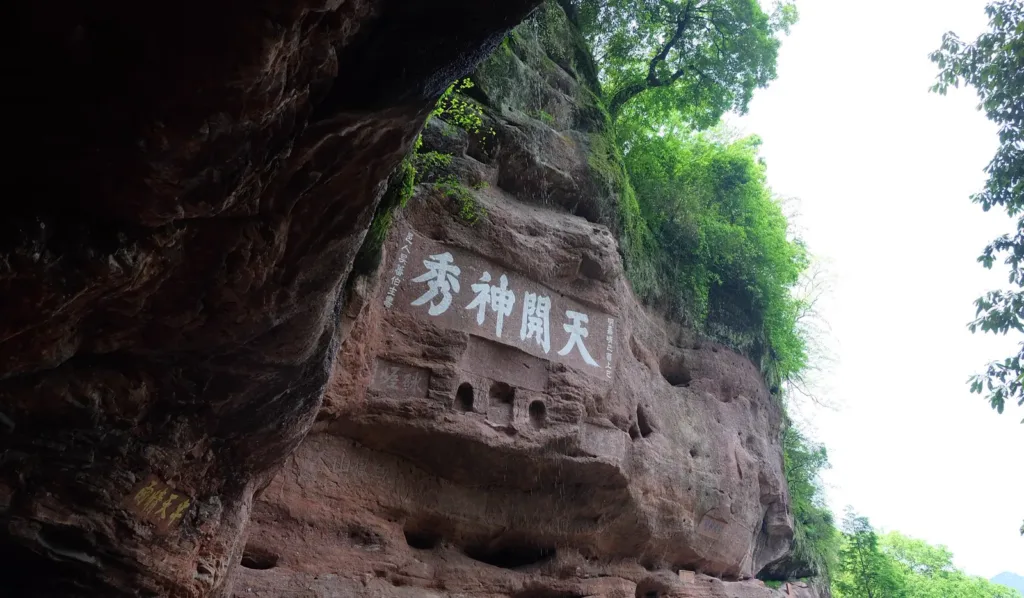 A large inscription, 天開神秀, cut into the sandstone above the steps at Mount Qiyun. Most carvings sit in the sheltered band under the overhangs, where rain cannot reach the stone. Photo: Poorjohnny · CC BY-SA 4.0
Mount Qiyun齐云山
A 585 m red-sandstone Taoist mountain 33 km west of downtown Huangshan, where a cliff-side street of temple halls, clergy houses and Huizhou homes (Yuehua Street) sits above the Hengjiang River and more than 500 carvings cover the rock faces.
Read the place guide →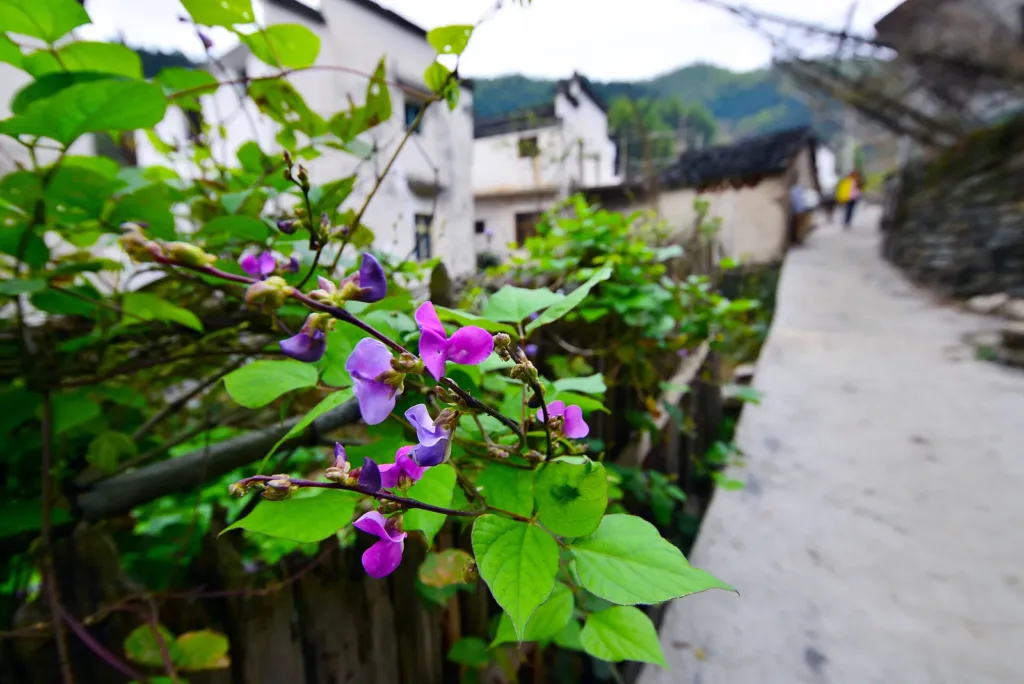 The stone-paved path along Mulihong's north side, where whitewashed Huizhou houses step down the ridge. Photo: fish4fish · CC BY-SA 3.0
Mulihong Village木梨硔
A Huizhou hamlet of about fifty households balanced on a ridge in Xiuning County, with sheer drops on three sides, cloud seas below on many mornings of the year, and no road in: the last stretch is a climb of about 800 steps.
Read the place guide →Plan your visit
Getting there
Xiuning County is about 15 km (straight-line distance) from central Huangshan. Search for 休宁县 in a map app to find stations and your accommodation.
Where to stay →Build your route
Mount Qiyun and Mulihong Village are about 20 km apart (straight-line distance). The linked place guides have entrance and visit details.
Continue with Huangshan →More in Huangshan
Sources & geographic information
Administrative names and parent areas: Official geographic directory (dmfw.mca.gov.cn) · Reference date 2026-09-06.
Background text adapted from Xiuning County — Wikipedia contributors, under CC BY-SA 4.0. Text has been shortened and reorganized; source revision 1331072534.
Map data © OpenStreetMap contributors. Pins mark approximate centres, not entrances or boundaries.
Image credits & notes (1)
- Representative view in Xiuning County · 休宁县代表景观。休宁县蓝渡桥Photo: Zhangzhugang · CC BY-SA 4.0Resized for the web; the photo itself has not been edited.
