

Explore the region
A state altar inside a city park
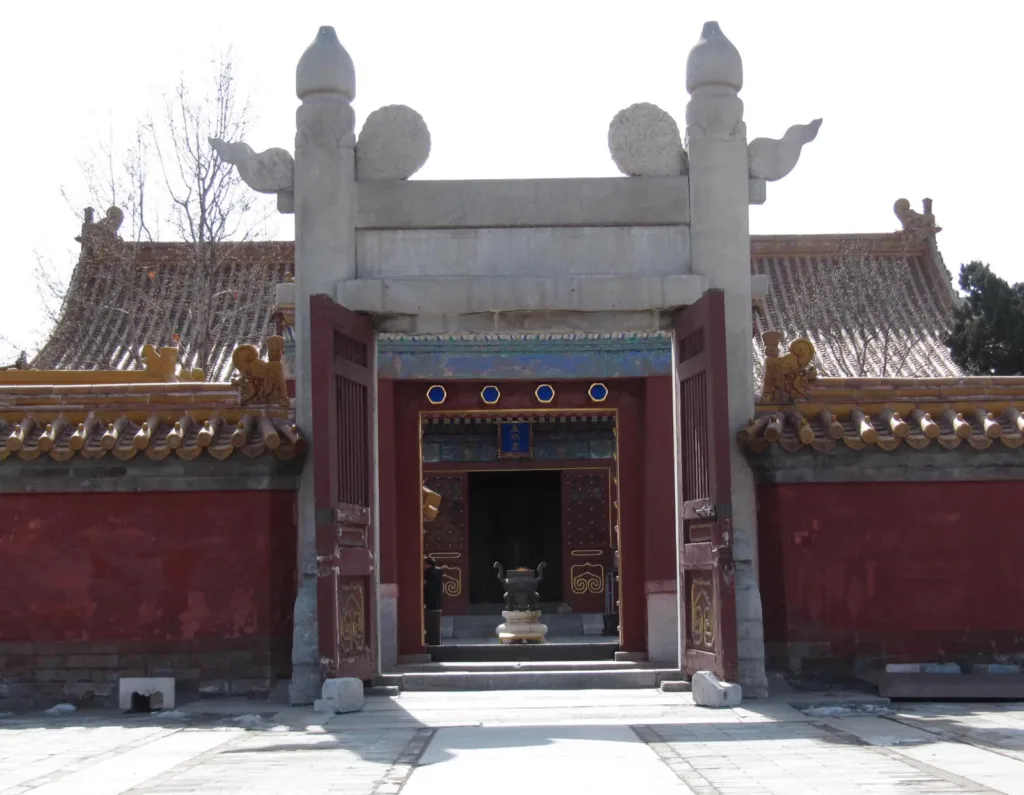
Ditan, also called the Fangze Altar, was founded in 1530 under the Ming dynasty and used by Ming and Qing emperors for sacrifices to the deity of the earth. It is in Dongcheng District, beside Andingmen Outer Street, and covers 37.4 hectares. The protected historic ensemble includes the Fangze Altar, Huangqishi (Imperial Respecting Hall), the Butcher Pavilion, the fasting palace and the Divine Storehouse.
The principal Fangze Altar is a broad, two-tiered square platform. Its square plan belongs to the traditional cosmological pairing of square earth and round heaven; it is not simply a small temple hall. Walk around the terrace before climbing it, if access is open, to take in how its raised levels, stone surfaces and enclosing precinct make the ritual platform legible as a distinct ceremonial space.
The Huangqishi is another key stop. It once housed ancestral spirit tablets used in the state rites; in the 1920s, when the grounds became the public Jingzhao Park, the hall was adapted as a public library. The change from imperial ritual space to civic park is part of the site’s history, not a reason to treat the hall as an ordinary, permanently open museum room.
How to explore
For a focused visit, enter through the gate that best fits your approach and make the Fangze Altar the anchor. Walk its outer edge, enter the ritual precinct if it is open, then continue to the Huangqishi and other surviving structures shown on the park map. Finish with a loop through the tree-lined grounds rather than treating the altar as the whole park. Allow about 1–1.5 hours for this focused route, or 1.5–2.5 hours if you want a slower park walk; these are editorial planning suggestions, not park estimates or guarantees.
The municipal tourism listing names South, West, North and East gates. It associates the South Gate with Yonghegong (Lama Temple) station on Lines 2 and 5, the West Gate with Andingmen station on Line 2, and the North Gate with Hepingli Beijie station on Line 5. It does not provide a current exit letter or walking time. Check a live map for the street-level approach and follow signs to the chosen gate; do not assume the neighbouring Yonghe Temple and Ditan share an entrance.
Opening, admission and seasonal events
When checked on 21 October 2026, Beijing’s tourism portal displayed daily hours of 06:00–21:30 from 1 May to 31 October and 06:00–20:30 from 1 November to 30 April. It listed park admission at CNY 2 and a separate CNY 5 ticket for Huangqishi. The municipal park directory confirms that Ditan is a fee-charging park requiring reservation, but does not give a price or reservation channel. Because the detailed tourism listing is undated, treat its hours and amounts as published listing information rather than guaranteed current terms; confirm with the park before setting out. The listing gives visitor-service numbers 010-64214657 and 010-84257506.
Ditan’s larger public events are date-specific, not part of the daily visit. The 2026 Spring Festival Temple Fair ran from 17 to 23 February and included ritual-themed performances alongside contemporary programming. The “I and Ditan” Beijing Book Fair was listed for 17–27 September 2026. Both 2026 editions had ended by the fact-check date; check official park or district notices for future dates and any event-specific entry arrangements.
Combine your visit
Suggested order within this visit:
-
Fangze Altar
Begin with the square ritual platform that explains the site’s purpose.
-
Ceremonial buildings
Read the supporting architecture in relation to the altar.
-
Ditan park paths
Finish in the tree-lined grounds outside the concentrated ritual area.
This sequence is an editorial suggestion based on the features described in the sources. Access to individual buildings or areas should be checked locally; no travel time or shared admission is implied.
Find Temple of Earth
地坛 · 东城区
The pin marks the area, not the entrance.
More places nearby
Approximate straight-line distances between map pins, not travel distances.
Yonghe Temple 雍和宫
Less than 1 km awayYonghe Temple, also called the Lama Temple, began as a Qing prince’s residence and later became a Tibetan Buddhist monastery. That history is visible in the procession of courtyards and major halls along a north–south axis…
View guide →Guozijian 国子监
Less than 1 km awayBeijing Guozijian was the imperial academy and education-administration center of the Yuan, Ming, and Qing periods. It stands immediately west of the Temple of Confucius, joining formal learning with the ritual honoring of the…
View guide →Temple of Confucius, Beijing 北京孔庙
Less than 1 km awayBeijing’s Temple of Confucius occupies a sequence of enclosed courtyards beside the imperial academy on Guozijian Street. Xianshi Gate, Dacheng Gate, Dacheng Hall, and Chongsheng Temple organize the main axis, while the…
View guide →Sources & visit information
Visitor details checked on 21 October 2026. Opening and admission details below are figures displayed by Beijing’s tourism portal; the portal entry is undated, so confirm them with the park before travelling. Hours, tickets, reservations and transport can change; confirm with the operator before you go.
- Ditan Park — Beijing Municipal Government ↗
- Ditan Park — Historic Gardens Directory ↗
- Ditan Park — Beijing Tourism ↗
- The Huangqishi at Ditan Park Was Once a Library ↗
- Line 5 Station-to-Station Distances — Beijing MTR ↗
- Ditan and Longtan Temple Fairs Open for the Year of the Horse — Dongcheng District ↗
- 2026 Mid-Autumn and National Day Park Culture Activities — Beijing Municipal Forestry and Parks Bureau ↗
Image credits & notes (1)
- A ceremonial gateway frames an inner court at the Temple of Earth in Beijing. Photo: Ivan WalshPhoto: CC BY 2.0