

Junshan Silver Needle Tea-Scented Chicken 君山银针茶香鸡
Junshan Silver Needle Tea-Scented Chicken is featured among the local specialties of Hunan.
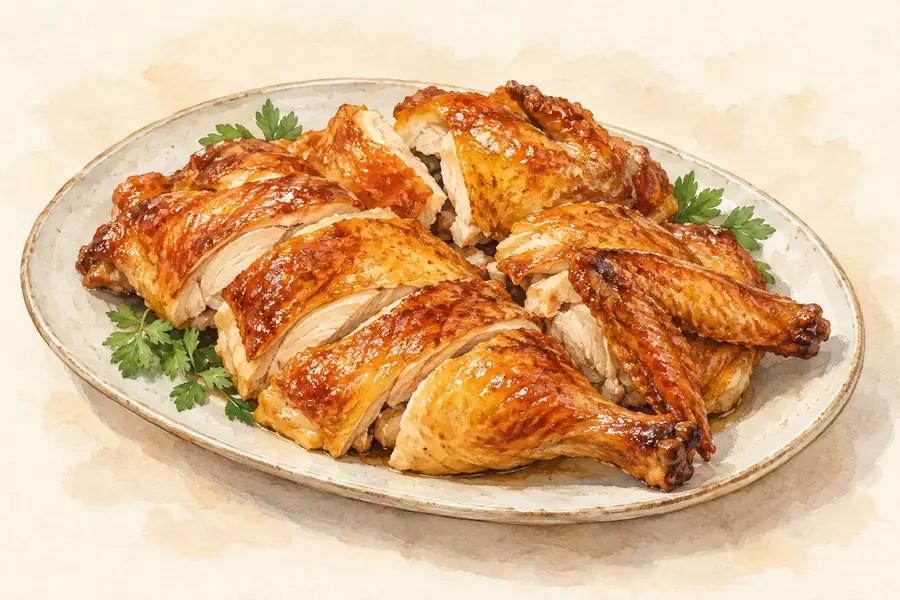
Junshan Silver Needle Tea-Scented Chicken (君山银针茶香鸡) is a tea-scented chicken listed for Yueyang in Hunan, where 君山银针 is a famous yellow tea and 茶香鸡 means tea-aroma chicken.
Tea as an aroma, not a drink
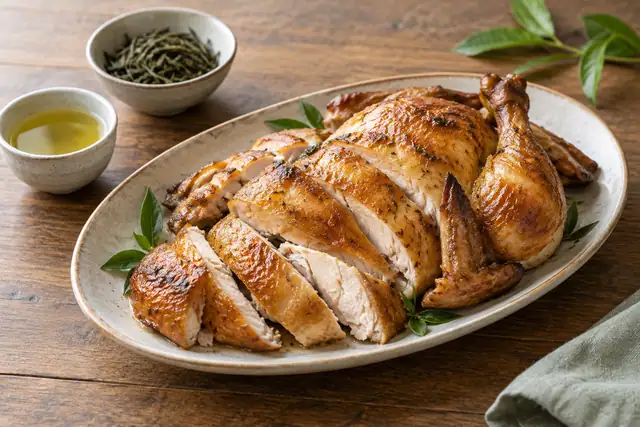
The bird is marinated with salt, ginger, scallion and often rice wine, then cooked by steaming, braising or a combination of smoke and steam with tea leaves. The tea may be used as a rub, as a bed under the bird in the steamer, or as a strong infusion added to the braising liquid, so the aroma reaches the meat rather than sitting on the skin. Slow, moist heat keeps the flesh tender, where a dry oven would harden it.
Gentle meat with a green note
The meat is moist and lightly savoury, with a tea note that is aromatic rather than bitter — a faint green, toasted scent rather than a cup of tea poured over chicken. The skin is usually golden and slightly firm from the marinade. Because the seasoning stays gentle, the dish reads as refined rather than spicy, which is unusual on a Hunan table dominated by chilli. The tea flavour is easy to miss if the bird is served with a strong sauce.
A local tea attached to a bird
君山银针 is a yellow tea grown on Junshan Island in Dongting Lake near Yueyang, and the dish uses that local tea as its aromatic signature. Naming a specific tea alongside the meat is a claim about a local pairing rather than about a cooking technique, so the dish belongs to Yueyang's regional repertoire. What changes between kitchens is the grade of tea used and how it is applied to the bird.
Ingredients and dietary checks
Chicken, salt, ginger, scallion, rice wine and tea leaves, with soy or a braising sauce in some versions. Soy and rice wine both matter for restrictions: soy brings wheat and wine brings alcohol. Ask 有小麦吗 (is there wheat), 有酒吗 (does it contain alcohol) and 用什么茶 (which tea) if you want to know what is actually in the pot.
How to order 君山银针茶香鸡
Show 君山银针茶香鸡 and ask 一只还是半只 (one bird or half), 怎么卖 (how it is sold) — often by weight — and 辣不辣 (how spicy), since some kitchens add chilli while others keep the dish mild. Ask 热的还是凉的 (warm or cold), because the bird is often served cold as a starter as well as warm as a main dish.
Serve it before the chilli arrives
Eat it as a shared dish, pulling the meat from the bone with chopsticks rather than carving it. Keep the skin with the meat, since the marinade and the tea aroma sit there. It works well early in a Hunan meal, before the chilli-heavy dishes, so the tea note is still detectable, and it pairs with plain rice or a light vegetable.
More dishes to compare
Explore related local specialties and compare their names, preparation notes and ordering guidance.
Pork with fresh peppers 辣椒炒肉 →
Pork with fresh peppers (辣椒炒肉) is the everyday Hunan dish and the strongest possible contrast: quick, hot and chilli-forward against a slow-cooked bird scented with tea. Placed side by side they show how wide the province's cooking runs, from a workday stir-fry to a banquet-style aromatic dish.
Questions before you order
Does the chicken taste strongly of tea?
Usually faintly. The tea supplies aroma rather than bitterness, and a strong sauce can mask it. Ask 用什么茶 (which tea is used) and 怎么做的 (how it is cooked) if the tea is the reason you are ordering it.
Is this dish spicy?
It is usually one of the mild dishes on a Hunan table, but kitchens differ. Ask 辣不辣 (how spicy) before ordering, especially if you want the tea aroma to come through.
Sources & reading
The supplied food list supports this name and regional association. The culinary terms below are explained as menu vocabulary; a local recipe, origin story and venue availability have not been independently verified.