

Explore the region
A temple shaped by its setting
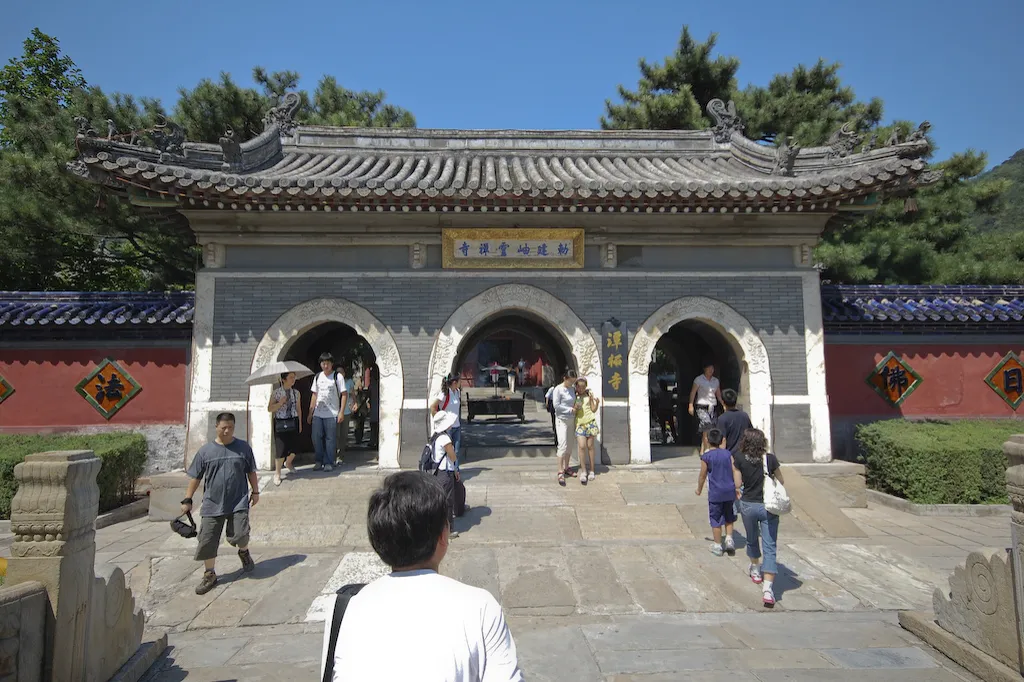
Set at the foot of Tanzhe Mountain in Mentougou District, the temple faces south and leans against Baozhu Peak. Nine surrounding peaks frame the site, while the buildings rise and fall with the slope. Its name refers to a dragon pool behind the temple and zhe trees on the mountain. The saying “Tanzhe Temple came before Beijing” is a local expression of its long history, not a literal foundation record.
The local government dates the temple to the Jin period and describes a history extending through the Tang, Song, Yuan, Ming and Qing dynasties. In the Qing era, the Kangxi Emperor bestowed the name Xiuyun Temple. The surviving complex retains a Ming–Qing appearance, but it is not a single-period building: its halls and courtyards reflect successive religious and courtly uses.
Follow the halls, then slow down in the garden spaces
Begin with the central north–south arrangement. The mountain gate, Hall of the Heavenly Kings, Mahavira Hall and Vairocana Pavilion form the principal sequence. Look at how the broad roofs, painted timber and successive courtyards sit against the wooded slope; the changing elevation makes the complex feel less like a flat city courtyard and more like a temple fitted into a mountain garden. The city government describes its plan as axial and largely symmetrical, adjusted to the site’s terrain, with pagodas, Buddhist pillars and inscriptions contributing to the setting.
After the central halls, allow time for side courts and the tree-filled grounds rather than treating every building as an interchangeable stop. The local government singles out the centuries-old “Emperor Tree,” a ginkgo more than a thousand years old by its account, and the Ming-era Two-Color Magnolia, whose blossoms combine purple and white. Their appeal is seasonal: the ginkgo is most striking when its leaves turn gold, while the magnolia is a spring feature. The same government page names the nearby pagoda forest and the wider mountain scenery as part of the area’s heritage landscape.
The temple is still a Buddhist religious site. Keep to visitor routes and follow posted instructions around active worship areas, trees and protected structures. The setting rewards a quieter pace: pause in the courtyards to notice the contrast between formal rooflines, shaded old trees and the mountain backdrop.
Getting there and planning the visit
The Beijing Bus Group lists route 931 between Apple Garden Hub (苹果园枢纽站) and Tanzhe Temple. It is the direct public-transport approach documented here; check the current timetable and service notices before travelling. The operator’s October 2026 notice also shows that road controls can temporarily cause skipped stops or shortened journeys, and lists its 24-hour information line as 96166. From the temple stop, follow on-site signs to the visitor entrance; use current local directions for the return journey.
A Beijing municipal directory classifies Tanzhe Temple as a paid, reservation-required attraction. That entry does not give a ticket price, booking window or a reliable current daily schedule. Confirm admission and opening details through the latest venue notice before setting out; do not rely on older published prices. The directory also says that the site is not fully open at all times, so access arrangements can vary.
Suggested time on site
Allow about 2–3 hours as an editorial planning suggestion for the main hall sequence, several side courts and time among the old trees. Add time if you want a slower architectural visit or are travelling during a seasonal foliage period. This is a suggested pace, not a venue-published duration; actual access and crowding can change the visit.
Combine your visit
Suggested order within this visit:
-
Central entrance sequence
Start by reading the temple’s north–south organization.
-
Mahavira Hall
Focus on the main hall and its roof details.
-
Side courtyards and commemorative monuments
Finish by comparing the compound’s less axial spaces.
This sequence is an editorial suggestion based on the features described in the sources. Access to individual buildings or areas should be checked locally; no travel time or shared admission is implied.
Find Tanzhe Temple
潭柘寺 · 门头沟区
The pin marks the area, not the entrance.
More places nearby
Approximate straight-line distances between map pins, not travel distances.
Jietai Temple 戒台寺
6 km awayJietai Temple on Ma’an Mountain is closely associated with Buddhist ordination. Its central attraction is the large square bluestone altar in Jietan Hall, built in tiers with carved decoration and surrounding niches. The altar’s…
View guide →Shougang Park 首钢园
10 km awayShougang Park reuses a former steelworks in Shijingshan, bringing blast furnaces, industrial corridors, lakeside paths, and Olympic sports architecture into one large urban landscape. No. 3 Blast Furnace makes the scale of the…
View guide →Fahai Temple (Beijing) 法海寺
12 km awayFahai Temple preserves Ming murals in the Moshikou area of Shijingshan. The paintings reward close attention to faces, garments, and especially the delicate gauze around Water-and-Moon Guanyin. The temple setting also includes a…
View guide →Sources & visit information
Sources checked on 21 October 2026. Hours, tickets, reservations and transport can change; confirm with the operator before you go.
Image credits & notes (1)
- The south-facing entrance gate at Tanzhe Temple, photographed on 24 August 2007. Photo: Cygnus78Photo: CC BY-SA 2.0