

Photo adjustments
Resized and WebP compressed; subject not altered.
Explore the region
About Jietai Temple
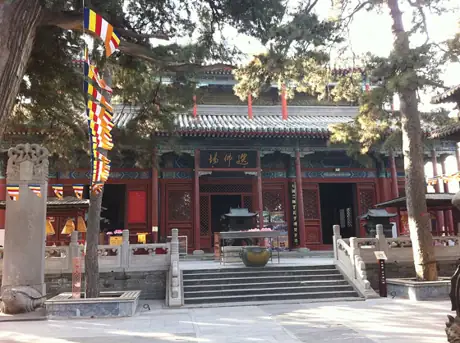
Its central attraction is the large square bluestone altar in Jietan Hall, built in tiers with carved decoration and surrounding niches. The altar’s arrangement helps explain the formal ceremony through which monks received precepts. Outside the hall, old pines with twisting and reclining forms add a very different kind of detail. A focused visit can therefore pair the ritual architecture with the trees, without needing to make the temple only a secondary stop on a longer Western Hills tour.
The temple was first built in 622, in the fifth year of the Wude era of the Tang dynasty, under the name Huiju Temple (慧聚寺). In 1069, during the Liao dynasty, the monk Fajun (法钧) founded an ordination altar there; afterward, students who completed their study of scripture and precepts had to pass examination at the Lengyan altar of nearby Tanzhe Temple (潭柘寺) before being allowed to become monks. It was renovated and briefly renamed Wanshou Temple in the Ming Zhengtong era and expanded under the Qing Kangxi and Qianlong emperors.
Jietai Temple's ordination altar is counted among the three great ordination altars in China, alongside those at Kaiyuan Temple (开元寺) in Quanzhou and Zhaoqing Temple (昭庆寺) in Hangzhou. It was listed as a Major Historical and Cultural Site Protected at the National Level (全国重点文物保护单位) in 1996.
The main hall is the Mahavira Hall, preceded by the Heavenly Kings Hall and followed by the Thousand Buddhas Pavilion, with the Jietan Hall (戒台殿) housing the ordination altar in a courtyard to the northwest. The present white-marble altar, built in the Ming dynasty, is square with sides of three zhang (丈) and stands just over one zhang (丈) high, in three carved tiers decorated with lotus petals and clouds.
What to look for
- Ordination altar: examine the three-tiered stone platform, carved patterns, and niches around its sides.
- Old pine trees: compare the distinctive trunks and branches that have become named features of the temple.
Location & getting there
Getting to Jietai Temple
The temple is on the slope of Ma’an Mountain in Mentougou, along the wider National Highway 108 corridor.
- Use Jietai Temple as the final destination and allow for the mountain approach; Tanzhe Temple is a separate site farther along the regional route.
Combine your visit
Suggested order within this visit:
-
Jietan Hall
Begin with the ordination altar and its ceremonial arrangement.
-
Altar decoration
Look closely at the carved tiers and deity niches.
-
Pine-tree courts
Finish with the contrasting natural forms around the temple.
This sequence is an editorial suggestion based on the features described in the sources. Access to individual buildings or areas should be checked locally; no travel time or shared admission is implied.
Find Jietai Temple
戒台寺 · 门头沟区
The pin marks the area, not the entrance.
More places nearby
Approximate straight-line distances between map pins, not travel distances.
Tanzhe Temple 潭柘寺
6 km awayTanzhe Temple occupies a mountain setting in Mentougou, with a long Buddhist history expressed mainly through buildings surviving from the Ming and Qing periods. Its principal halls form several north–south sequences, and the…
View guide →Shougang Park 首钢园
7 km awayShougang Park reuses a former steelworks in Shijingshan, bringing blast furnaces, industrial corridors, lakeside paths, and Olympic sports architecture into one large urban landscape. No. 3 Blast Furnace makes the scale of the…
View guide →Beijing Garden Expo Park 北京园博园
8 km awayBeijing Garden Expo Park preserves the garden exhibition landscape created beside the Yongding River in Fengtai. Its themed gardens allow comparisons among imperial, Jiangnan, and Lingnan design traditions, while the broader…
View guide →Sources & visit information
The linked encyclopedia sources support background and place descriptions. Current opening hours, ticket prices, booking rules and transport schedules have not been independently verified for this guide. Confirm them with the venue or operator before travelling.
Visitor information adapted and edited from Wikipedia contributors · CC BY-SA 4.0. Source revision 1367598079.
Background paragraphs translated and condensed from Wikipedia contributors, "戒台寺", Chinese Wikipedia · CC BY-SA 4.0. Source revision 92021219.
Background paragraphs condensed from Wikipedia contributors, "Jietai Temple", English Wikipedia · CC BY-SA 4.0. Source revision 1367598079.