

Explore the region
A temple built into the capital’s plan
Taimiao stands immediately east of Tian’anmen, in Dongcheng District, inside the grounds of the Beijing Working People’s Cultural Palace. It was founded in 1420 as the Ming and Qing emperors’ ancestral temple. Since 1950 the site has served the public as the Working People’s Cultural Palace, so the visit brings together an imperial ritual landscape and a living civic cultural venue.
Its position makes sense as part of a larger plan, not as an isolated temple. Taimiao occupies the east side of the imperial approach, while the Altar of Land and Grain stands opposite it to the west. This paired arrangement expressed the importance of ancestral and state rites in the design of the capital.
Follow the ceremonial sequence
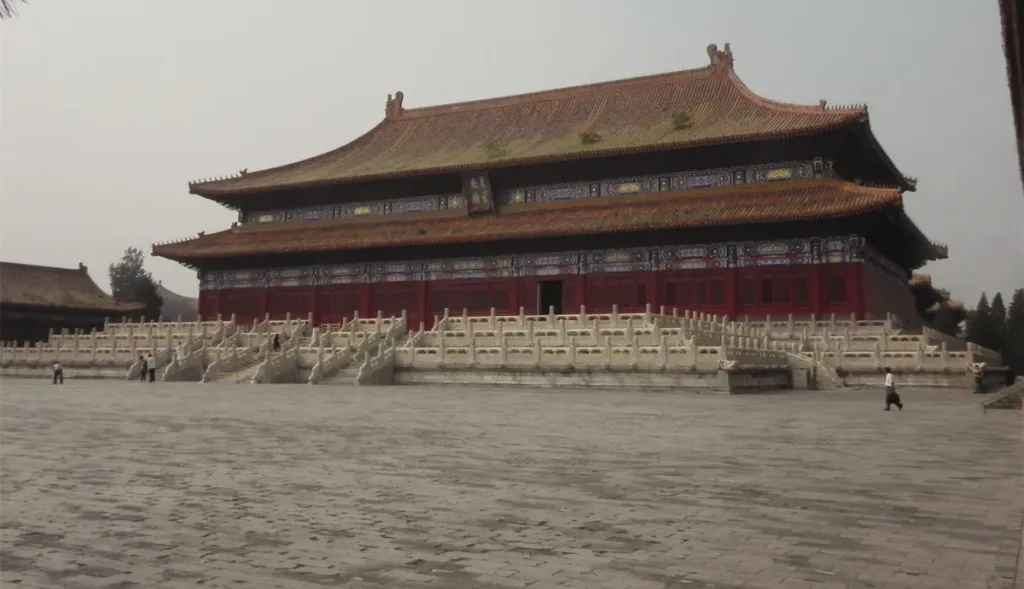
The complex faces south and has outer and inner enclosures. In the inner court, the main buildings follow a north–south axis: the glazed gates and bridge lead through the main ritual gate to the Hall for Worship of Ancestors, then to the middle hall and the rear hall. Moving through that sequence helps explain why the temple feels formal and enclosed before its principal hall opens onto a broad forecourt.
The Hall for Worship of Ancestors, also called the Offering Hall, is the visual anchor. Its double-eaved roof, yellow glazed tiles and eleven-bay frontage rise above a three-tier marble terrace. In the Ming and Qing periods, emperors used this hall for major ancestor-worship ceremonies. The middle hall was the daily home of imperial ancestral tablets, while the rear hall housed tablets of earlier rulers and stored ritual objects; side halls were associated with the memorial tablets of princes and meritorious officials. These are historical functions, not a promise that every room or ritual furnishing is on view today.
The operator currently identifies the main hall as the venue for the “China Bell” exhibition. Follow the day’s signs and access controls rather than assuming that every historic interior can be entered. Outside the inner enclosure, the grounds offer a quieter counterpoint: the operator reports 714 registered ancient cypress trees more than a century old.
Plan the visit and ticket layers
There are two distinct admissions. Entry to the Cultural Palace grounds is listed at CNY 2. The separate “Taimiao · China Bell” exhibition ticket is listed at CNY 15 from 1 April to 31 October and CNY 10 from 1 November to 31 March. These are the venue’s posted rates checked on 21 October 2026; check its current notice for exceptions or changes. The venue lists ticket counters at the South, East and West Gates, but its current visitor page does not specify an individual advance-reservation rule.
The grounds open 06:30–20:00 in peak season (1 April–31 October), with last entry at 19:30, and 07:00–18:00 in the off-season (1 November–31 March), with last entry at 17:30. The ancient-building zone and exhibition are listed as 09:00–17:00 and close on Mondays except statutory public holidays. If the historic interiors or exhibition are your priority, avoid an ordinary Monday and check the venue’s notices before setting out.
For the East Gate, the venue directs visitors from Tian’anmen East on Metro Line 1: use Exit B, walk north from Nanchizi Archway for about 200 metres, then follow the alley opposite Hanting Hotel to the gate. This is a street-level approach to the Cultural Palace, not an entrance to the neighbouring Palace Museum.
A practical first visit is to allow about 60–90 minutes for the grounds and central sequence, or around 1.5–2 hours if you also want time for the exhibition. These are editorial estimates; queues, access notices and the pace of looking at the buildings will change the time needed.
Combine your visit
Suggested order within this visit:
-
Entrance courtyards
Start with the progression of enclosed ceremonial space.
-
Hall for Worship of Ancestors
Focus on the central hall and its platform.
-
Side and rear halls
Compare the subsidiary spaces with the main ritual axis.
This sequence is an editorial suggestion based on the features described in the sources. Access to individual buildings or areas should be checked locally; no travel time or shared admission is implied.
Find Imperial Ancestral Temple
太庙 · 东城区
The pin marks the area, not the entrance.
More places nearby
Approximate straight-line distances between map pins, not travel distances.
Wangfujing 王府井
Less than 1 km awayWangfujing is a central Beijing shopping street linking the Chang’an Avenue area with department stores, bookshops, and large modern malls farther north. Much of the main retail stretch is pedestrianized, making it a…
View guide →Forbidden City 故宫
Less than 1 km awayThe Forbidden City is the former imperial palace at the centre of Beijing, now visited as the Palace Museum. Its successive gates, ceremonial courtyards and palace buildings make the north–south axis a useful way to understand…
View guide →National Museum of China 中国国家博物馆
1 km awayThe National Museum of China occupies the east side of Tiananmen Square. Its Ancient China exhibition provides a chronological route from prehistoric cultures to the late Qing dynasty, while specialist galleries let visitors…
View guide →Sources & visit information
Sources checked on 21 October 2026. Hours, tickets, reservations and transport can change; confirm with the operator before you go.
Image credits & notes (1)
- The Hall for Worship of Ancestors (Xiangdian), seen from the forecourt. Photo: Shanghai Daotai (Wikimedia Commons: 上海道台)Photo: CC BY-SA 4.0