

Explore the region
First, separate the place from the institution
“Forbidden City” is the historic palace architecture. “Palace Museum” is the present-day museum established within that former imperial palace, with collections as well as the buildings themselves. That distinction makes planning simpler: the main axis is the architectural narrative; galleries, exhibitions and original-room displays are a second layer. The Museum’s own visitor map places the Meridian Gate, the three great ceremonial halls, and the inner-court palaces in a deliberate south-to-north order.
What to look for in the three great halls
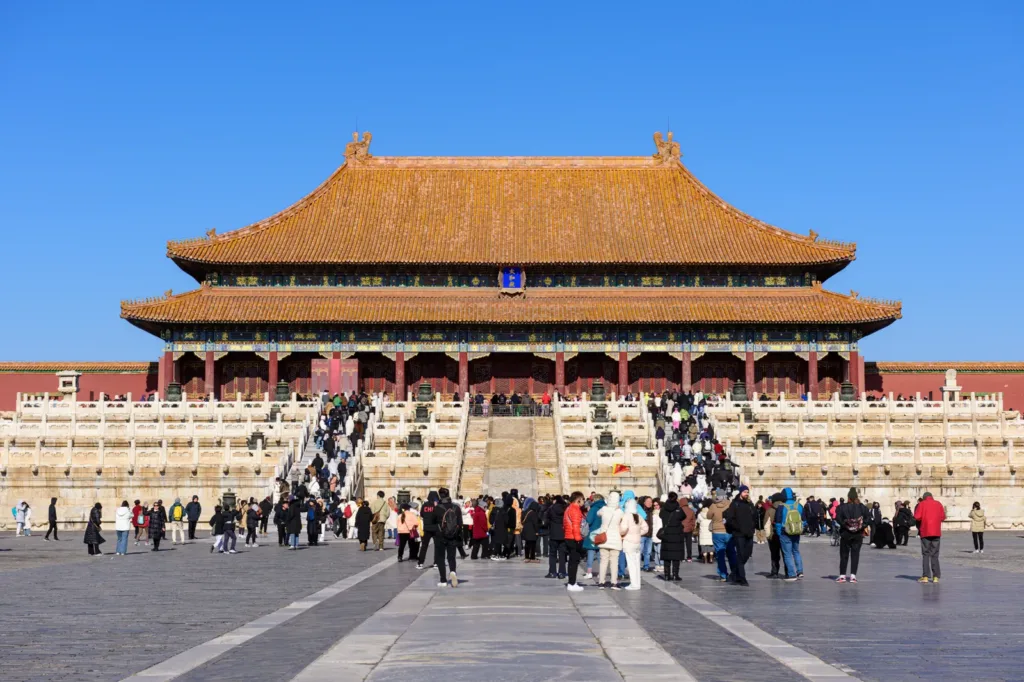
The three halls on the central axis performed different jobs. At the Hall of Supreme Harmony, look at the double-eaved roof and the white-marble terraces beneath it. This was the setting for major imperial ceremonies, including enthronements and imperial weddings. Its size and elevated position helped make the emperor’s authority visible; it was not simply an everyday office.
The smaller, square Hall of Central Harmony had a preparatory role. Before a great ceremony, the emperor rested here and received the officials responsible for the occasion. Noticing the change in scale between these first two halls makes the sequence more readable than photographing each roof in isolation.
At the Hall of Preserving Harmony, the story changes again. In the Qing dynasty it hosted imperial banquets and, from the Qianlong period, the final palace stage of the civil-service examinations. Read the main axis as a series of spaces for ceremony, preparation and selection—not a row of interchangeable halls. These are historical functions; follow current access barriers rather than assuming every interior can be entered.
Book before you travel to the gate
The Palace Museum requires a real-name reservation for every visitor. On the checked rules, general-admission tickets, Clock Gallery tickets, Treasure Gallery tickets and exhibition reservations open at 20:00, seven days before the visit. There are no same-day tickets. A ticket is valid only on its reserved date.
Foreign visitors are explicitly covered: use the passport for both reservation and inspection, and carry the same original, valid passport to the gate. The rule allows one ticket per identity document per visit date. A purchased ticket cannot be changed to a different ticket type, date, time slot or visitor.
Reserve through the Museum’s official “故宫博物院” (Palace Museum) mini-program. Its individual-visitor notice warns that no third parties are authorised to sell admission or gallery tickets, or to arrange exhibition reservations. Use the official booking entry linked in the sources below and check the live screen for availability.
Choose the correct time slot. Morning bookings must be checked in by 12:00. Afternoon bookings may be checked in from 11:00.
What an adult ticket costs
On 21 October, the Museum is in its Apr 1–Oct 31 peak season. Standard adult general admission is CNY 60. From Nov 1 through Mar 31, it is CNY 40. The Treasure Gallery and Clock Gallery each have a separate CNY 10 ticket. A paid gallery ticket is not a promise that every exhibition room or historic interior will be available: some exhibitions require their own reservation and the live official booking page controls availability.
Opening window and exceptions
The Museum is closed every Monday except statutory holidays. Peak-season entry begins at 08:30, general entry stops at 16:00, and the Museum closes at 17:00. Off-season entry begins at 08:30, general entry stops at 15:30, and closing is 16:30. The Clock and Treasure galleries have their own later last-entry times: 16:10 in peak season and 15:40 in off-season. Holiday, major-event and special-condition changes are announced by the Museum and override this schedule.
On the verification date, the Museum’s visitor page also carried a notice that Yanxi Palace was closed from 1 September through 31 October 2026 for protective investigation. Recheck its current notices shortly before visiting; restoration work and exhibition programming can change the accessible route.
Enter south, leave north or east
Meridian Gate / Wumen (午门) is the only visitor entrance. It is the south gate. Arrive with the reservation document’s original ID, pass the required checks, and start there. The Palace Museum operates the visit one way from south to north.
Gate of Divine Prowess / Shenwumen (神武门) is the north exit. Donghuamen (东华门) is the east exit. Neither is an entrance for ordinary visitors. Xihuamen / West Gate is normally a staff passage, not an alternative visitor entrance. In other words, do not arrange to meet a driver or group at Wumen after you have exited elsewhere unless you deliberately plan the return walk.
Do not confuse a Palace reservation with Tian’anmen Square access
A Palace Museum reservation gets you to Wumen, not automatically into Tian’anmen Square. The Museum says a Palace-only visitor may approach Wumen via East or West Tongzi River Road. It separately describes the route for visitors who have reservations for both Tian’anmen Square and the Palace Museum, via the Square-area security entrances and in accordance with the Palace booking time. Tian’anmen Square has its own official reservation channels. If the Square is part of the day, make and check that separate reservation; if it is not, use the Museum’s perimeter approach to Wumen rather than assuming the Palace ticket will admit you to the Square.
Three editorial routes that respect the official flow
These are editorial pacing suggestions, not official itineraries or access guarantees. They organise the visit around the Museum’s published map. On the day, use the current map and notices; do not build your plan around a named exhibition, restored room or gallery being open.
1. The central-axis first visit — editorial 2–2.5 hours. From Wumen, follow the ceremonial sequence through the Gate of Supreme Harmony and the Hall of Supreme Harmony, Hall of Central Harmony and Hall of Preserving Harmony. Continue through the inner-court sequence around the Gate and Palace of Heavenly Purity, Hall of Union and Palace of Earthly Tranquility, then continue north to Shenwumen. This is the clearest option when architecture, scale and court ritual matter more than individual collections.
2. Central axis plus eastern courts — editorial 3–4 hours. Keep the central spine as the orientation line, then take an east-side branch only where the current visitor map and barriers permit. Use it to notice how the palace shifts from formal ceremonial space to more enclosed residential and service courts; rejoin the one-way northbound flow rather than trying to backtrack. Choose this when you want more spatial variety without committing the day to a temporary show.
3. Central axis plus western courts — editorial 3–4 hours. Make the same axial passage, then add a west-side branch where open. This works well for travellers who prefer a slower architectural read of courtyards and thresholds. Return to the established northbound circulation and finish at Shenwumen, or choose Donghuamen if an east-side onward connection makes more sense.
For a more deliberate visit, reserve 4.5–5.5 editorial hours and leave spare time rather than adding unconfirmed displays. These durations are planning estimates only: crowding, security, weather, mobility needs, closures and the current entry rules can make a visit shorter or longer.
Metro arrival and post-exit transport are different problems
There is no Metro station inside the Palace Museum, and no Metro exit at Wumen. Treat the subway as the start of a surface walk to the south entrance, not as a gate-to-gate connection.
Getting to Wumen from Line 1: Start at Tian’anmen East or Tian’anmen West, the two Line 1 stations identified by the Palace Museum for the Wumen area. From Tian’anmen East, go to the Museum’s east-side perimeter and follow the official East Tongzi River Road approach to Wumen. From Tian’anmen West, use the equivalent west-side perimeter and West Tongzi River Road approach. These are surface approaches to the south gate, so follow current police, security and road-control instructions rather than relying on a station exit letter. The Museum also says the Tian’anmen–Duanmen approach to Wumen operates Tue–Sun 08:00–16:00, subject to on-site notices; it is not a Monday fallback.
After leaving at Shenwumen, do not simply reverse the arrival plan. The Museum guide lists the Shenwumen and Jingshan East Gate surface bus stops for the north side. Choose your onward surface connection for the next destination in a live map app; the north gate is not a Metro interchange.
If returning to Line 1 is the priority, choose the east exit instead of the north exit. The Museum says Donghuamen is about 800 m west along Dong’anmen Dajie from the Wangfujing commercial street. Wangfujing and Tian’anmen East are consecutive Line 1 stations in the operator’s line information. That makes Donghuamen the more logical exit for a surface walk toward Wangfujing Metro—still not a station located at the gate.
Combine your visit
Palace architecture and its landscape setting: Forbidden City → Jingshan Park → Beihai Park.
-
Forbidden City故宫
Follow the official south-to-north palace route; choose exhibitions according to the current museum notices.
-
Jingshan Park景山公园
The park immediately north of the palace provides a different perspective on its roofscape and central axis.
-
Beihai Park北海公园
The neighbouring imperial lake garden changes the emphasis from palace courtyards to water, pavilions and landscaped grounds.
This is an editorial sequence of neighbouring sites, not a timed tour. Confirm each gate and the street connections; allow the palace to remain the main visit if the full combination would be rushed.
Find Forbidden City
故宫 · 东城区
The pin marks the area, not the entrance.
More places nearby
Approximate straight-line distances between map pins, not travel distances.
Jingshan Park 景山公园
Less than 1 km awayJingshan Park rises directly north of the Forbidden City. Its five hilltop pavilions turn the former imperial garden into a viewpoint over central Beijing, with Wanchun Pavilion at the middle summit overlooking the palace’s…
View guide →Imperial Ancestral Temple 太庙
Less than 1 km awayThe Imperial Ancestral Temple, or Taimiao, stands east of Tiananmen beside the Forbidden City. Its three principal courtyards and major halls were built for ceremonies honoring the imperial family’s ancestors. The Hall for…
View guide →Beihai Park 北海公园
1 km awayBeihai Park is arranged around a large lake northwest of the Forbidden City. Jade Islet rises from the water with the White Dagoba above Yong’an Temple, while the northern shore holds a different group of pavilions, courtyards…
View guide →Sources & visit information
Visitor details checked on 21 October 2026. Hours, tickets, reservations and transport can change; confirm with the operator before you go.
Image credits & notes (1)
- Frontal daylight view of the Hall of Supreme Harmony, its yellow tiled roof and white stone terrace crowded with visitorsPhoto: N509FZ · CC BY-SA 4.0