

Taijiang Sisters’ rice 台江姊妹饭
Taijiang Sisters’ rice (台江姊妹饭) is a Miao spring and festival food from Taijiang in Qiandongnan: glutinous rice is soaked in plant-derived juices, made into coloured portions, and steamed. Its cultural meaning is tied to the Miao Sisters’ Festival rather than to a generic rainbow dessert.
Tap any red Chinese text to hear it in Mandarin.
What it is
The name to show or type is 台江姊妹饭 Tái Jiāng Zǐ Mèi Fàn. Guizhou’s official “Qian-cuisine chef” selection lists it under Qiandongnan Prefecture, which confirms the dish’s formal local-food identity without implying that every colourful sticky-rice dish in Guizhou is the same thing.
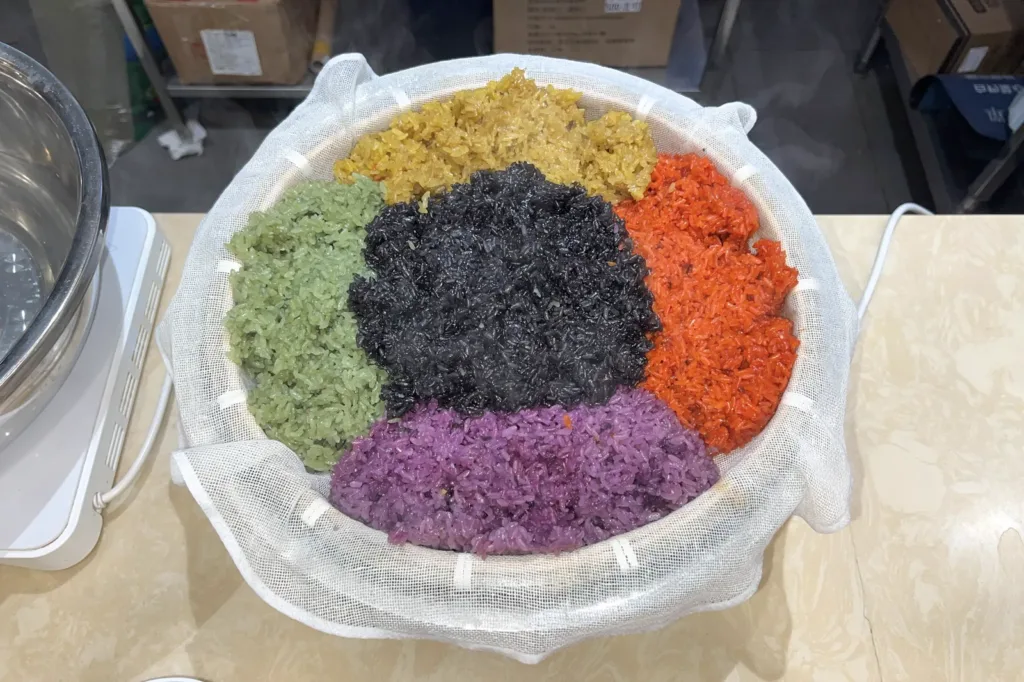
The base is glutinous rice. Accounts from Taijiang describe leaves or flowers from different plants being crushed into coloured juices; the rice is soaked in those juices and then steamed. The preparation is not a single colour formula: the plants, shades, and accompanying foods can vary between makers and occasions. Do not identify a dye plant from colour alone.
Expect steamed sticky rice, not a fixed sweet pudding. When a serving is available, ask whether it is sweet or savoury and what comes with it. A small first portion is sensible if you are not used to dense glutinous-rice dishes. If you have a food allergy or a strict diet, ask which leaves or flowers were used and whether the accompanying foods contain meat, preserved ingredients, nuts, or other items you avoid; the colour of the rice is not an ingredient list.
The festival connection
姊妹饭 is closely associated with the Miao Sisters’ Festival in Taijiang. Xinhua’s accounts describe preparation around the lunar third month and a custom in which young men may ask girls for 姊妹饭; the rice may contain different objects whose meanings form part of the exchange. This is a cultural account of the festival practice, not a promise that an ordinary restaurant portion today will contain a hidden item.
A 2025 Guizhou ethnic-affairs report describes plant leaves being collected from the first to the fourth lunar months and steamed into 五彩姊妹饭, while also placing the festival and related activities in spring. The Sisters’ Festival has been listed as a national intangible cultural heritage item for Taijiang since the first national list published in 2006. These sources do not establish a fixed Gregorian date for a future visit. Check the latest Taijiang announcement before planning around a festival; an older event poster or photograph is not a current schedule.
How to look for it
This is a dish, not a single venue, so there is no one restaurant, address, opening time, or “most authentic” shop to recommend here. To look for a current serving without treating a platform ranking as an endorsement:
- In Meituan (美团) or Amap/Gaode Maps (高德地图), search the exact Chinese name 台江姊妹饭 Tái Jiāng Zǐ Mèi Fàn. If there are no useful results, try 姊妹饭 Zǐ Mèi Fàn and set the map area to Taijiang or your current destination.
- Open the current menu or listing and confirm that the name appears as a dish, rather than relying on a photo of generic 五色糯米饭. Read recent reviews for evidence that it was served recently, then check the current opening status.
- Ask before travelling or ordering: “今天有台江姊妹饭吗?是甜口还是咸口?用了哪些植物染料?配菜是什么?” Availability can be seasonal or event-related, and a listing may outlive a dish’s supply.
- Do not use a platform’s ranking, “most authentic” label, or one vendor’s recipe as proof of a universal standard. If a festival food is being offered as part of a cultural event, follow the organisers’ instructions and ask permission before photographing people or handling food prepared as a gift.
Amap’s own route guide allows a visitor to route to a selected point by car, public transport, walking, or cycling, and warns that public-transport results can differ from the actual ride. Use that tool only after choosing a current food listing; this dish record does not turn any old stall, festival photograph, or map result into a permanent destination.
Practical limits
There is no dish-specific ticket, reservation system, entrance, or return route. The location and transport fields for this entry are therefore intentionally left unassigned. If you are already visiting Taijiang, use the exact Chinese name above to find a live nearby listing and verify supply on the day. If you are planning specifically for the Sisters’ Festival, confirm the current programme and the food arrangement separately rather than assuming that the festival dates or a particular serving format repeat unchanged.
More dishes to compare
Explore related local specialties and compare their names, preparation notes and ordering guidance.
Guiyang sticky-rice breakfast 贵阳糯米饭 →
Steamed glutinous rice is portioned and topped or folded around savory additions such as cured meat, pickles, crisp pork and chili. Each stall has its own standard mixture. The rice is dense and sticky, while the toppings supply salty, crunchy and spicy contrasts. It can be a complete breakfast despite a compact shape.
Bingjiang 冰浆 →
Fruit is blended or worked with cooked sticky rice and ice into a thick chilled dessert, then finished with optional toppings. The rice gives more body than a simple fruit juice. The texture is icy but creamy and slightly grainy, with fruit sweetness and chewy or crunchy additions depending on the stall.
Sources & reading
Recipes and servings vary between kitchens.
Image credits & notes (1)
- Five-colored glutinous rice at a Guangxi-style restaurant in Beijing, photographed on 31 March 2025. This is a related regional example, not a photograph verified as Taijiang Sisters’ rice or taken in Taijiang. Photo: N509FZPhoto: CC BY-SA 4.0