

Yuanyang Terrace Red Rice 元阳梯田红米饭
Yuanyang Terrace Red Rice is a small-grained local rice associated with the Hani terrace farming system. Eat it simply steamed when available, or look for red-rice noodles and porridge; the point is to taste a crop that is still tied to the water, villages and seasonal work of the terraces rather than to a single restaurant.
Tap any red Chinese text to hear it in Mandarin.
What this food is
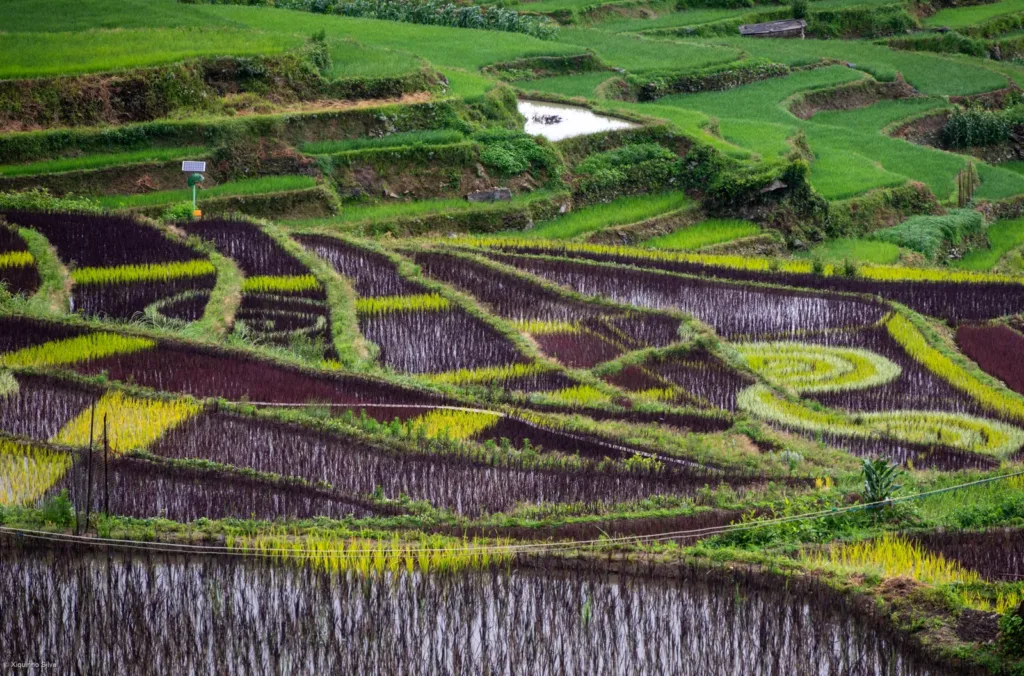
Yuanyang Terrace Red Rice is the cooked form of red rice grown in Yuanyang County’s Hani terraces. UNESCO describes red rice as the terraces’ primary crop within an integrated system of forests, water channels, paddy fields, villages, buffalo, cattle, ducks, fish and eels. The landscape is not just a scenic backdrop: its irrigation and farming relationships are part of what gives the grain its local meaning.
The Yuanyang county government describes the local grain as a small-grained brown-rice type with a relatively high expansion when cooked and a strong rice aroma. Those are useful local descriptions, not a promise that every packet or every kitchen will taste identical. Processing, the age of the rice and the cooking method can change the result.
How to taste it and what to notice
Start with plain steamed red rice if a household meal or current menu offers it. Notice the darker red-brown colour of the grain, its firmer or more substantial bite compared with polished white rice, and the way the rice’s aroma remains present alongside savoury dishes. The most important observation is not a health claim but the relationship between the bowl and the landscape: ask whether the rice is local, what season it came from and whether it is being served as ordinary table rice or as a harvest-season new rice.
Local reporting describes red rice as soft, fragrant and lightly sweet after cooking, while also listing it as a base for red-rice noodles (红米线), rice rolls (红米卷粉), cold rice jelly (红米凉粉), red-rice porridge (红米粥) and luoguo rice (锣锅饭). These are regional uses rather than one fixed recipe. A long-table banquet or family kitchen may prepare them differently, and a visitor should ask what is actually being served that day.
The most meaningful seasonal context is the first new rice of the harvest. A 2023 Yunnan cultural-tourism report records a local Hani and Yi custom of sharing the first new rice with relatives and friends after the first harvest, and describes red rice served at a new-rice tasting banquet with terrace fish, terrace duck eggs and other dishes. That report documents a 2023 event, not a guaranteed annual date or a daily tourist performance. If you encounter a village meal, follow the host’s invitation, ask before photographing people and do not treat a family celebration as a staged show.
Red rice is not automatically vegetarian, gluten-free or free of allergens. Plain rice may be suitable for some diets, but banquet dishes, broths, sauces and mixed preparations can contain meat, stock, eggs, fermented ingredients or rice wine. Explain allergies and dietary restrictions before cooking begins, and ask which grain and ingredients are being used.
Finding it without turning the dish into a shop recommendation
This is a dish, not a fixed address. Search for 元阳梯田红米饭 Yuányáng Tītián Hóngmǐfàn, 元阳红米 Yuányáng Hóngmǐ, or, for the noodle variation, 元阳红米线 Yuányáng Hóngmǐxiàn on Meituan (美团) or Amap / Gaode Maps (高德地图). Add 元阳 Yuányáng or 新街镇 Xīnjiē Zhèn when results are ambiguous. Check the current menu, recent reviews, opening information and whether the item is available today. Search ranking is not proof of authenticity, and a result does not guarantee that a seasonal dish is still on the menu.
Reaching the terrace area if you want to eat it there
Because the food has no single venue, use the route to the Hani terrace area rather than a made-up restaurant address. The practical overland pattern is to reach Yuanyang by road and continue to the terrace villages. An English transport guide lists coaches from Kunming South Coach Terminal (昆明南部客运站) to Yuanyang Xinjie Bus Station (元阳新街客运站), and also describes a train from Kunming to Jianshui (建水) followed by a coach from Jianshui Bus Terminal (建水汽车客运站) to Yuanyang. It identifies Nansha Town (南沙镇) as the current county centre and Xinjie Town (新街镇) as closer to the terrace viewpoints. Schedules and transfer arrangements change, so confirm the current departure and destination before buying a ticket.
From Xinjie, the same guide says that the scattered terrace viewpoints and villages are not connected by a dependable public bus or taxi network; travellers commonly use a locally chartered minibus or private vehicle. Arrange the return to Xinjie or Nansha before leaving a village, and confirm how you will connect to your onward coach or train. Do not assume that a meal, market or new-rice event will provide a ride back after dark.
Sources & reading
Image credits & notes (1)
- The irrigated Hani rice terraces in Yuanyang County, Honghe, shown as the agricultural landscape associated with Yuanyang terrace red rice; this is not a bowl-of-rice close-up. Photo: Xiquinho SilvaPhoto: CC BY 2.0