

Dai-Style Barbecue 傣味烧烤
Dai-Style Barbecue (傣味烧烤) is Xishuangbanna’s broad charcoal-grilled street-food tradition: lightly seasoned skewers, fish or meat scented with lemongrass, and sharp dips that let each bite move between savoury, sour and spicy. It is especially good for an evening market meal because you can order several small portions rather than one fixed recipe.
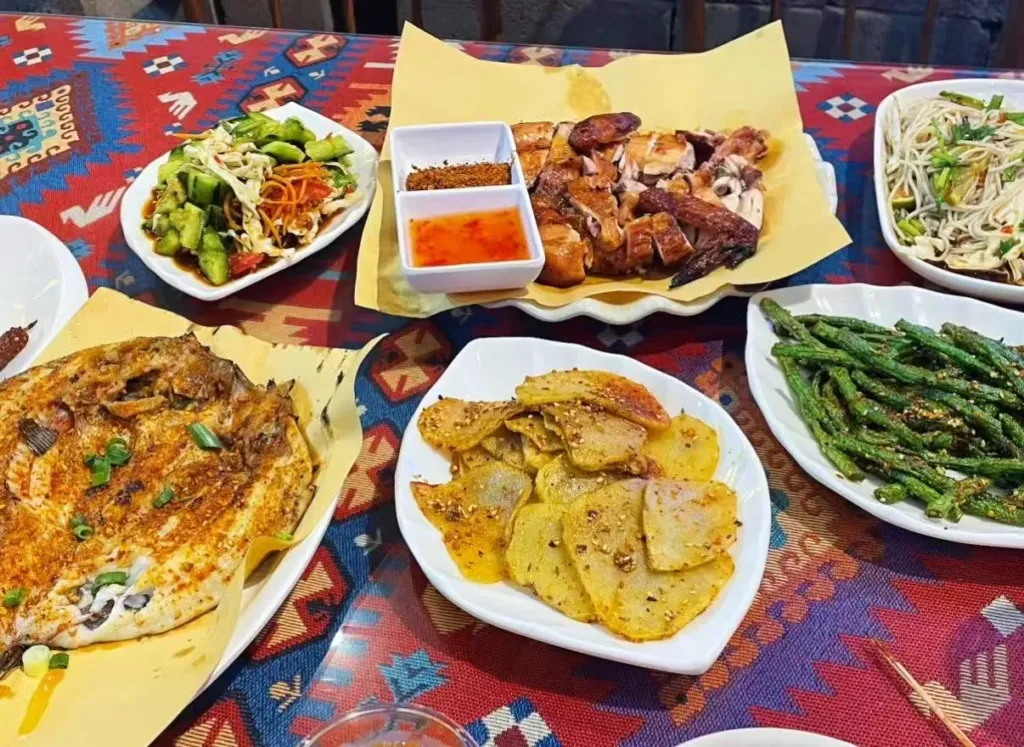
What it is
In Xishuangbanna, 傣味烧烤 names a family of grilling styles rather than one standardized dish. The regional tourism guide places it within a Dai food tradition that often combines sticky rice, sour flavours, grilled meat or seafood, and aromatic plants; it also records several local grilling methods rather than one recipe. A Yunnan cultural-tourism report describes skewered meat and vegetables, alongside pork belly, squid, pig’s trotters and stir-fried items, as common parts of the spread.
The signature is restraint. Stalls often use a thin coating instead of a heavy sauce or a thick layer of bright-red chilli, so the ingredient keeps its own texture and flavour. A small dish of dry seasoning (干碟, gāndié) or lemon dip (柠檬蘸, níngméng zhàn) can change the same skewer from smoky and savoury to sour and hot. Local reporting also describes the classic contrast as sour, aromatic and spicy rather than cumin-led; treat it as a style cue, not a promise for every stall. The exact mix varies by stall, so “Dai-style” is not a promise of one fixed spice blend.
What to look for
Lemongrass-grilled fish (香茅草烤鱼, xiāngmáocǎo kǎoyú) is the clearest example of how the style works. A documented preparation cleans and splits a fresh tilapia, fills the cavity with a tomato-based nanmi mixture, herbs, garlic and chilli, then binds it with lemongrass and holds it flat with bamboo before charcoal-grilling. The bamboo and lemongrass are part of the cooking method, not just decoration: the skin takes on smoke while the fish stays fragrant and moist.
You may also see leaf-wrapped grilling (包烧, bāoshāo) beside the skewers. It is a related Dai cooking method, but not a synonym for the whole barbecue category: food is sealed in banana leaves or mudong leaves and cooked over a fire or grill, which protects its juices from direct charring. Keeping the two names separate helps when ordering.
How to eat it
Start with a few skewers and taste one before adding dip. Try a piece of meat or vegetable plain, then use the dry seasoning or lemon dip sparingly; the point is to compare the charred ingredient with the fresh, sour lift rather than cover it completely. For a group, combine skewers with a whole fish or a wrapped item if the stall offers them, and ask which parts are spicy.
Most importantly, ask what is available that night. The category commonly includes meat, fish and seafood, and the same grill may handle several ingredients. Vegetarian, allergy-sensitive and no-chilli requests therefore need a direct question at the stall; do not infer them from the appearance of a skewer. Recipes, portions, prices and trading hours are not standardized.
Practical tips
In practice, use the Chinese name 傣味烧烤 when asking, read the stall’s current menu and price board, and choose a place that can answer questions about ingredients.
Where to eat it
You can find Dai-Style Barbecue all over Yunnan, so there is no need to seek out one particular restaurant. To find one near you, search for “傣味烧烤” in Meituan (美团) or Amap (高德地图) and check recent reviews, distance and opening hours.
Image credits & notes (1)
- A Dai-style barbecue spread with grilled fish, meats, vegetables and dipping sauces. Photo: 유신예Photo: CC BY-SA 4.0