

Braised Three Delicacies 烧三鲜
Braised Three Delicacies is featured among the local specialties of Shaanxi.
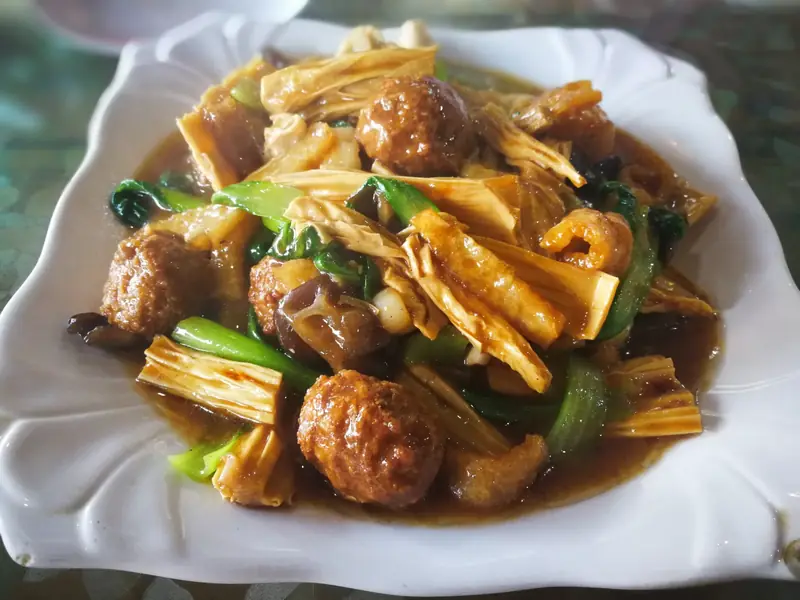
Image notes
Resized for the web; the photo itself has not been edited.
烧三鲜 is a braised dish whose name states a method and a count. 烧 means cooking in a sauce, and 三鲜 means three fresh ingredients, chosen by the kitchen rather than fixed by the title.
What braising in a sauce involves
烧 starts with the main ingredients cooked through, then finished in a seasoned sauce that is reduced or lightly thickened. The sauce is meant to coat rather than to fill a bowl, which is what separates this technique from stewing.
Order matters in the pan. Ingredients that need longer go in first and are lifted out, then returned at the end so nothing overcooks while the sauce comes together.
How the plate tastes
The flavour is savoury and rounded, with the sauce carrying soy, aromatics and often a hint of sweetness. Because three ingredients share one sauce, the dish tastes unified rather than like separate items on a plate.
Texture contrast is the point of combining three components: something firm, something soft and something that absorbs the sauce. That is why the exact selection matters more than the seasoning does.
Where the name belongs
烧三鲜 is listed for Shaanxi at province level rather than being tied to one county, and it belongs to the wider family of braised mixed dishes found across northern and central China. The name is a category as much as a recipe.
Because 三鲜 is a flexible label, each region fills it differently. Reading 烧三鲜 on a Shaanxi menu tells you the kitchen is working inside that shared convention rather than reproducing a single standard plate.
Ingredients and dietary questions
Three main ingredients share one sauce, and any of them may be meat, poultry, seafood or vegetable. Soy sauce, cooking oil, aromatics and a starch thickener are usually present around them.
Because the combination changes, the ingredient list cannot be predicted from the name. Ask what the three are that day, especially if you avoid pork, seafood, soy or gluten.
Ordering it
Show the characters 烧三鲜 and ask which three ingredients the kitchen is using. That single question tells you whether the dish suits the rest of the table or duplicates something already ordered.
Ask whether the sauce arrives thin or thick, since the finishing step varies. If the plate is meant to be shared, one order alongside a vegetable and rice is usually enough for two or three people.
Serving and eating
Serve it as a middle course, after cold plates and before anything heavier, so the sauce does not sit on top of an already rich meal. Spoon it over plain rice rather than eating it on its own.
If the sauce thickens as it cools, a spoonful of hot broth or tea loosens it again without changing the flavour. Stirring from the bottom also keeps the sauce from separating while the plate is on the table.
More dishes to compare
Explore related local specialties and compare their names, preparation notes and ordering guidance.
Yulin Three-Meat Stew 榆林拼三鲜 →
榆林拼三鲜 keeps the three-part idea but assembles the components rather than braising them into one sauce. Set against 烧三鲜, the pair shows how one province treats the same naming convention in two different serving styles.
Questions before you order
Which three ingredients are in 烧三鲜?
It varies. 三鲜 is a flexible label, so the components are chosen by the kitchen and can change with the season or the shop.
Is 烧三鲜 a soup?
No. It is braised in a sauce that coats the ingredients, so the liquid is part of the dish rather than a bowl of soup.
Sources & reading
The supplied food list supports this name and regional association. The culinary terms below are explained as menu vocabulary; a local recipe, origin story and venue availability have not been independently verified.