

Yaozhou Pinched Dough Noodles 耀州疙瘩面
Yaozhou Pinched Dough Noodles is featured among the local specialties of Shaanxi.
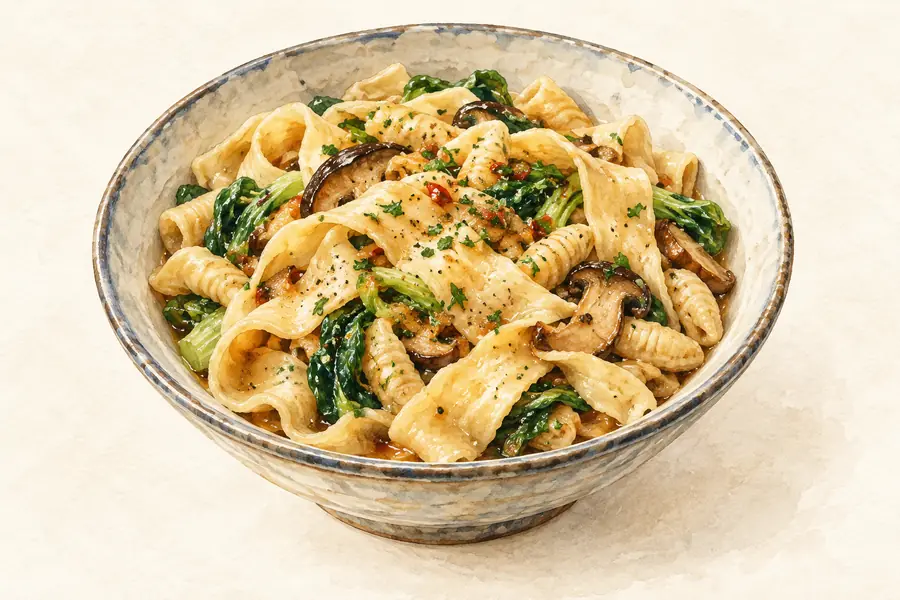
耀州疙瘩面 (Yaozhou Pinched Dough Noodles) is a noodle dish from Yaozhou in Tongchuan, Shaanxi, whose name describes short pinched dough pieces rather than long strands, finished either dry-tossed or in a broth.
A noodle named for its shape
The name tells you what to expect before you see the bowl: 疙瘩 is a lump or nub, 面 is the general word for flour-based food, and 耀州 pins it to Yaozhou in Tongchuan. Because it is hand-shaped, the dish has more in common with a small dumpling than with a strand of noodles, which is also why the size and thickness vary from one kitchen to the next. There is no machine setting to keep them identical.
Pinching the dough, then boiling
The dough is mixed firm and rested so the gluten relaxes and the pieces can be shaped without springing back. The cook pulls off small pieces and presses each one against a surface with the thumb, producing a nub with one smooth side and one roughened side; the roughness is deliberate, because it holds dressing far better than a smooth strand. The pieces boil until they float and turn opaque, then are drained and tossed or covered with broth.
Firm, chewy, sauce-hungry
Expect a firm, springy chew that sits between a noodle and a dumpling skin, with a surface that scrapes up sauce as you lift it. Because the pieces are thicker than strands, they stay hot longer and resist turning soft, which makes them comfortable to eat slowly. In the dry version, chilli oil, vinegar and garlic give a savoury, slightly sharp character; in the broth version the same pieces taste much milder.
Flour, water and what is added
The base is wheat flour, water and salt, which means the noodles contain gluten and cannot be made gluten-free. The dressing is where the variation lives: chilli oil, vinegar, garlic, sesame, and sometimes a spoonful of meat sauce or a scatter of vegetables. Broth versions may be built on meat stock, which matters if you avoid animal products. Ask 素的吗 to check whether a meat sauce or stock is used, and 有芝麻吗 if sesame is a concern.
Ordering 疙瘩面
Say 疙瘩面 and then settle the format: 干的 for drained and tossed, 汤的 for broth. Ask 辣不辣 for the chilli level and 多放醋 if you want it sharper, and use 小份 or 大份 to choose a size. If the shop offers both a plain dressing and one with meat sauce, ask 哪个是素的 before choosing. Showing 耀州疙瘩面 helps where several regional styles are sold side by side.
Tossing it properly
In the dry version, lift the pieces from the bottom of the bowl and turn them over several times so the oil that pooled underneath coats every nub. Eat while hot, because the rough surfaces seal in the sauce quickly and begin to soften as the bowl cools. With a soup version, spoon broth over the pieces as you eat rather than leaving them to sit. Because the pieces are dense, one bowl is more filling than it looks.
More dishes to compare
Explore related local specialties and compare their names, preparation notes and ordering guidance.
Sanyuan Coiled Noodles 三原疙瘩面 →
三原疙瘩面 is the same pinched-dough noodle from Sanyuan, also in Shaanxi, so the two share both the name and the shaping technique. The comparison is useful because the family is identical and the regional habits differ: how large the pieces are pressed, whether the bowl arrives dry or with broth, and how strongly it is dressed. Tasting both is the clearest way to see that 疙瘩面 is a technique with local accents.
Questions before you order
Does 疙瘩面 mean dumplings?
No. 疙瘩 means a lump or nub and 面 signals flour-based food, so the name describes small pinched pieces of dough rather than filled dumplings.
Why do the pieces have a rough side?
They are pressed by hand against a surface, and that rough side holds sauce far better than a smooth strand, which is part of the point of the shape.
Sources & reading
The supplied food list supports this name and regional association. The culinary terms below are explained as menu vocabulary; a local recipe, origin story and venue availability have not been independently verified.