

Huayin Big-Knife Noodles 华阴大刀面
Huayin Big-Knife Noodles are Huayin’s thin, resilient wheat noodles, shaped with a large blade and served in dry-tossed, oil-poured or saozi-topped sour-spicy variations.
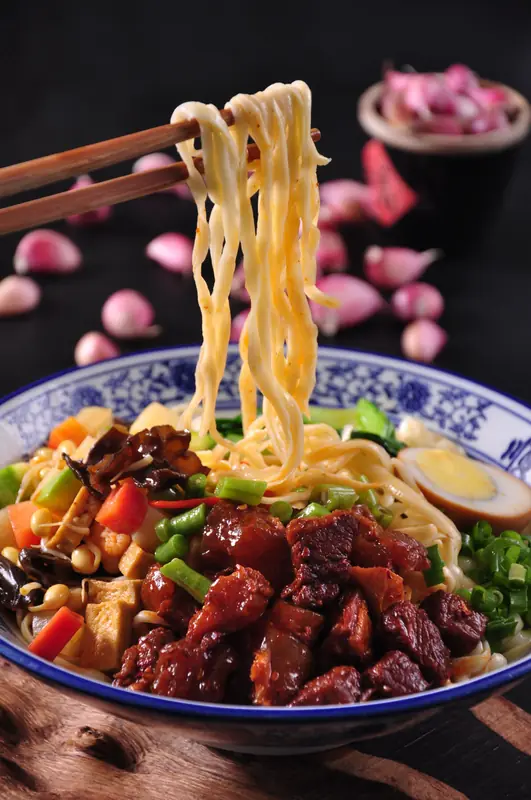
Image notes
Resized for the web; the photo itself has not been edited.
Tap any red Chinese text to hear it in Mandarin.
In brief
Huayin Big-Knife Noodles are Huayin’s thin, resilient wheat noodles, shaped with a large blade and served in dry-tossed, oil-poured or saozi-topped sour-spicy variations.
What you are eating
At the foot of Mount Hua, Huayin Big-Knife Noodles are a local wheat-noodle specialty whose name comes from the unusually large blade used to cut the sheet into strands. The finished noodles are usually yellowish, smooth and slippery, with a firm chew. Vinegar and chilli oil give many bowls a sour-spicy edge rather than a plain wheat taste.
The technique is the point. A reported Huayin method mixes flour with alkaline water and egg white, works the dough into a crumbly mass, and lets it rest before pressing. The dough is pressed with a wooden pole fixed at one end; the maker rides the other end and uses body weight to flatten it. Two rolling pins then stretch the dough into a very thin sheet.
The sheet is folded over a rolling pin into more than ten layers, with flour dusted between the folds. A blade more than two chi long—roughly two-thirds of a metre—is then used to cut the stack. Depending on the maker’s hand, the strands can be as fine as “dragon whiskers” or as wide as a chive leaf.
If the kitchen is open to view, look for the sequence rather than posing the cook as a performer: pressing, rolling, folding and the quick, even knife rhythm. Ask before making close photographs, and keep clear of the working bench.
How it is served
Local descriptions include dry-tossed noodles, noodles with a saozi-style topping, oil-poured noodles and soup preparations. One documented topping uses diced tofu and chopped glass noodles fried with bean paste, then adds coriander, scallion and chilli oil. Other local descriptions include minced meat, chive or scallion, and braising stock, so recipes and toppings vary from kitchen to kitchen.
Do not treat the tofu version as a guaranteed vegetarian order. The dough may contain egg white, and toppings can involve wheat, egg, soy or bean products, pork and chilli. If you have an allergy or avoid meat, ask what is in both the noodles and the topping, and ask about shared cooking equipment.
How to find it in Huayin
This is a dish, not a ticketed attraction, and it has no single address, entrance or official return route. Keep the Chinese name 华阴大刀面 Huàyīn Dàdāo Miàn on your phone. Search that exact phrase on Meituan (美团) or Amap / Gaode Maps (高德地图), adding 华阴 Huàyīn if results are ambiguous. Check the current menu, recent reviews, opening information and whether the dish is available that day before choosing; this is a way to find nearby options, not an endorsement of a particular shop.
For transport, choose a currently open listing near your lodging or wherever your day in Huayin ends. Walk or ride to that chosen listing, then use the same confirmed local transport or a newly checked listing for the return. A noodle dish cannot provide a reliable last-mile station, exit number or return timetable, so no dish-specific route is supplied here. If you have just left Mount Hua, check the listing’s current map position instead of assuming that every noodle shop is beside a trail gate.