

Guide Yellow River Fish 贵德黄河鱼
Guide Yellow River Fish is featured among the local specialties of Qinghai.
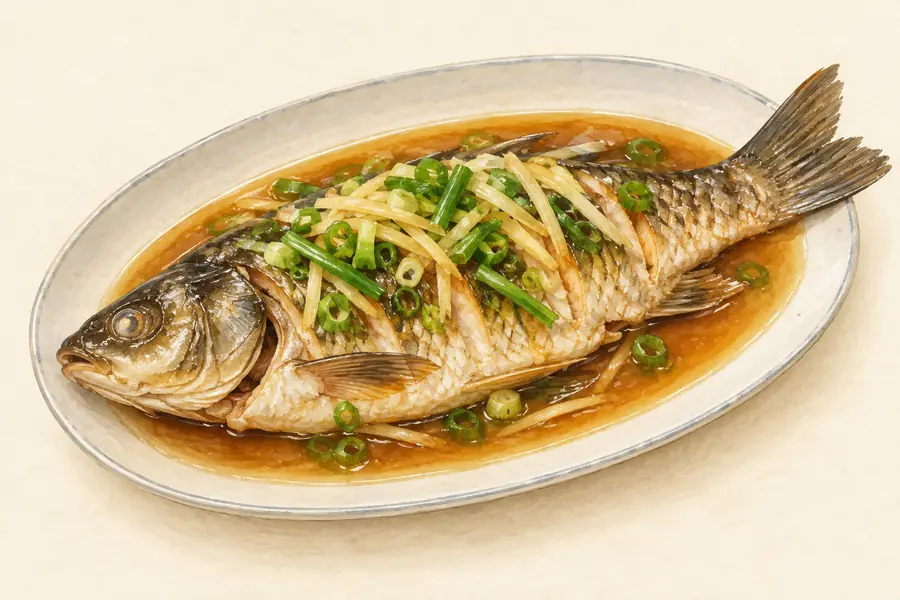
Guide Yellow River Fish (贵德黄河鱼) is the Yellow River fish served as a riverside speciality in Guide County, Hainan Tibetan Autonomous Prefecture, Qinghai, where the county sits on the upper Yellow River.
How it is cooked
River fish of this kind is cooked whole and plainly in the farm restaurants that serve it: scaled, opened, and either braised in a shallow sauce or simmered into a milky soup, with ginger, spring onion and chilli used to cut the muddiness of freshwater fish.
The cooking method matters more here than the recipe, because the fish itself is the claim being sold. A whole braised or souped fish at a shared table is the classic form; anything heavily battered or strongly spiced makes the species harder to judge, which is worth remembering if you care what you were served.
What to expect
Yellow River fish in the upper reaches are freshwater fish with firm white flesh and small bones, so they are usually eaten slowly and with attention. Braised, the sauce carries the flavour; souped, the broth does. Either way, expect a mild, slightly sweet fish rather than a strongly marine taste.
Where it belongs
Guide sits on the Yellow River in Hainan Prefecture, and riverside farm restaurants have built the fish into their identity: a 2016 Xihai Metropolis Daily investigation, reprinted by the Chinese Academy of Sciences Northwest Institute of Plateau Biology, found several Guide farm restaurants advertising 野生黄河鲤鱼 and 野生黄河鱼 as their house speciality.
The same report is also the reason to order carefully. It found ordinary carp being sold under the 黄河鲤鱼 label, and the fish printed on one Guide menu as 黄河鱼 was identified as 骨唇黄河鱼 rather than the 黄河鲤鱼 the label suggested. The report describes the fish as long-bodied, slightly compressed, conical-headed and silvery — useful detail if you want to look at what arrives.
Ingredients and dietary questions
The fish, water or stock, ginger, spring onion and chilli are the base; soy sauce or vinegar may follow in a braise. Ask whether the broth is fish-based or made with a meat stock if you avoid other meats, and ask if chilli can be left out. Freshwater fish carries small bones, so take care with children.
Ordering it
Order by weight at the tank or from the menu, then confirm how it will be cooked: 红烧 (braised), 清炖 (simmered plain — often 清炖黄河鱼) or 酸菜鱼. Ask 是什么鱼 — what fish is this? — before agreeing, since the useful information is the species, not the brand name on the tank.
How it is eaten
A whole fish is a shared dish, served on a plate or in a wide bowl and picked apart at the table; the head and tail are left for the host’s table in many Chinese settings, and the best pieces are usually offered to guests. Soup versions are ladled into small bowls and drunk alongside the meat.
More dishes to compare
Explore related local specialties and compare their names, preparation notes and ordering guidance.
Hand-torn noodle soup 尕面片 →
Hand-torn noodle soup (尕面片) is the Qinghai staple: wheat dough torn by hand into a broth. It is what a plateau table eats on an ordinary day, while a riverside fish dish is the speciality that a farm restaurant builds its menu around; both belong to the same provincial table.
Questions before you order
Is 黄河鲤鱼 the same as 黄河鱼?
No, or at least not automatically. 鲤鱼 is carp, while the menus that use the broader label 黄河鱼 may be serving another species — a 2016 report in Guide found the fish printed as 黄河鱼 identified as 骨唇黄河鱼. Ask which fish it is before ordering.
Where should I eat it?
Guide’s riverside farm restaurants are where the dish is traditional, but this guide deliberately names no venue: prices, standards and ownership change. Choose by the tank, ask the species and confirm whether the fish is river-caught or farmed.
Sources & reading
The supplied food list supports this name and regional association. The culinary terms below are explained as menu vocabulary; a local recipe, origin story and venue availability have not been independently verified.