

Wusu Pilaf 乌苏抓饭
Wusu Pilaf is featured among the local specialties of Xinjiang.
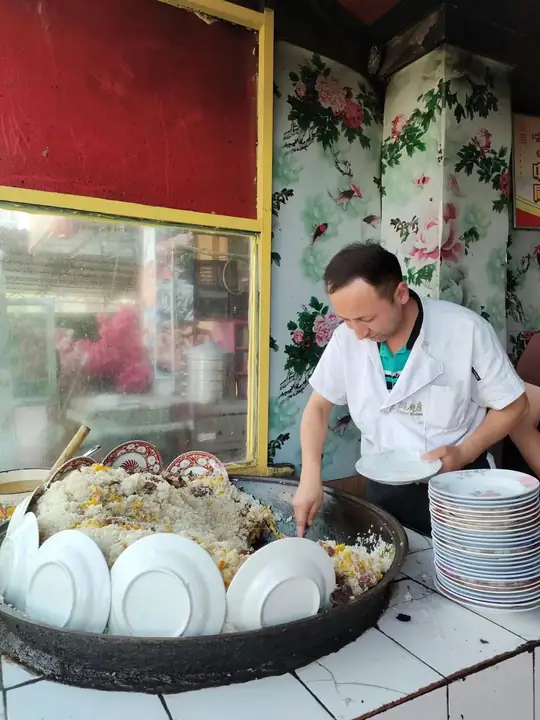
Photo adjustments
EXIF orientation normalized; resized without changing aspect ratio; converted to WebP. No subject edits.
Wusu Pilaf (乌苏抓饭) is a rice dish catalogued for Tacheng Area, Xinjiang, where 抓饭 names rice cooked together with meat and vegetables in one pot.
Rice cooked in the meat pot
The dish is built in stages in a single pot. Meat goes in first with onions and carrots and is cooked until the vegetables soften and release their colour, then water is added and rice is cooked on top of that liquid, absorbing everything underneath. The cook judges the amount of water by experience, because too much turns the grains soft and too little leaves them hard. Nothing is drained away, so the flavours stay in the pot. Ask 怎么做的 (how is it made) if you want the process described.
Sweet from carrots, rich from meat
Carrots and onions give the rice a gentle sweetness while the meat and its fat make it savoury and rich, so the dish lands somewhere between the two. The grains should stay separate rather than clumping, which is how you can tell the water was right. Some versions add raisins or dried fruit, which pushes the balance further towards sweet, so ask 有葡萄干吗 (does it contain raisins) if you prefer a savoury plate.
A town name on a shared dish
The record files 乌苏抓饭 under Tacheng Area and puts 乌苏, a city of that area, in front of the dish name. The technique is found all over Xinjiang, so the place word is what distinguishes one version from another rather than describing a different method. The word 抓 in the dish name recalls eating it by hand, but cutlery is standard now and no one will expect you to use your fingers.
Ingredients and dietary questions
Expect rice, meat, onions, carrots, oil and salt, with cumin or other spices and sometimes dried fruit. The pot is cooked with meat, so it is not a vegetarian dish even though vegetables are prominent; ask 有素的吗 (is there a vegetarian version) if you need one. Ask 是什么肉 (what meat is it) if you avoid beef or mutton, and 咸不咸 (how salty is it) if you are watching salt.
Ordering it
Show 乌苏抓饭 and ask 一份多大 (how big the portion is), 是什么肉 (which meat) and 有葡萄干吗 (does it contain raisins). Restaurants often serve it with a small bowl of soup, a salad or a yoghurt drink, so ask 配什么 (what comes with it). One portion is usually a meal in itself, and if several dishes are on the table a single portion still goes a long way.
Eating it
Mix a little of the meat and vegetables into each spoonful so that the rice is not left plain at the bottom of the plate. A sharp salad or a sour drink cuts the richness, and chili or pickles are optional rather than expected. Leftovers reheat better than most rice dishes because the grains were cooked in fat, but the carrots soften further on the second day.
More dishes to compare
Explore related local specialties and compare their names, preparation notes and ordering guidance.
Turpan Pilaf 吐鲁番抓饭 →
Turpan Pilaf (吐鲁番抓饭) is the neighbouring entry for the same rice-and-meat pot, named for another city in Xinjiang. Comparing them shows that the method is shared across the region while the place word marks the local version, and that the meat, the dried fruit and the seasoning remain questions for each kitchen.
Questions before you order
Is the dish sweet?
It has a gentle sweetness from carrots, and some versions add raisins or dried fruit, which makes it sweeter still. Ask 有葡萄干吗 (does it contain raisins) if you prefer it savoury.
Can I eat it without meat?
Not as it is usually made: the rice cooks in the same pot as the meat. Ask 有素的吗 (is there a vegetarian version) if you need one, since a plain rice dish is a different plate.
Sources & reading
The supplied food list supports this name and regional association. The culinary terms below are explained as menu vocabulary; a local recipe, origin story and venue availability have not been independently verified.