

Shihezi Cold Noodle Sheets 石河子凉皮
Shihezi Cold Noodle Sheets is featured among the local specialties of Xinjiang.
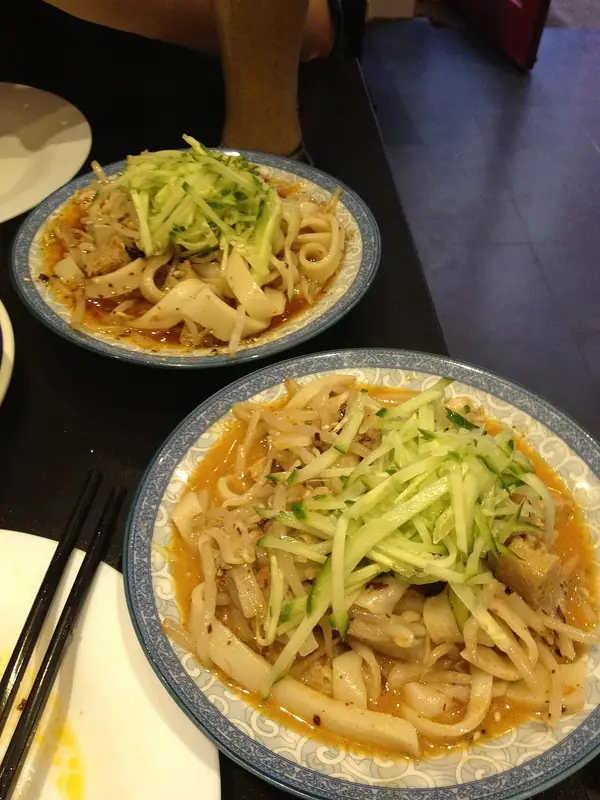

Photo adjustments
Full frame retained; EXIF orientation normalized, proportionally resized to at most 800 pixels and converted to WebP. No generated pixels or subject changes. Cards may crop the display.
Shihezi Cold Noodle Sheets (石河子凉皮) is a sour-spicy wheat-sheet snack from Shihezi (石河子), Xinjiang (新疆). Its thin sheets sit in a red dressing with wheat gluten and vegetables; the local craft entered the Xinjiang Production and Construction Corps (新疆生产建设兵团) intangible cultural heritage list in March 2014.
How it is made
An October 2022 Eighth Division–Shihezi Media Centre (第八师石河子市融媒体中心) feature, published by Bingtuan Online (兵团在线), describes locally grown winter-wheat flour as the starting material. Making the sheets involves kneading, washing, settling, filtering, fermenting, steaming, scalding and cooling. Their thickness is given as 0.8 to 1 millimetre.
The seasoned liquid uses more than twenty aromatics, including scallion, ginger, Sichuan pepper, star anise, tsaoko, bay leaf and cassia. The sheets are cut into strips and dressed with sliced gluten, chilli preparations, sesame powder, crushed peanuts, garlic and ginger juices, salt water and vinegar, with coriander and cucumber added at the end.
Flavour and texture
The media centre describes springy, slippery sheets and a sour-spicy liquid. Vinegar supplies acidity, while sesame and peanuts add aroma and cucumber a refreshing contrast. It describes taking a few mouthfuls of the remaining liquid after finishing the sheets.
Where it comes from
The media centre traces the dish to earlier military-agricultural settlers who combined niangpi (酿皮) from Qinghai (青海), Gansu (甘肃) and Xinjiang with Shaanxi (陕西) wheat- and rice-sheet techniques and Sichuan (四川) jelly dressings.
The name of Bamao Liangpi Street (八毛凉皮一条街) comes from Bayi Woollen Mill (八一毛纺织厂). The food street developed within the mill’s residential compound.

Sources & reading
Written from the linked sources and checked sentence by sentence against quoted extracts by a separate reviewer on 2026-09-26. Recipes and servings vary between kitchens.