

Explore the region
About Xigu Park
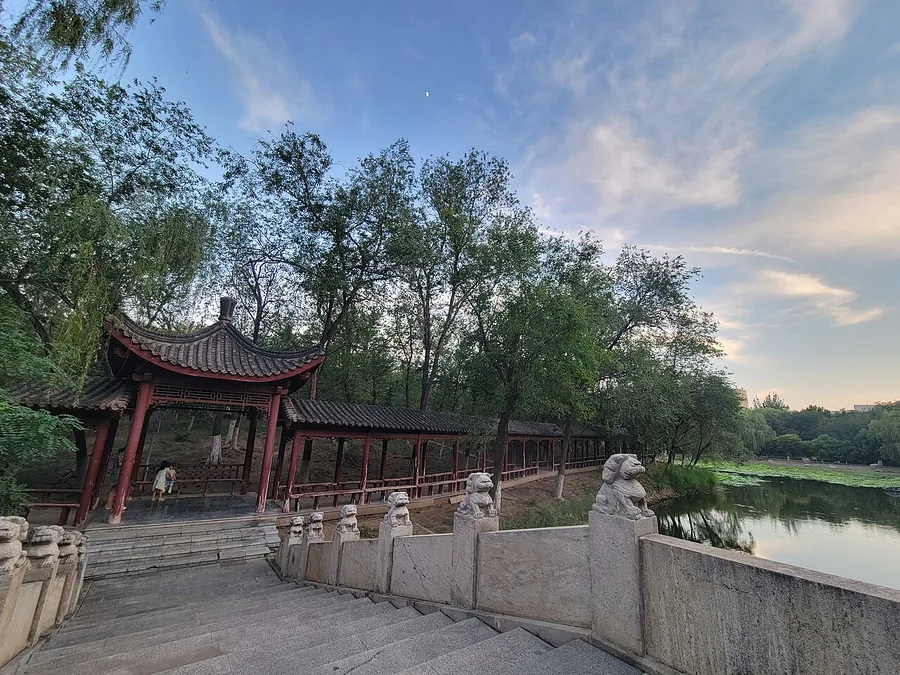
Its lakes and planted paths are complemented by a concentrated arts area, including the Xigu Painting and Calligraphy Academy and memorial displays for Tianjin artists Liang Qi and Gong Wang. This gives the park a useful combination of outdoor walking and local cultural interpretation. The grounds have changed repeatedly since opening in 1959; choose the present lake paths and open cultural buildings rather than relying on older descriptions of animal or amusement facilities.
The grounds once held the Qing-era Xigu Arsenal (西沽武库); after it was abandoned the land became a vegetable garden known along the river for wild peach and willow trees, the 'Peach-Willow Embankment' (桃柳堤). After Japan occupied Tianjin in 1937 a Japanese-affiliated railway company farmed the site; the Nationalist government's railway farm took over after 1945, and the Tianjin Railway Bureau turned it into a forestry farm after 1949. The name Xigu comes from the site's position on the west bank of the Gu River, now the North Canal.
The park covers 320,000 square meters, including 210,000 square meters of green space and 60,000 square meters of water, divided into eight zones for fitness, activities, plant landscape, river custom, history and culture, performance, wetland ecology and amusement. It is threaded by canals, streams, wetlands and lake-islands totaling 62,436.32 square meters of water drawn from the adjoining North Canal, forming a system described as 'three canals, one stream and one lake'.
The Hongqiao Intangible Cultural Heritage Museum, a district demonstration base for intangible cultural heritage, opened inside the park in December 2017 and was named to Tianjin's first group of intangible-heritage inheritance and experience bases in December 2023. It houses the Yidecheng Snuff Culture Museum (益德成闻药文化博物馆), described as China's first museum devoted to snuff and 'smelling medicine' culture.
What to look for
- The park's lake, island and planted walking areas.
- The painting-and-calligraphy precinct and Liang Qi–Gong Wang memorial displays when open.
Location & getting there
Getting to Xigu Park
The park lies southeast of the junction of Guangrong Road and Hongqiao North Street, on the west bank of the North Canal.
Combine your visit
Suggested order within this visit:
-
Park lake paths
Begin with the landscape and water views.
-
Painting and Calligraphy Academy precinct
Add the park's dedicated arts setting.
-
Liang Qi and Gong Wang memorial area
Focus on the work of two Tianjin artists if the building is open.
This sequence is an editorial suggestion based on the features described in the sources. Access to individual buildings or areas should be checked locally; no travel time or shared admission is implied.
Find Xigu Park
西沽公园 · 红桥区
The pin marks the area, not the entrance.
More places nearby
Approximate straight-line distances between map pins, not travel distances.
Dabei Temple 大悲禅院
2 km awayDabei Temple, the Temple of Great Compassion, is a Buddhist monastery organized around older western and later eastern compounds. Its sculpture gives the visit a clear focus: the Sakyamuni figure in the main hall sits on a…
View guide →Tianjin Eye 天津之眼
2 km awayThe Tianjin Eye is a giant observation wheel built over Yongle Bridge on the Haihe. Its most distinctive feature is the combination of transport structures: the circular wheel rises above a working river crossing, with the…
View guide →Awakening Society Memorial 觉悟社纪念馆
2 km awayThe Awakening Society Memorial occupies the small grey-brick courtyard where Zhou Enlai, Deng Yingchao, Ma Jun and fellow students formed their association in 1919. It reopened on 29 April 2026 after repairs and an exhibition…
View guide →Sources & visit information
The linked encyclopedia sources support background and place descriptions. Current opening hours, ticket prices, booking rules and transport schedules have not been independently verified for this guide. Confirm them with the venue or operator before travelling.
Visitor information adapted and edited from Wikipedia contributors · CC BY-SA 4.0. Source revision 94086345.
Background paragraphs translated and condensed from Wikipedia contributors, "西沽公园", Chinese Wikipedia · CC BY-SA 4.0. Source revision 94237621.
