

Explore the region
About Fuling Tomb
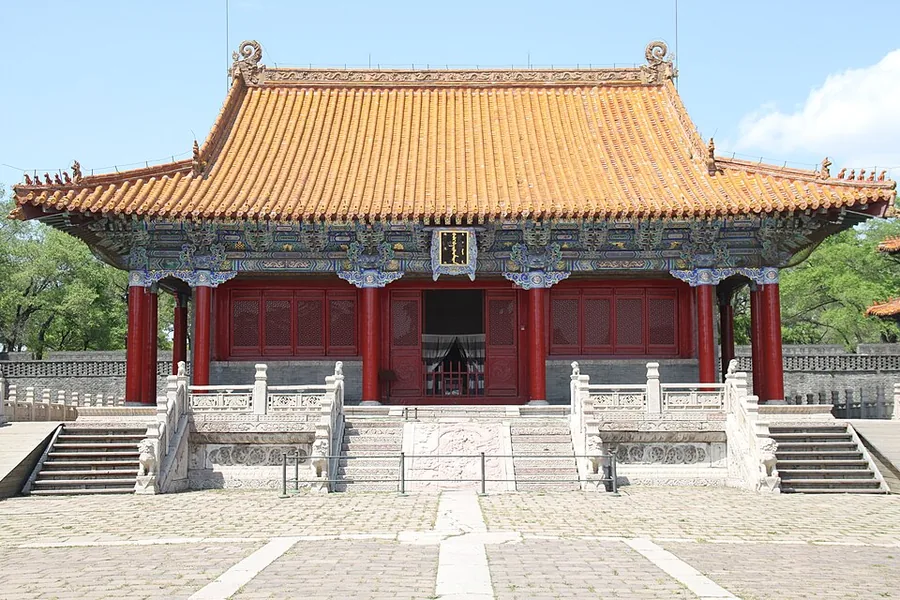
Unlike a flat ceremonial compound, its sequence rises from the spirit path by a long flight of steps to the stele pavilion and fortified inner enclosure. Stone animals, glazed walls and Long'en Hall make the ascent architecturally varied. The surrounding park is part of the setting, but the tomb itself is the reason to leave central Shenyang for this eastern visit.
Nurhaci died at Shengjing (present-day Shenyang) in 1626 but was not buried immediately, since no suitable site had been found. In 1629 a site northeast of the city was chosen, and Hong Taiji had the tomb of his birth mother, of the Yehe Nara clan (叶赫那拉氏), moved there from Dongjing that year. First called 'Taizu Ling', the tomb was given the name Fuling in 1636, meaning that the Qing state's fortune would last long, and was completed by 1651, with further building added under the Kangxi and Qianlong emperors.
Fuling was listed in 1988 among the third batch of Major Historical and Cultural Sites Protected at the National Level (全国重点文物保护单位), and in 2004 was inscribed on the World Heritage List as part of an extension of the Ming and Qing imperial tombs.
The complex covers about 194,800 square meters and rises from south to north through a front courtyard, a fortified square enclosure and a crescent-shaped treasure city, unlike the layout of Ming tombs or of Qing tombs built after entering the pass. Its red wall measures 900 meters north to south and 340 meters east to west. Beneath the mound at the rear of the treasure city lies the underground chamber holding Nurhaci, his empress and three sacrificed consorts. The grounds have been a park since 1929.
What to look for
- The spirit path's stone animals and the 108-step ascent through the tomb landscape.
- The stele pavilion and Long'en Hall inside the elevated fortified enclosure.
The surrounding area
Provincial capital base; Fangcheng, Tiexi and Xita are different city districts with distinct reasons to visit.
Location & getting there
Getting to Fuling Tomb
Use Dongling Park/Fuling at 210 Dongling Road in Hunnan District. Allow for the stair ascent and check the accessible visitor route if steps are difficult.
Combine your visit
Suggested order within this visit:
-
Spirit path
Begin with the stone guardian animals.
-
Steps and stele pavilion
Follow the rising ceremonial approach.
-
Long'en Hall enclosure
Finish with the main memorial buildings.
This sequence is an editorial suggestion based on the features described in the sources. Access to individual buildings or areas should be checked locally; no travel time or shared admission is implied.
Find Fuling Tomb
福陵 · 沈阳市
The pin marks the area, not the entrance.
More places nearby
Approximate straight-line distances between map pins, not travel distances.
Shenyang Botanical Garden 沈阳植物园
6 km awayShenyang Botanical Garden also preserves the landscape of the 2006 horticultural exposition. Its identity comes from the combination of wooded grounds, regional display gardens and large themed landmarks. Lily Tower, Phoenix…
View guide →9.18 Historical Museum 九一八历史博物馆
10 km awayThe 9.18 Historical Museum examines the Mukden Incident of September 1931 through photographs, objects and historical interpretation. Its broken-calendar monument gives the date a forceful physical presence before visitors enter…
View guide →Zhang Xueliang Former Residence 张氏帅府
11 km awayZhang Xueliang's former residence, long known as the Zhang Marshal's Mansion, combines a traditional three-courtyard house with western-style villas. The Daqing Building served as the family's office, while the Xiaoqing Building…
View guide →Sources & visit information
The sources below support the place-specific description and arrival information. Suggested combinations are editorial planning ideas; confirm current opening, entry arrangements and transport services for your date.
Visitor information adapted and edited from Wikipedia contributors · CC BY-SA 4.0. Source revision 92027093.
Background paragraphs translated and condensed from Wikipedia contributors, "清福陵", Chinese Wikipedia · CC BY-SA 4.0. Source revision 92027093.
Image credits & notes (1)
- A hall at Fuling (East Tomb), Shenyang, Liaoning, photographed in May 2014.Photo: Gary Lee Todd, Ph.D. · CC0Resized for the web; the photo itself has not been edited.
