

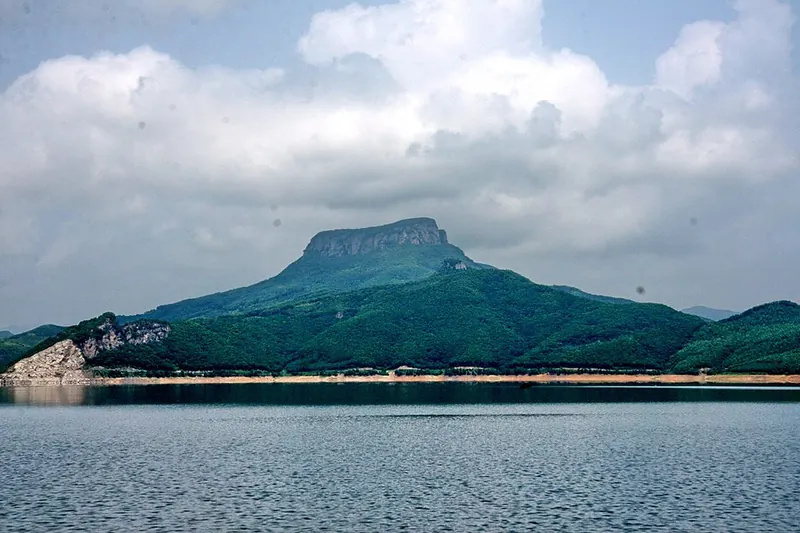
Photo adjustments
Full frame retained; proportionally resized and converted to WebP. No retouching or changes to the photographed subject. Card displays may crop the view.
Explore the region
About Wunü Mountain
Steep cliffs supplied much of the defence, with built walls closing the more accessible gaps. On the summit, building foundations and traces of semi-subterranean houses reveal a settlement rather than merely a scenic lookout. The contrast between the flat occupied summit and the precipitous sides is the key to understanding the site, so allow time to read the archaeological interpretation after the ascent.
Wunü Mountain fortress, also recorded as Heulseunggol (纥升骨城) or Jolbon (卒本城), is considered the birthplace of the Goguryeo people and its first capital from 34 BC, after founding king Jumong (朱蒙), who had fled south from Dongfuyu (东夫余), founded his state at Zuobenchuan (卒本川) in 37 BC. The capital moved to Guonei City (国内城) in 3 AD. Remains found on the mountain also date back more than 4,500 years, to the late Neolithic period.
The fortress lies 8.5 kilometers northeast of Huanren on the bank of the Hun River (浑江), with an irregular outline about 1,540 meters long and 350 to 550 meters wide and three gates. It is divided into an upper section on the flat, oval summit of the main peak, ringed by cliffs over 100 meters high, and a lower section on the gentler northeastern slope. Of the 4,754-meter wall, natural cliffs account for about 4,189 meters and stone sections for 565 meters. Excavations uncovered building foundations, semi-subterranean houses, pottery, stone and iron tools and iron weapons.
Together with the nearby ancient cities of Gungnae and Hwando, Wunü Mountain was inscribed on the UNESCO World Heritage List in recognition of its historical significance to the Goguryeo kingdom and the architecture and planning of its capital, under the listing “Capital Cities and Tombs of the Ancient Koguryo Kingdom”.
What to look for
- The relationship between natural cliff defences and surviving built-wall sections.
- Summit building foundations and residential remains from the Goguryeo occupation.
The surrounding area
Inland provincial base region for cave and hill landscapes beyond the urban centre.
Location & getting there
Getting to Wunü Mountain
Approach the Wunü Mountain scenic area from Huanren; the 2026 local tourism directory lists Yanhe Street in Huanren Town as its visitor address. Confirm the transfer to the mountain and the operating ascent route.
Combine your visit
Suggested order within this visit:
-
Cliff and wall approach
Read how the mountain formed the city's defences.
-
Summit building foundations
Examine the occupied plateau.
-
Residential remains
Add the evidence of everyday settlement life.
This sequence is an editorial suggestion based on the features described in the sources. Access to individual buildings or areas should be checked locally; no travel time or shared admission is implied.
Find Wunü Mountain
五女山 · 本溪市
The pin marks the area, not the entrance.
More places nearby
Approximate straight-line distances between map pins, not travel distances.
Hetu Ala 赫图阿拉城
62 km awayHetu Ala was Nurhaci's early capital before the Later Jin court moved west towards Liaoyang and Shenyang. Its position on a ridge between waterways explains the Manchu name, often translated as a horizontal ridge. The inner and…
View guide →Benxi Water Cave 本溪水洞
110 km awayBenxi Water Cave is a limestone cave system with contrasting dry and water-filled sections. The entrance chamber opens towards passages where stalactites, stalagmites and columns cluster along natural fractures. The underground…
View guide →Pingdingshan Massacre Memorial Hall 平顶山惨案遗址纪念馆
137 km awayThe Pingdingshan memorial commemorates civilians killed by Japanese troops at a village near Fushun in 1932. Its historical exhibition explains the attack and subsequent investigations, while the hall containing excavated human…
View guide →Sources & visit information
The sources below support the place-specific description and arrival information. Suggested combinations are editorial planning ideas; confirm current opening, entry arrangements and transport services for your date.
- Wikipedia: 五女山城 ↗
- Benxi tourism bureau: Wunü Mountain visitor location, January 2026 ↗
- English Wikipedia: Wunü Mountain (revision 1371399064, 2026-08-26) ↗
Visitor information adapted and edited from Wikipedia contributors · CC BY-SA 4.0. Source revision 86545756.
Background paragraphs translated and condensed from Wikipedia contributors, "五女山城", Chinese Wikipedia · CC BY-SA 4.0. Source revision 86545756.
Background paragraphs condensed from Wikipedia contributors, "Wunü Mountain", English Wikipedia · CC BY-SA 4.0. Source revision 1371399064.