

Photo adjustments
Proportionally resized and converted to WebP without cropping, retouching or changing the photographed subject.
Explore the region
About Fengguo Temple
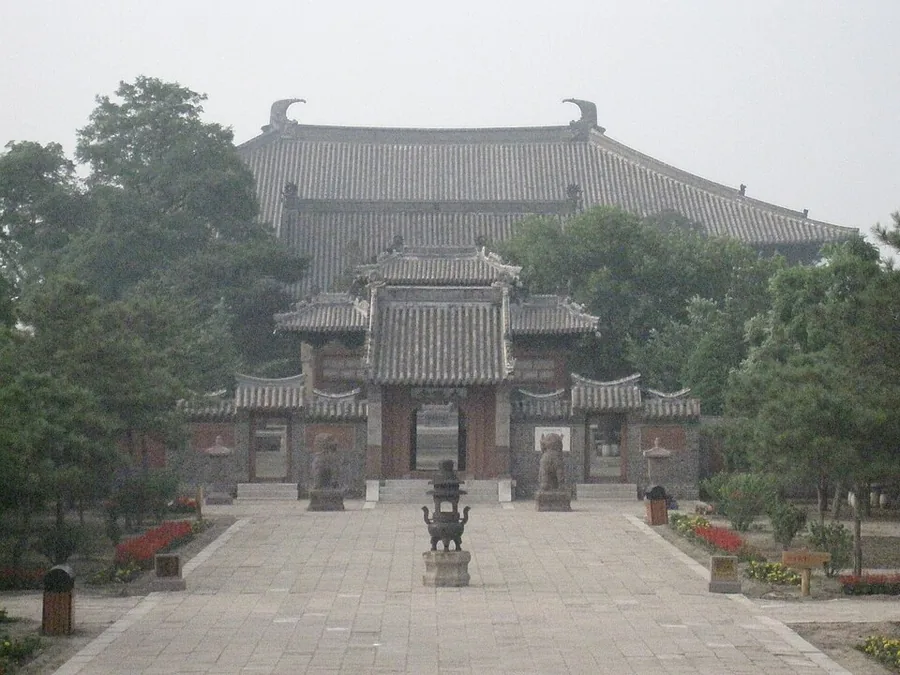
The figures form a striking horizontal sequence beneath the broad timber roof. Painted brackets and beams, together with later wall paintings, reward close inspection after the first impression of scale. Smaller Qing-period entrance buildings survive in front, making the change in proportions between the approach and the great hall especially noticeable.
Fengguo Temple was first built in the ninth year of the Liao Kaitai era (1020) under the name Xianxi Temple (咸熙寺); it was renamed Fengguo Temple in the Jin dynasty, and is also known as the Great Buddha Temple (大佛寺) or Seven Buddha Temple (七佛寺) because its main hall houses the Seven Buddhas of the Past. The temple flourished in the Liao, Jin and Yuan dynasties; by the Ming and Qing only the Daxiongbao Hall (大雄宝殿) remained, and the Qing added several smaller halls around it.
The Daxiongbao Hall faces south with a single-eave hip roof, nine bays wide and five bays deep, and measures 48.20 meters wide by 25.13 meters deep, one of the two largest surviving Buddha halls in China, smaller only than the Daxiongbao Hall of Huayan Temple in Datong, Shanxi. The smaller Wuliang Hall (无量殿), built in the early Qing with a single-eave hip-and-gable roof, measures 16.14 meters wide by 12.22 meters deep.
The temple was listed in 1961 in the first batch of Major Historical and Cultural Sites Protected at the National Level (全国重点文物保护单位), and is one of three surviving Liao-period temples in China. Its seven Buddha statues, Liao-period sculptures over eight meters tall including their lotus pedestals, stand beneath Liao-period painted beams and brackets, with wall murals thought to date from the Yuan dynasty.
What to look for
- The seven large Liao-period Buddha figures arranged across the main hall.
- The hall's timber brackets and painted structural decoration, contrasted with the smaller entrance buildings.
Location & getting there
Getting to Fengguo Temple
Go to the north side of Dongjie, East Street, in Yi County's town centre. Use Fengguo Temple as the destination rather than a similarly named Great Buddha Temple elsewhere.
Combine your visit
Suggested order within this visit:
-
Entrance and Wuliang Hall
Begin with the smaller later buildings.
-
Daxiong Hall
Concentrate on the seven figures and early timber structure.
This sequence is an editorial suggestion based on the features described in the sources. Access to individual buildings or areas should be checked locally; no travel time or shared admission is implied.
Find Fengguo Temple
奉国寺 · 锦州市
The pin marks the area, not the entrance.
More places nearby
Approximate straight-line distances between map pins, not travel distances.
Ruiying Temple 瑞应寺
47 km awayRuiying Temple is a Tibetan Buddhist monastery in Fosi Village, with deep connections to the Mongolian communities around Fuxin. Its halls rise across the hillside, and the complex includes monastic-college buildings as well as…
View guide →Liaoshen Campaign Memorial 辽沈战役纪念馆
47 km awayThe Liaoshen Campaign Memorial in Jinzhou interprets the 1948 campaign that changed control of northeastern China during the civil war. Its galleries combine campaign history with civilian-support and commemoration themes…
View guide →North Pagoda of Chaoyang 朝阳北塔
66 km awayChaoyang's North Pagoda contains several periods of construction within its square brick form. Earlier tower cores and foundations were incorporated into later rebuilding, while the closely spaced eaves and sculpted exterior…
View guide →Sources & visit information
The linked encyclopedia sources support background and place descriptions. Current opening hours, ticket prices, booking rules and transport schedules have not been independently verified for this guide. Confirm them with the venue or operator before travelling.
Visitor information adapted and edited from Wikipedia contributors · CC BY-SA 4.0. Source revision 92040198.
Background paragraphs translated and condensed from Wikipedia contributors, "奉国寺", Chinese Wikipedia · CC BY-SA 4.0. Source revision 92040198.