

Photo adjustments
Full frame retained; proportionally resized and converted to WebP. No retouching or changes to the photographed subject. Card displays may crop the view.
Explore the region
About North Pagoda of Chaoyang
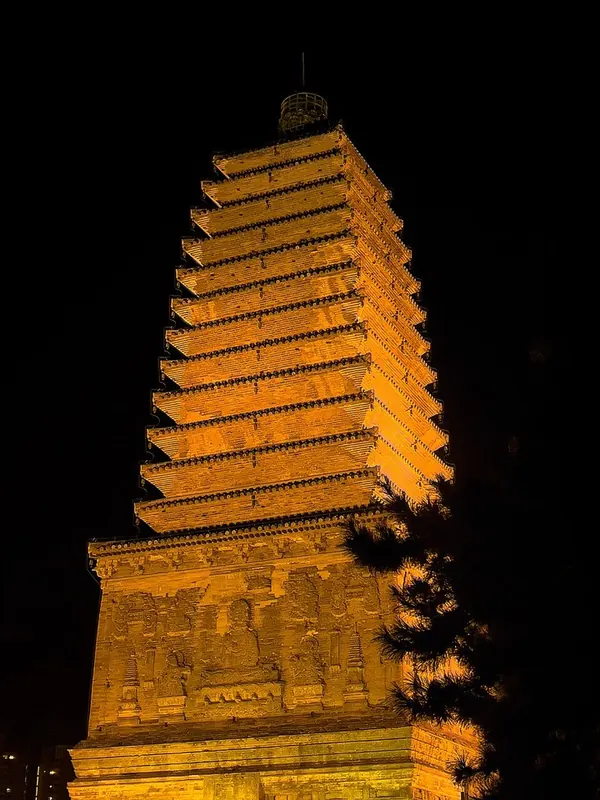
Earlier tower cores and foundations were incorporated into later rebuilding, while the closely spaced eaves and sculpted exterior give the surviving pagoda its distinctive appearance. Look for the cardinal-direction Buddha figures, miniature pagodas and flying celestial figures on the lower exterior. The associated museum adds the excavated reliquaries and tower history, helping explain why this apparently single monument represents a much longer sequence.
The pagoda originated under the Northern Wei dynasty, built by order of Empress Dowager Feng (冯太后) on former palace foundations of the Former Yan, Later Yan and Northern Yan kingdoms, and was first named Siyan Buddhist Pagoda (思燕佛图). In 602 a new pagoda, the Fanzhuang Temple Pagoda (梵幢寺塔), was built on the same site to house Buddha relics granted by the Sui emperor Wen (隋文帝).
It was renamed Kaiyuan Temple Pagoda (开元寺塔) and restored under Tang Xuanzong (唐玄宗), then renamed Yanchang Temple Pagoda (延昌寺塔) and restored twice more under the Liao dynasty. Each face of the pagoda body carries a seated Buddha of the Vajradhatu (金刚界) group: Akshobhya (阿閦佛) on a five-elephant throne to the east, Amitabha (阿弥陀佛) on a five-peacock throne to the west, Amoghasiddhi (不空成就佛) on a five-bird throne to the north and Ratnasambhava (宝生佛) on a double-horse throne to the south, each flanked by two bodhisattvas.
Eight miniature pagoda reliefs (灵塔), thirteen-tier close-eave square pagodas 3.2 meters tall, stand between the bodhisattva figures and the corner pillars. In 1988 excavation of the heavenly chamber above the tower's core yielded two relics identified as those of Sakyamuni (释迦牟尼), and the pagoda was listed the same year as a Major Historical and Cultural Site Protected at the National Level (全国重点文物保护单位).
What to look for
- The square tower's thirteen closely spaced eaves and sculpted Buddhist exterior.
- The museum interpretation of earlier tower phases and excavated reliquaries.
Background & history
Chaoyang North Tower (Chinese: 朝阳北塔) is located in Shuangta District, Chaoyang City, Liaoning Province, People's Republic of China. It is named after the tower's northernmost location among the three towers in Chaoyang in the early years. The tower lacks explicit documentation in historical records. During extensive maintenance from 1984 to 1992, the archaeological team discovered the rammed earth tower foundations of the Sixteen Kingdoms period, the Northern Wei Dynasty, the Sui Dynasty, the Tang Dynasty and the Liao Dynasty beneath the Chaoyang North Tower during construction. The base of the tower was eventually combined with historical materials and other archaeological findings to discover that the existing tower was built in the Tang Dynasty and rebuilt in the Liao Dynasty. The tower is also known as the "Five Ages Pagoda" or "Pagoda of Five Ages with One Body" because the base of the tower beneath it spans five eras.
Excerpt from Wikipedia: Chaoyang North Tower · Wikipedia contributors · CC BY-SA 4.0. Selected introductory sentences; formatting simplified. Background information, not current visitor-service advice.
Location & getting there
Getting to North Pagoda of Chaoyang
Go to North Tower Square at the northern end of Shuangta Street, by the Beidajie area of central Chaoyang. The exterior and associated museum can form one focused visit.
Combine your visit
Suggested order within this visit:
-
North Pagoda museum
Establish the successive construction phases and archaeological finds.
-
Pagoda exterior
Walk the permitted perimeter to compare the carved faces.
-
North Tower Square
Finish with a complete view of the tower's proportions.
This sequence is an editorial suggestion based on the features described in the sources. Access to individual buildings or areas should be checked locally; no travel time or shared admission is implied.
Find North Pagoda of Chaoyang
朝阳北塔 · 朝阳市
The pin marks the area, not the entrance.
More places nearby
Approximate straight-line distances between map pins, not travel distances.
Fengguo Temple 奉国寺
66 km awayFengguo Temple in Yi County preserves a monumental Liao-period main hall built to house the Seven Buddhas of the Past. The figures form a striking horizontal sequence beneath the broad timber roof. Painted brackets and beams…
View guide →Liaoshen Campaign Memorial 辽沈战役纪念馆
76 km awayThe Liaoshen Campaign Memorial in Jinzhou interprets the 1948 campaign that changed control of northeastern China during the civil war. Its galleries combine campaign history with civilian-support and commemoration themes…
View guide →Niuheliang 牛河梁遗址
84 km awayNiuheliang is a Hongshan-culture ceremonial landscape spread across the hills between Lingyuan and Jianping. Its significance comes from the relationship between temple remains, stone cairns and an altar, rather than a single…
View guide →Sources & visit information
The sources below support the place-specific description and arrival information. Suggested combinations are editorial planning ideas; confirm current opening, entry arrangements and transport services for your date.
- Wikipedia: 朝阳北塔 ↗
- Chaoyang government: North Pagoda location, construction and finds ↗
- English Wikipedia: Chaoyang North Tower (revision 1370287718, 2026-08-20) ↗
Visitor information adapted and edited from Wikipedia contributors · CC BY-SA 4.0. Source revision 90584208.
Background paragraphs translated and condensed from Wikipedia contributors, "朝阳北塔", Chinese Wikipedia · CC BY-SA 4.0. Source revision 90584208.
Background paragraphs condensed from Wikipedia contributors, "Chaoyang North Tower", English Wikipedia · CC BY-SA 4.0. Source revision 1370287718.