

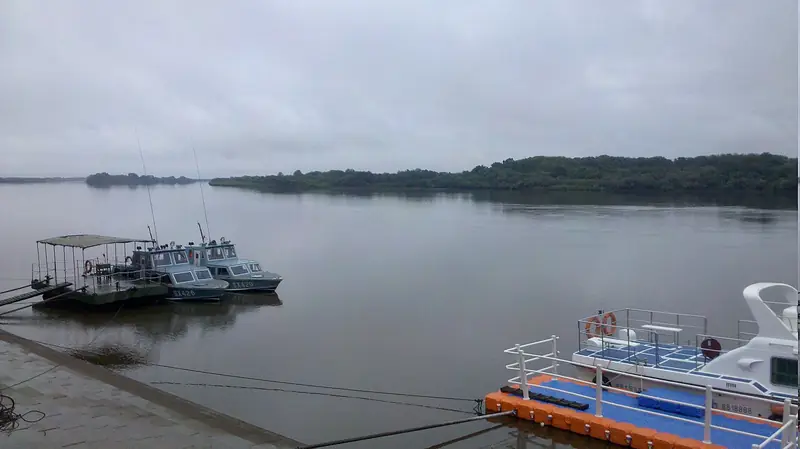
Photo adjustments
Full frame retained; EXIF orientation normalized, proportionally resized to at most 800 pixels and converted to WebP. No generated pixels or subject changes. Cards may crop the display.
Explore the region
About Hutou Fortress
Concrete underground passages and rooms show how the installation was designed to operate beneath the hills, while the museum explains its construction, forced labour and the fighting of August 1945. The surviving tunnel network is much larger than the public route. Read the exhibition before entering the authorised underground section so that the engineering remains are understood within their wartime human history.
Built by the Japanese Kwantung Army, the fortress was constructed between 1934 and 1939 and garrisoned by the 4th Border Garrison Unit of the Fifth Army, tasked with blocking a Soviet invasion of Manchuria and cutting the Siberian Railway. Because of the Soviet-Japanese neutrality pact the garrison saw no fighting for most of its existence, and by July 1945 it was held by the newly formed 15th Border Garrison Unit, about 1,400 strong.
The fortress occupies high ground on the Manchukuo side of the Ussuri River (乌苏里江), overlooking the Soviet town of Iman, now Dalnerechensk, and measures about 10 kilometers east to west and 4 kilometers north to south. Along the long border line it was the only strategic position able to monitor the Siberian Railway, and it was considered one of the most important of the fortresses the Kwantung Army built across Manchuria.
In 2006 it was listed, as one of the Northeast fortresses of the Japanese invading army, on the sixth batch of Major Historical and Cultural Sites Protected at the National Level (全国重点文物保护单位); the listing covers the underground works at Hutoushan (虎头山), Menghushan (猛虎山) and Hubeishan (虎北山), the Huoshishan train-gun underground works (火石山列车炮地下工事), howitzer turret ruins and the Huxiaoshan (虎啸山) area ruins.
What to look for
- The museum's documents and objects concerning construction and the 1945 fighting.
- The preserved concrete passages and underground rooms on the official visitor route.
Location & getting there
Getting to Hutou Fortress
Use the Hutou Fortress Site Museum in Hutou Town, Hulin, as the arrival point for the protected remains.
- Enter underground areas only through the museum's authorised route; scattered entrances elsewhere in the former military landscape are not public access points.
Combine your visit
Suggested order within this visit:
-
Site museum
Establish the historical and human context.
-
Authorised underground route
Read the concrete passages and rooms in relation to the exhibition.
-
Outdoor memorial area
Finish with the site's commemorative landscape.
This sequence is an editorial suggestion based on the features described in the sources. Access to individual buildings or areas should be checked locally; no travel time or shared admission is implied.
Find Hutou Fortress
虎头要塞 · 鸡西市
The pin marks the area, not the entrance.
More places nearby
Approximate straight-line distances between map pins, not travel distances.
Lake Khanka 兴凯湖
147 km awayLake Khanka, or Xingkai Lake, is a vast freshwater border lake shared by China and Russia. On the Chinese side, a wooded sandy ridge separates the main lake from Little Xingkai Lake, creating two very different water views…
View guide →Shuangyashan Museum 双鸭山市博物馆
208 km awayShuangyashan Museum places the city's coal industry within a wider account of the Sanjiang region. Its galleries cover ancient landscapes and archaeology, ethnic life, forests and wetlands, and the industrial story represented…
View guide →Taoshan Park 桃山公园
208 km awayTaoshan Park rises above central Qitaihe, offering wooded paths and views back over the city. Its planted slopes include willows and pines, while the open spaces make a contrast with the hill walk. The City Light sculpture…
View guide →Sources & visit information
The sources below support the place-specific description and arrival information. Suggested combinations are editorial planning ideas; confirm current opening, entry arrangements and transport services for your date.
- Wikipedia: 虎头要塞 ↗
- Heilongjiang Culture and Tourism: Hutou protected remains and public underground section ↗
- Ministry of Culture and Tourism: Hutou museum, underground fortress and memorials ↗
Visitor information adapted and edited from Wikipedia contributors · CC BY-SA 4.0. Source revision 91863529.
Background paragraphs translated and condensed from Wikipedia contributors, "虎头要塞", Chinese Wikipedia · CC BY-SA 4.0. Source revision 91863529.