

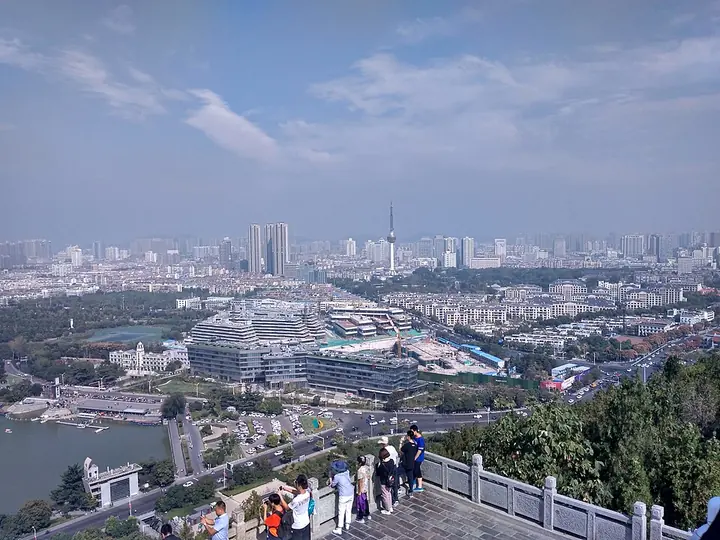
Photo adjustments
Full frame retained; proportionally resized and converted to WebP. No retouching or changes to the photographed subject. Card displays may crop the view.
City & district guides
About Xuzhou
The museum provides context for objects recovered around the region, while the Shizishan royal tomb exposes the rock-cut architecture and nearby terracotta figures in their broader burial setting. Yunlong Lake offers a contrasting outdoor landscape below Yunlong Mountain. Begin with the museum before choosing a tomb complex, then use the lakeshore as a separate change of pace. The major sites are distributed across the city and need individual transport planning.
The Xuzhou region's early archaeology is linked mainly to the Dawenkou culture. In the Shang dynasty the polity of Dapeng, or Peng, associated with the Dongyi people, dominated the area until it was subordinated to Shang authority. During the Western Zhou period the Xu people migrated south from Shandong to found a polity there, later annexed by the State of Song. Pengcheng, named after Dapeng, first appears in records in 573 BCE as a Song fortified city at the confluence of the Bian and Si rivers, and Song is said to have later moved its capital there.
After Song's annexation by the State of Qi in 286 BCE, Pengcheng became a frontier stronghold; it later fell to Chu and was incorporated into the Qin Empire in 223 BCE. During the Qin collapse it became a centre of Chu cultural revival, and in 206 BCE Xiang Yu made it the capital of the Western Chu he founded. Despite Xiang Yu's victory at the Battle of Pengcheng in 205 BCE, the city subsequently passed to Han control.
What to look for
- The Shizishan royal tomb combines rock-cut chambers with nearby Han terracotta finds.
- Yunlong Lake places open water beneath the slopes of Yunlong Mountain.
Background & history
Xuzhou (Chinese: 徐州), also known as Pengcheng (彭城), is a prefecture-level city in northwestern Jiangsu province, China. Located at the junction of four provinces—Jiangsu, Shandong, Henan, and Anhui—it occupies a natural geographic gap between the Shandong Hills and the North China Plain. Xuzhou is a designated important node city of Belt and Road Initiative, a provincial sub-center of Jiangsu, and the central city of the Huaihai Economic Zone. As a major national transport hub, it serves as the strategic intersection of the north–south Beijing–Shanghai axis and the east–west Land Bridge corridor. The city is the ancestral home of the Han dynasty imperial family, and its history is defined by its rich Han archaeological heritage. Formerly a regional coal-mining base, Xuzhou has transitioned into a center for heavy machinery manufacturing and new energy industries, and was awarded the United Nations Habitat Scroll of Honour award for its ecological restoration of mining areas.
Excerpt from Wikipedia: Xuzhou · Wikipedia contributors · CC BY-SA 4.0. Selected introductory sentences; formatting simplified. Background information, not current visitor-service advice.
The surrounding area
A northern extension focused on Han culture, with its own travel days rather than a short detour from Suzhou.
Location & getting there
Getting to Xuzhou
Xuzhou Station is just east of the central city; Xuzhou East is a separate high-speed station in the eastern outskirts. Check the Chinese station name, 徐州 or 徐州东, and arrange the onward city transfer accordingly.
Combine your visit
A suggested sequence linking the specific features of this visit.
-
Xuzhou Museum徐州博物馆
Begin with the region’s archaeological context.
-
Shizishan royal tomb狮子山楚王陵
Connect the collection with a rock-cut royal burial and terracotta evidence.
-
Yunlong Lake云龙湖
Finish with an independently connected lakeside visit below the mountain.
This order is editorial. Confirm access and any transfers between stops; it does not establish a walking route, same-day connection or common admission ticket.
Find Xuzhou
徐州 · 徐州市
The pin marks the area, not the entrance.
More places nearby
Approximate straight-line distances between map pins, not travel distances.
Xuzhou Museum徐州博物馆
2 km awayXuzhou Museum links the city’s local history with the material culture of the Han-period Chu kingdom. Jade, figurines and burial objects provide a particularly strong focus, including the collection’s gold-thread jade burial suit.
View guide →Huaihai Campaign Memorial Museum淮海战役纪念馆
4 km awayThe Huaihai Campaign Memorial Museum in Xuzhou interprets the military campaign alongside the civilian labour that supported it. The grain-processing exhibit makes that support concrete through the work of preparing supplies…
View guide →Mausoleum of the Chu Prince狮子山楚王陵
4 km awayThe Shizishan tomb was cut into the southern slope of Lion Hill in Xuzhou and contains a complex series of rock chambers. Nearby Han-period terracotta pits held miniature officials, guards and armed figures, providing a…
View guide →Sources & visit information
The sources below support the place-specific description and arrival information. Suggested combinations are editorial planning ideas; confirm current opening, entry arrangements and transport services for your date.
- en.wikipedia.org ↗
- mapcarta.com ↗
- Xuzhou ↗
- ditu.amap.com ↗
- 徐州博物馆 ↗
- 狮子山汉楚王墓 ↗
- en.wikipedia.org ↗
- jsgd.jiangsu.gov.cn ↗
- 云龙湖 ↗
- English Wikipedia: Xuzhou (revision 1361808516, 2026-06-30) ↗
Visitor information adapted and edited from Wikipedia contributors, “徐州博物馆” · CC BY-SA 4.0. Source revision 92133463.
Visitor information adapted and edited from Wikivoyage contributors, “Xuzhou” · CC BY-SA 4.0.
Visitor information adapted and edited from Wikipedia contributors, “狮子山汉楚王墓” · CC BY-SA 4.0. Source revision 93084259.
Visitor information adapted and edited from Wikipedia contributors, “云龙湖” · CC BY-SA 4.0. Source revision 92776932.
Background paragraphs condensed from Wikipedia contributors, "Xuzhou", English Wikipedia · CC BY-SA 4.0. Source revision 1361808516.