

Explore the region
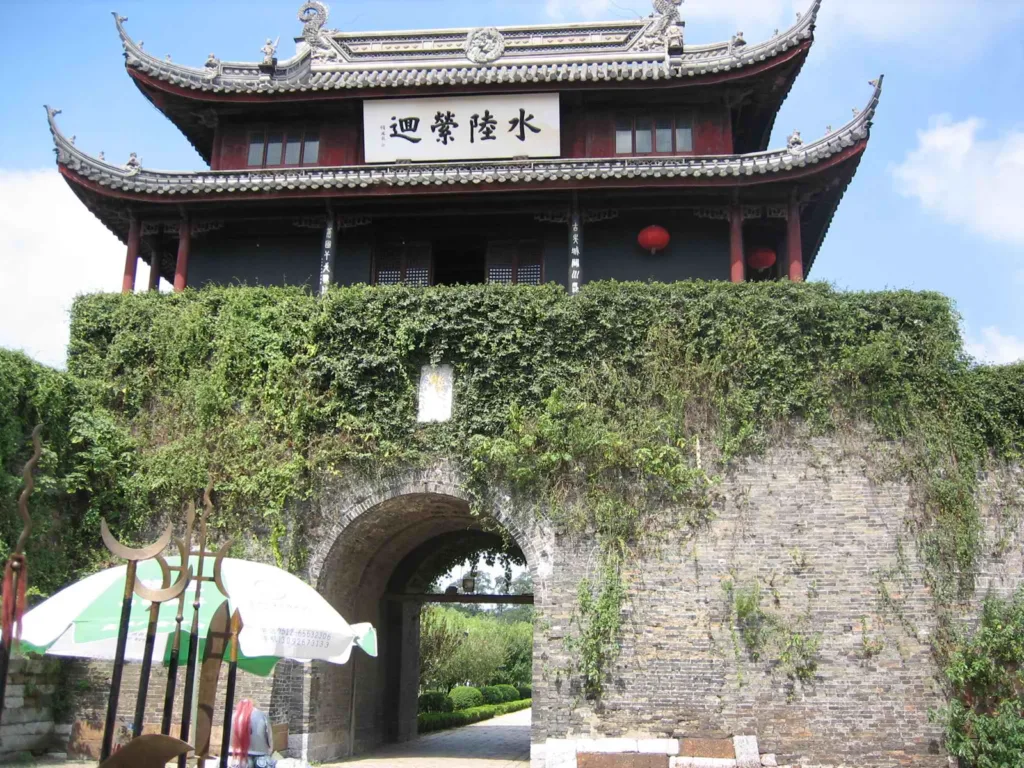
Panmen is not just a surviving gate tower. Its paired water and land passages were designed to control movement along the canal and overland approaches. The offset land entrances, inner and outer barriers, and enclosed barbican make the defensive plan legible on foot: pause at each opening and notice how the walls prevent a straight view through. The water gate sits alongside the land gate, connecting the city’s defensive architecture to the waterways that once carried people and trade.
Allow time to look beyond the gate itself. The stone-arched Wumen Bridge crosses the outer moat and Grand Canal beside the entrance; from its crest, compare the water route with the gate’s landward approach. Continue into the scenic area for Ruiguang Pagoda, the tower within the old enclosure. Its brick-and-timber form, projecting eaves, and carved stone base reward a slower look. The three features—gate, bridge, and pagoda—work best as a sequence: approach from the bridge, read the layered defenses, then turn back toward the tower and canal views.
The official scenic-area description also identifies garden courts, historic-style streets, and restored cultural structures among the wider grounds. Treat those as parts of one managed heritage landscape, not as separate attractions requiring separate transfers. Restoration has shaped what visitors see today, so the present structures should not all be mistaken for untouched remains from a single period.
Getting there: The scenic-area operator lists buses 949, You 2 (游2), You 5 (游5), 39, 1, and You 4 (游4), and gives Panmen Scenic Area North (盘门景区北站) as a stop for routes including 949 and You 2. Because the operator’s route guide is undated, confirm the live route and direction before boarding. Its published rail-to-bus itinerary is Metro Line 2 to Guangji Road South (广济路南站), Exit 3, then bus 921 to Xinshi Bridge South (新市桥南站), followed by a walk from Xinshi Bridge toward Dongdajie (东大街); confirm that bus 921 still runs before relying on this itinerary.
For a taxi or ride-hail, enter 盘门景区东大街49号 as the destination and ask to be let out at the signed public visitor entrance on Dongdajie. Use only a legal curbside stopping place; do not ask a driver to stop across a bus lane or at the gate itself.
The official pages opened for this guide do not establish current routine opening hours, ticket price, or whether advance reservation is required. Check the scenic area’s official visitor channels for the date of your visit; do not rely on old event notices for regular admission or night programming.

Combine your visit
A suggested sequence linking the specific features of this visit.
-
Wumen Bridge
Begin with the crossing outside the old city gate.
-
Panmen water-and-land gate
Compare the separate controls for water and road traffic.
-
Ruiguang Pagoda
Finish with the tower inside the former enclosure.
This order is editorial. Confirm access and any transfers between stops; it does not establish a walking route, same-day connection or common admission ticket.
Find Panmen Scenic Area
盘门 · 苏州市
The pin marks the area, not the entrance.
More places nearby
Approximate straight-line distances between map pins, not travel distances.
The Surging Wave Pavilion 沧浪亭
1 km awayCanglang Pavilion arranges its garden around a wooded rock hill while borrowing views of water outside the boundary. This relationship between an inner hill and outer water gives it a distinctive composition among Suzhou gardens.
View guide →Master of the Nets Garden 网师园
2 km awayThe Master of the Nets Garden joins an eastern residential sequence to a western garden around Rosy Cloud Pool. Carefully placed buildings make the small water surface appear more expansive.
View guide →Mountain Villa with Embracing Beauty 环秀山庄
3 km awayHuanxiu Shanzhuang is a compact Suzhou garden centred on an elaborate rockery associated with the Qing garden designer Ge Yuliang. Its peaks, narrow passages and surrounding pond create a miniature mountain landscape.
View guide →Sources & visit information
Sources checked on 22 October 2026. Hours, tickets, reservations and transport can change; confirm with the operator before you go.
Image credits & notes (1)
- Panmen land gate and gatehouse with the stone passage below; photograph taken 9 August 2006 according to image metadata. Photo: AjaxroolsPhoto: CC BY-SA 3.0