


Photo adjustments
Full frame retained; proportionally resized and converted to WebP. No retouching or changes to the photographed subject. Card displays may crop the view.
Explore the region
About The Surging Wave Pavilion
This relationship between an inner hill and outer water gives it a distinctive composition among Suzhou gardens.
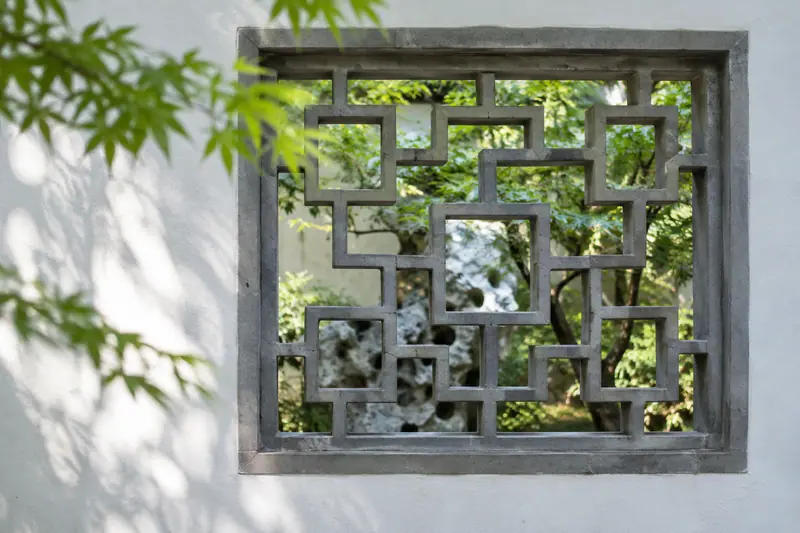
Mingdao Hall stands among the buildings around the hill, while the Five Hundred Worthies Shrine preserves engraved portraits of people associated with Suzhou. Compare the large landscape arrangement with smaller patterned windows and carved details as you move through the grounds.
The garden lies south of old Suzhou at Sanyuanfang and is the oldest of the surviving gardens in the Jiangnan region; with the Lion Grove, Humble Administrator's Garden and Lingering Garden it is counted among Suzhou's 'Four Great Gardens of the Song, Yuan, Ming and Qing,' representing the artistic style of the Song dynasty. In 1044 the poet Su Shunqin (苏舜钦), then demoted, bought a ruined garden on the site from a Five Dynasties owner and built a waterside pavilion, naming it Canglang Pavilion after a phrase in the Chuci.
Canglang Pavilion was listed as a Jiangsu provincial-level protected cultural site in 1982, added to the UNESCO World Heritage list as part of the Classical Gardens of Suzhou in 2000, and listed as a Major Historical and Cultural Site Protected at the National Level (全国重点文物保护单位) in 2006. Its Five Hundred Worthies Shrine (五百名贤祠) holds 594 carved stone portraits of people linked to Suzhou history from the Zhou to the Qing dynasty.
What to look for
- The garden borrows exterior water views into its wooded rock-hill setting.
- The Five Hundred Worthies Shrine contains engraved historical portraits.
The surrounding area
A provincial city base for classical gardens, canals and soup-noodle breakfasts; do not confuse its old city with the distant North railway station.
Location & getting there
Getting to The Surging Wave Pavilion
Approach the garden off Renmin Road in the Sanyuanfang area south of Suzhou’s old city, near the Confucian Temple.
Combine your visit
A suggested sequence linking the specific features of this visit.
-
Waterfront garden boundary
Begin with the borrowed-water view that shapes the garden.
-
Mingdao Hall
Compare the hill landscape with a principal surrounding hall.
-
Five Hundred Worthies Shrine
Finish with the engraved portraits connected to Suzhou’s history.
This order is editorial. Confirm access and any transfers between stops; it does not establish a walking route, same-day connection or common admission ticket.
Find The Surging Wave Pavilion
沧浪亭 · 苏州市
The pin marks the area, not the entrance.
More places nearby
Approximate straight-line distances between map pins, not travel distances.
Master of the Nets Garden 网师园
Less than 1 km awayThe Master of the Nets Garden joins an eastern residential sequence to a western garden around Rosy Cloud Pool. Carefully placed buildings make the small water surface appear more expansive.
View guide →Panmen city gate 盘门
1 km awayPanmen preserves a paired water-and-land gate on the southwestern side of Suzhou’s former city wall. The offset passages show how the defences controlled both boats and road traffic.
View guide →Temple of Mystery 玄妙观
2 km awayXuanmiao Temple stands on Guanqian Street in Suzhou and is dedicated to the Taoist Three Pure Ones. Its Sanqing Hall preserves a substantial Southern Song timber building with a broad, double-eaved roof.
View guide →Sources & visit information
The sources below support the place-specific description and arrival information. Suggested combinations are editorial planning ideas; confirm current opening, entry arrangements and transport services for your date.
Visitor information adapted and edited from Wikipedia contributors, “沧浪亭” · CC BY-SA 4.0. Source revision 93102860.
Visitor information adapted and edited from Wikivoyage contributors, listing “The Surging Wave Pavilion” · CC BY-SA 4.0.
Background paragraphs translated and condensed from Wikipedia contributors, "沧浪亭", Chinese Wikipedia · CC BY-SA 4.0. Source revision 93102860.