

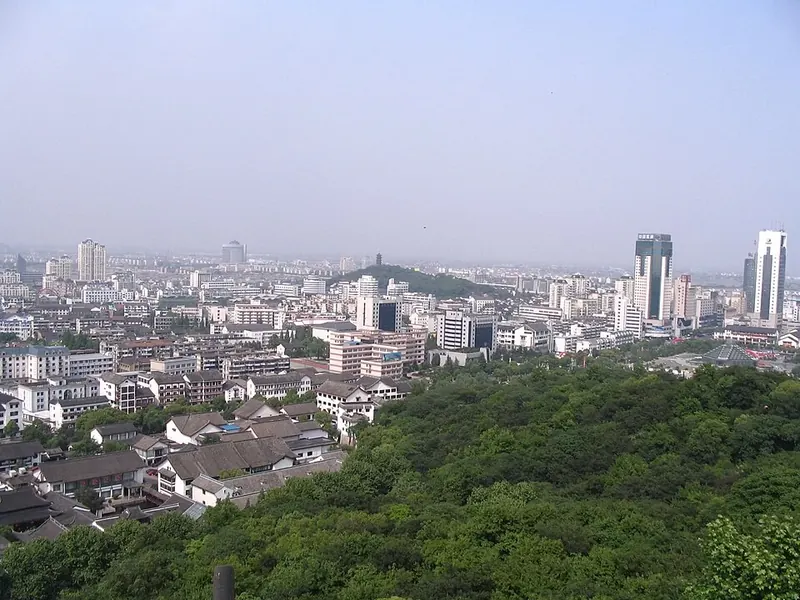
Photo adjustments
Full frame retained; proportionally resized and converted to WebP. No retouching or changes to the photographed subject. Card displays may crop the view.
Explore the region
About Shaoxing
Lu Xun’s former home and Sanwei Study connect domestic architecture with his writing, while Bazi Bridge shows how several streets meet across a waterway junction. Yellow-wine culture adds another local thread beyond the major monuments. Choose two old-city areas and read their lanes and water together; regional sites such as East Lake require an additional journey.
Shaoxing was a capital of the ancient state of Yue during the Spring and Autumn period. It later served as a regional administrative centre under several names. The present name was adopted in 1131 during the Southern Song dynasty. Shaoxing also holds the formal designation of National Historic and Cultural City.
The wider municipality descends from southern hills towards northern plains. The Kuaiji Mountains (会稽山) run through its territory, with separate basins on either side. The Cao'e River (曹娥江) flows north into the Qiantang River (钱塘江), whose southern bank is bordered by a plain containing numerous waterways and lakes.
What to look for
- Lu Xun Native Place connects preserved domestic and school settings with modern Chinese literature.
- Bazi Bridge’s branching approaches show the ingenuity of the canal city’s street network.
Location & getting there
Getting to Shaoxing
Shaoxing North railway station serves high-speed arrivals outside the old centre. Continue to Yuecheng and the Lu Xun Middle Road area by the current local transport connection.
Combine your visit
A suggested sequence linking the specific features of this visit.
-
Lu Xun Native Place鲁迅故里
Begin with the writer’s home, garden and school setting.
-
Bazi Bridge八字桥
Compare the literary compound with the city’s canal and bridge landscape after a local transfer.
This order is editorial. Confirm access and any transfers between stops; it does not establish a walking route, same-day connection or common admission ticket.
Find Shaoxing overview
绍兴 · 绍兴市
The pin marks the area, not the entrance.
More places nearby
Approximate straight-line distances between map pins, not travel distances.
Chinese Yellow Wine Museum 中国黄酒博物馆
4 km awayThe Chinese Yellow Wine Museum explains Shaoxing’s brewing tradition through tools, storage and decorated vessels. The wooden press and jar wall make production and ageing tangible, while the huadiao section focuses on the…
View guide →Shusheng Cultural Street 书圣故里
4 km awayShaoxing’s Shusheng Guli streets connect a waterside neighbourhood with the memory of calligrapher Wang Xizhi. Jiezhu Temple and the Ink Pool are associated with his former home in local tradition, while Tishan Bridge carries…
View guide →Warehouse bridge straight street 仓桥直街
5 km awayCangqiao Straight Street follows the Huanshan River beside Fushan, linking old courtyard houses with a sequence of stone bridges. Many residential compounds retain the taimen arrangement characteristic of Shaoxing: a street…
View guide →Sources & visit information
The sources below support the place-specific description and arrival information. Suggested combinations are editorial planning ideas; confirm current opening, entry arrangements and transport services for your date.
- Shaoxing ↗
- Lu Xun Native Place ↗
- sxsk.sx.gov.cn ↗
- www.amap.com ↗
- Shaoxing ↗
- Chinese Wikipedia: 绍兴市 (revision 94241304, 2026-09-08) ↗
- English Wikipedia: Shaoxing (revision 1363512229, 2026-07-10) ↗
Visitor information adapted and edited from Wikipedia contributors, “Lu Xun Native Place” · CC BY-SA 4.0. Source revision 1287816976.
Visitor information adapted and edited from Wikivoyage contributors, “Shaoxing” · CC BY-SA 4.0.
Visitor information adapted and edited from Wikipedia contributors, “Shaoxing” · CC BY-SA 4.0. Source revision 1363512229.
Background paragraphs translated and condensed from Wikipedia contributors, "绍兴市", Chinese Wikipedia · CC BY-SA 4.0. Source revision 94241304.
Background paragraphs condensed from Wikipedia contributors, "Shaoxing", English Wikipedia · CC BY-SA 4.0. Source revision 1363512229.