

Explore the region
Tap any red Chinese text to hear it in Mandarin.
A bridge built around water and streets
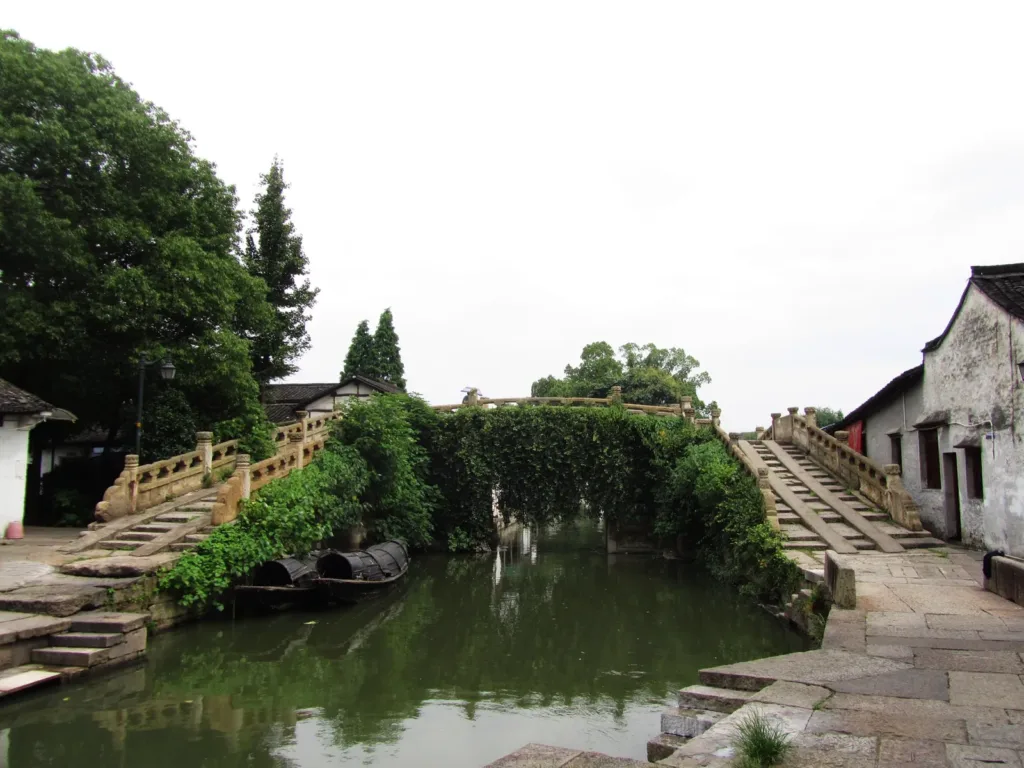
At the eastern end of Baziqiao Straight Street in Yuecheng District, the bridge sits in a lived-in historic quarter of stone lanes, canal-side paths and white-walled homes. The present structure was rebuilt in 1256; its first construction was already recorded before the Southern Song’s Jiatai years (1201–1204). The name refers to the splayed plan described in the old record: the approaches meet at angles that resemble the character 八.
Look from a waterside path before crossing. The bridge carries a stone-beam crossing over the water junction, while its approaches turn toward different streets. The arrangement was designed to let land routes meet without blocking boat movement below and beside the bridge. The official local account describes three rivers, a towpath at the southern approach, openwork panels and lotus-shaped details on the stone posts. The wider historic district is part of the Shaoxing section of the Grand Canal World Heritage property, so the bridge makes most sense as part of a water network rather than as a freestanding monument.
How to explore it
Begin on the bank or beside the canal, where the branching ramps and the relationship between bridge, towpath and houses are easier to read than from the bridge deck. Cross slowly, then compare the different approaches from the lane ends. Continue along the stone-paved waterside paths to see the small steps down to the water and the neighboring bridges in the historic quarter. Guangning Bridge and Dongshuang Bridge are nearby but separate bridges; this entry is for Bazi Bridge itself.
The bridge and surrounding historic streets are presented as free, open public space rather than a gated museum. I found no bridge-specific reservation procedure or dated gate timetable in the accessible visitor information. That does not cover admission, reservations or opening rules for any separate temple, museum, boat ride or other managed venue nearby. The lanes are also a residential setting: take care on damp stone, keep clear of household entrances, and do not treat residents or waterside activity as a staged attraction.
Getting there
- Metro: Take Shaoxing Metro Line 1 to City Square Station (城市广场站), then continue toward the eastern end of Baziqiao Straight Street (八字桥直街东端). The station is in the old-city area; the final walk is not an inside-the-station transfer, so check the live pedestrian route before leaving the station.
- Bus: A current visitor listing names routes 8, 21, 30, 52 and 88 to 市妇保院 Shì Fùbǎoyuàn; from that stop, continue on foot toward Baziqiao Straight Street. Recheck the route and stop direction on the day, as bus services can change.
- From high-speed rail: From Shaoxing North Railway Station (绍兴北站), Line 1’s northern branch provides the rail-to-metro connection toward City Square Station (城市广场站); then use the metro last-mile approach above.
- Taxi or ride-hailing: Show the driver “绍兴市越城区八字桥直街东端(八字桥)”. This is a public bridge and neighborhood rather than a single ticket gate, so confirm the drop-off point before getting out.
No scheduled boat arrival or return service at Bazi Bridge was verified for this entry. The canals explain the bridge’s historic design, but they should not be treated as a current passenger-boat route without a same-day operator notice.
Combine your visit
A suggested sequence linking the specific features of this visit.
-
Canal-bank viewpoint
Read the branching bridge plan before stepping onto it.
-
Stone crossing and approaches
Compare the different directions served by the descending paths.
-
Waterside towpath view
Finish by examining the relationship between bridge and navigation channel.
This order is editorial. Confirm access and any transfers between stops; it does not establish a walking route, same-day connection or common admission ticket.
Find Bazi Bridge
八字桥 · 绍兴市
The pin marks the area, not the entrance.
More places nearby
Approximate straight-line distances between map pins, not travel distances.
Warehouse bridge straight street 仓桥直街
Less than 1 km awayCangqiao Straight Street follows the Huanshan River beside Fushan, linking old courtyard houses with a sequence of stone bridges. Many residential compounds retain the taimen arrangement characteristic of Shaoxing: a street…
View guide →Shen Garden 沈园
1 km awayShen Garden is a literary memorial landscape associated with Lu You and Tang Wan. Its poem wall, ponds and Song-inspired pavilions frame the story remembered through the Chaitoufeng poems. Much of the present garden results from…
View guide →Former Residence of Lu Xun in Shaoxing 鲁迅故里
1 km awayLu Xun’s Shaoxing home and neighbourhood preserve places that recur in his writing. The former residence leads into the Baicao Garden setting, while Sanwei Study represents the disciplined schoolroom contrasted with that outdoor…
View guide →Sources & visit information
Sources checked on 24 October 2026. Hours, tickets, reservations and transport can change; confirm with the operator before you go.
Image credits & notes (1)
- Bazi Bridge seen from the south, with its stone approaches, railings and canal-side steps. Photo: 猫猫的日记本Photo: CC BY-SA 3.0