

Explore the region
About Huaxilou
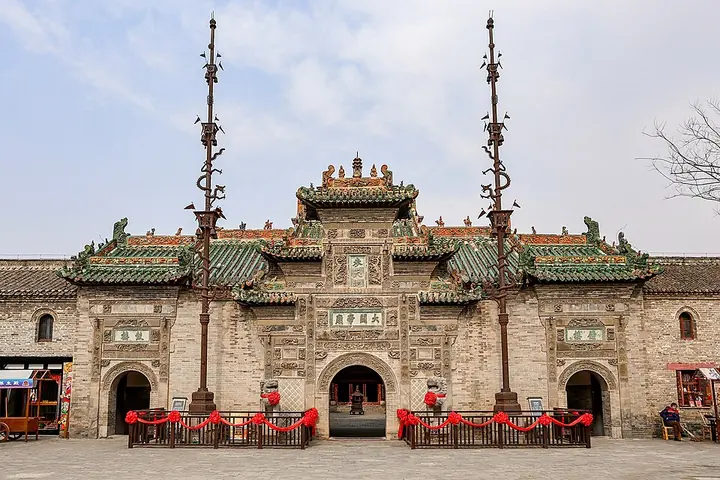
Huaxilou (花戏楼), originally named the Great Guandi Temple (大关帝庙) and also called the Shanxi–Shaanxi Guild Hall (山陕会馆), stands on Xianning Street (咸宁街) in the old Beiguan (北关) quarter of Bozhou (亳州), Anhui, near the Guo River (涡河). Its popular name, roughly "the decorated opera house", comes from the stage's brick carving, woodcarving and paintwork, most of which show scenes from local opera.
Merchants from Shanxi and Shaanxi founded the temple to Guan Yu in 1656; the Shanxi trader Wang Bi (王璧) and the Shaanxi trader Zhu Kongling (朱孔领) led the project. In 1676 medicinal-goods merchants from the two provinces added the opera stage, and the complex was rebuilt in 1740, gained a new main hall, side galleries and a painted stage ceiling in 1766, and was repaired again in 1784. The State Council listed it in the third batch of Major Historical and Cultural Sites Protected at the National Level on 13 January 1988.
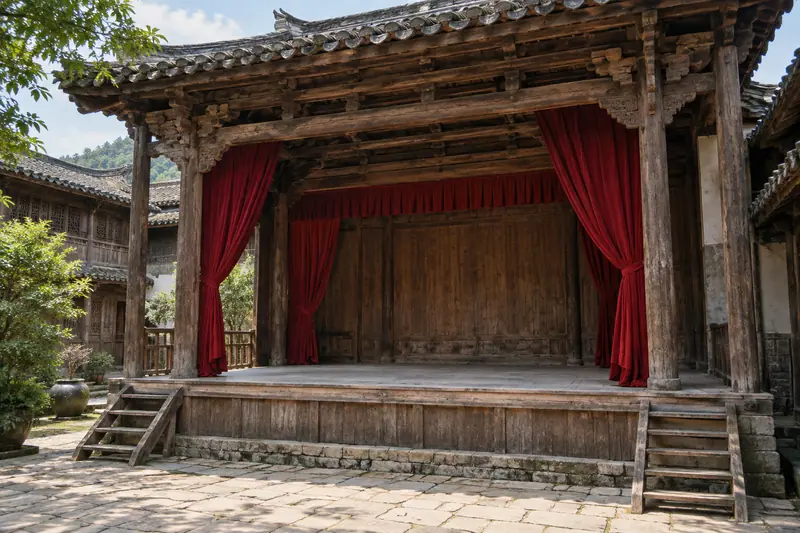
The temple faces south and covers about 3,163 square metres of floor space. The stage faces north, with its platform thrust forward, and has a bell tower on its east side and a drum tower on its west. Its beams carry openwork woodcarvings of eighteen Three Kingdoms operas, among them Changban Slope (长坂坡), the Empty Fort Strategy (空城计) and Huarong Trail (华容道), and the caisson ceiling holds nine painted panels. The paint was applied with a flat-colouring method that is no longer practised, which is why faded patches have been left unretouched.
The gate is a three-tier archway of water-polished brick. On a few dozen square metres of wall there are 52 carved scenes with 115 figures, 33 birds and 67 animals, drawn from operas and folk tales such as Three Visits to the Thatched Cottage (三顾茅庐) and the Legend of the White Snake (白蛇传). The work is described as Shanxi-school miniature carving, with some figures no bigger than a peanut. The temple stands inside the Beiguan historic district, which holds 36 protected sites at national, provincial, city and district level, including the Nanjing Lane money shop (南京巷钱庄).
What to look for
- The gate's brick-carved facade: 52 scenes with 115 figures, 33 birds and 67 animals
- Openwork woodcarvings of eighteen Three Kingdoms operas on the stage beams
- Nine painted panels in the stage's caisson ceiling, including "Dragon and Phoenix Bring Good Fortune" (龙凤呈祥)
- A pair of iron flagpoles more than 16 m tall, cast in five sections with trigram and coiled-dragon patterns and hung with iron wind bells; the base inscription dates them to 1821 and names Shaanxi medicinal merchants as donors
- A pair of iron cranes standing on turtles, about 3 m tall, cast in 1694, in front of the main hall
- The bell tower, whose surviving bell is cast with the date Kangxi 2 (1663)
- Yue Wumu Wang Temple (岳武穆王庙), a Kangxi-era shrine to Yue Fei (岳飞) on the east side, with kneeling stone figures of Qin Hui (秦桧) and his wife
- Zhugong Academy (朱公书院), a shrine founded in 1698 to the Kangxi-era Bozhou magistrate Zhu Zhilian (朱之琏)
Location & getting there
Getting to Huaxilou
- Confirm the visitor entrance and access to the named areas before departure.
Combine your visit
A suggested sequence through the named features described in the source.
-
Theatre precinct
Begin with the theatrical architecture supported by merchant patrons.
-
Guandi Temple and guild-hall setting
Connect the theatre with the religious and commercial functions of the guild hall.
The order is an editorial suggestion. Internal opening arrangements and transfers between sectors need checking; no walking duration or access entitlement is implied.
Find Huaxilou
花戏楼 · 亳州市
The pin marks the area, not the entrance.
More places nearby
Approximate straight-line distances between map pins, not travel distances.
Linhuan City Site 临涣古城遗址
75 km awayLinhuan’s earthen city remains reveal the outline of a fortified settlement that relied partly on the Hui River for defence. Wall sections survive on the east, north and west, with traces of a moat outside them; the river…
View guide →Liuzi Canal Wharf Site 柳孜运河码头遗址
77 km awayLiuzi preserves part of the Tongji Canal, a major route through northern Anhui in the Sui and Tang canal system. Stone structures first described as a wharf are now interpreted as likely bridge supports, showing how excavation…
View guide →Suixi Old Street Ancient Building Complex 濉溪老街
93 km awaySuixi Old Street follows a narrow strip of staggered bluestone paving through the old county centre. Traditional shopfronts and houses from several later imperial and Republican periods line the route, giving it a layered…
View guide →Sources & visit information
Written from the linked sources and fact-checked against them on 2026-09-23. Opening hours, admission and access arrangements are not covered; confirm current visitor information with the site.
Some facts checked against Wikipedia contributors, "花戏楼" · CC BY-SA 4.0.
Image credits & notes (1)
- Huaxilou in Bozhou, photographed in February 2026 · 亳州花戏楼 Photograph date recorded by the source: 10 February 2026, 17:07:49.Photo: Windmemories · CC BY-SA 4.0Resized for the web; the photo itself has not been edited. Thumbnails may show a cropped view.
