

Explore the region
Tap any red Chinese text to hear it in Mandarin.
Why visit
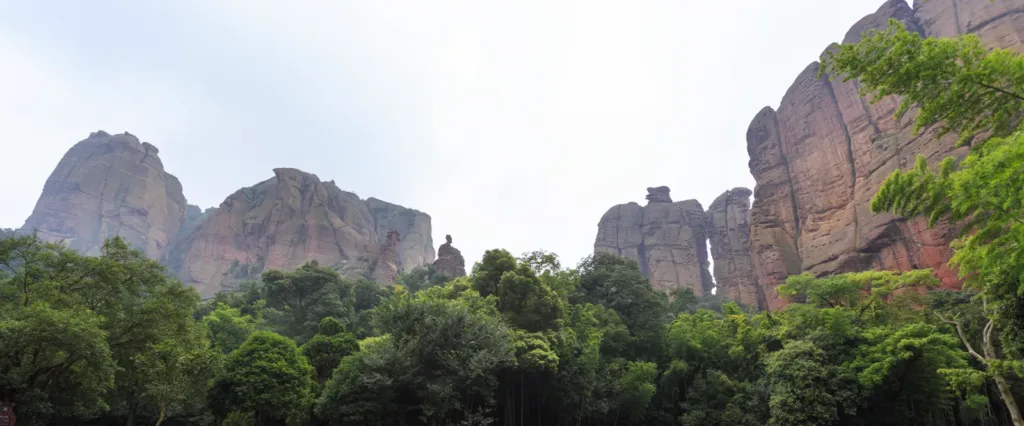
Guifeng works best as a half-day or full-day mountain visit, not as a quick photo stop in central Shangrao. The landscape keeps returning to the same visual idea: red-rock forms that resemble turtles, but in different scales and stages. The operator describes the scenic area as a 36-peak, 72-view landscape, with narrow passages, caves, natural bridges and isolated pillars spread through a managed mountain area.
The geological setting is worth stating precisely. UNESCO describes the larger Longhushan UNESCO Global Geopark as integrating Longhushan, Xiangshan and Guifeng parks. That is different from calling Guifeng a separately named component of the UNESCO World Heritage property China Danxia: UNESCO’s World Heritage page lists six component areas and names Longhushan, but does not list Guifeng as a standalone component. Guifeng is still a strong place to read Danxia erosion at walking scale, with paths that bring the rock walls, gaps and vegetation close enough to compare rather than merely view from a distance.
What to look for
Start by looking for the turtle forms that gave 龟峰 its name. Then compare the shapes that erosion leaves behind: a narrow slit of sky at 一线天, larger rock walls and pillars, and caves or openings where water and weathering have removed softer material. The operator also lists 回声谷 and several named rock forms; names are a prompt to inspect the outline, not a promise that every named feature will be open on every visit.
Set aside time for the human layer. 南岩寺 is built into a natural cave and is described by the operator as having more than 40 carved stone niches. The site also has a long sequence of 摩崖石刻, including the “一线天” inscription dated to 1626 and carvings around 振衣台 and the route toward 一线天. Look at how the lettering follows the rock rather than treating the inscriptions as scenery detached from the cliff.
Stay on signed and currently open paths. Steep steps, uneven rock and wet surfaces can change how far a route feels, and a broad map pin does not identify every trailhead or internal sector. Keep the return connection in mind before choosing a longer loop.
Tickets, entry and transport
The operator page identifies the scenic-area visitor centre as the ticket collection point, but it does not provide a dependable current opening timetable or a current price list. A Qunar guide published on 15 July 2026 listed an adult admission ticket of RMB 60, a sightseeing-bus ticket of RMB 20 and a boat ticket of RMB 80. Treat those as dated reference figures, not guaranteed current prices or proof that a package includes every service.
A 24 September 2026 reservation notice attributed to Shangrao Guifeng Scenic Area required advance reservation during the National Day holiday through Douyin, Ctrip, Meituan or Tongcheng, with entry by personal ID or a booking QR code. The notice does not establish the process for a foreign passport. International visitors should ask the operator or booking platform specifically about passport booking, payment and gate verification before relying on an online reservation.
By rail and bus: Take the train to 弋阳站 (Yiyang Station), then look for 公交 2路 toward 龟峰景区. Qunar’s July 2026 guide lists the ride at about 30 minutes and RMB 3, and also mentions a Guifeng shuttle bus taking about 35 minutes; it gives no dependable departure timetable. The operator’s own page also links the railway station with route 2 but gives a different 15-minute estimate. Keep the route number, but verify the day’s stop, last departure and return connection locally.
A 16 October 2026 report also described a direct bus connection from Shangrao’s high-speed-rail hub and a double-decker tourist bus serving Guifeng, but it did not publish a route number or timetable. Do not build a same-day itinerary around that service without checking its current departure information.
By taxi or ride-hailing: Give the driver the Chinese destination 弋阳龟峰景区游客中心 Yìyáng Guīfēng Jǐngqū Yóukè Zhōngxīn rather than simply “Shangrao.” The operator uses the visitor centre as the ticket point, and Amap places an internal Guifeng scenic-area point beside 龟峰大道; confirm the actual visitor-centre drop-off with the driver and the venue on the day.
There is no useful city-centre metro leg for this mountain visit. Confirm the visitor entrance, trail status, sightseeing-bus or boat operation and the last way back before entering. The boat is a separate paid item in the dated Qunar listing, but I found no reliable current boarding point or return schedule, so do not assume a particular water route is operating.
Combine your visit
A suggested sequence through the named features described in the source.
-
Turtle-shaped rock scenery
Examine Turtle-shaped rock scenery as a separate part of Guifeng.
-
Danxia pillars and natural-bridge route
Pillars, natural bridges and caves display different stages and forms of Danxia erosion.
-
Cliff inscriptions
Examine Cliff inscriptions as a separate part of Guifeng.
The order is an editorial suggestion. Internal opening arrangements and transfers between sectors need checking; no walking duration or access entitlement is implied.
Find Guifeng
龟峰 · 上饶市
The pin marks the area, not the entrance.
More places nearby
Approximate straight-line distances between map pins, not travel distances.
Shangqing, Jiangxi 上清古镇
47 km awayShangqing’s old-town visit centres on the Celestial Master’s Mansion, the traditional residence and ritual complex of the Zhang lineage of Daoist masters. Its sequence places ceremonial halls towards the front and residential…
View guide →Longhu Mountain 龙虎山
50 km awayLonghu Mountain combines red sandstone cliffs with a river landscape and the religious centres of Zhengyi Daoism. Around Xianshuiyan, cavities in the cliff faces are associated with ancient suspended burials; in Shangqing, the…
View guide →Shangrao Museum 上饶博物馆
55 km awayShangrao Museum draws attention to crafts and scholarship rooted in northeastern Jiangxi. Its collection includes finds from Song-period She inkstone workshops and Raozhou bronze mirrors, alongside material on early rice…
View guide →Sources & visit information
Sources checked on 1 November 2026. Hours, tickets, reservations and transport can change; confirm with the operator before you go.
Image credits & notes (1)
- Danxia rock walls and pillars rising above the forest at Guifeng Scenic Area, Yiyang County, Jiangxi. Photo: ZhangzhugangPhoto: CC BY-SA 4.0