

Explore the region
About Shangqing, Jiangxi
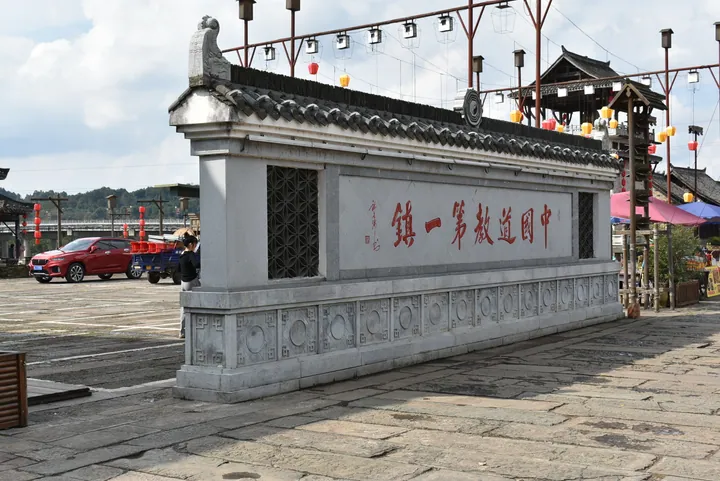
Its sequence places ceremonial halls towards the front and residential spaces farther within. The entrance gateway, large bronze bell and Yu Huang Hall provide specific details to study. Parts have been rebuilt in modern times, so the site records a continuing religious tradition as well as surviving older architecture.
Tianshi Mansion was first built in the fourth year of the Chongning era (崇宁) of the Northern Song dynasty (1105), originally at Guanmenkou (关门口) in Shangqing town. It was moved to its present site in the sixth year of the Yuan Yanyou era (延祐, 1319) and rebuilt at the centre of Shangqing town in the first year of the Ming Hongwu era (洪武, 1368). It was burned down during military unrest in the Qing Kangxi era; most surviving buildings are modern reconstructions, with some dating from the Ming and Qing dynasties. In 1983 the State Council designated it a National Key Daoist Temple (道教全国重点宫观).
What to look for
- The Celestial Master’s Mansion gateway and large bronze bell.
- Yu Huang Hall and the transition from ceremonial to residential courtyards.
Background & history
Shangqing (Chinese: 上清; pinyin: Shàngqīng) is a town under the county-level city of Guixi, in the municipal region of Yingtan, Jiangxi. It is a small stop on a major railroad – the Fuzhou branch line from the Yingtan junction on the Nanchang—Shanghai line. Most visitors will be touring the nearby Mount Longhu, a Daoist holy mountain.
Excerpt from Wikipedia: Shangqing, Jiangxi · Wikipedia contributors · CC BY-SA 4.0. Selected introductory sentences; formatting simplified. Background information, not current visitor-service advice.
Location & getting there
Getting to Shangqing, Jiangxi
Go to the Celestial Master’s Mansion in central Shangqing Town, Guixi, within the wider Longhushan region. Arrange a road or scenic-area transfer to Shangqing itself rather than stopping at the separate main mountain visitor centre.
Combine your visit
A suggested sequence linking the specific features of this visit.
-
Mansion gateway and bell
Begin with the formal entrance and the historic bronze object.
-
Yu Huang Hall
Continue into the principal ceremonial part of the complex.
-
Residential courtyards
Where open, compare the household spaces with the front ritual halls.
This order is editorial. Confirm access and any transfers between stops; it does not establish a walking route, same-day connection or common admission ticket.

Find Shangqing, Jiangxi
上清古镇 · 鹰潭市
The pin marks the area, not the entrance.
More places nearby
Approximate straight-line distances between map pins, not travel distances.
Longhu Mountain 龙虎山
8 km awayLonghu Mountain combines red sandstone cliffs with a river landscape and the religious centres of Zhengyi Daoism. Around Xianshuiyan, cavities in the cliff faces are associated with ancient suspended burials; in Shangqing, the…
View guide →Mount Dajue 大觉山
40 km awayDajue Mountain in Zixi combines forested hills with a temple set in a large rock cave. The cave shrine is the clearest cultural feature, while the canyon below supports the scenic area’s rafting activities. These offer quite…
View guide →Guifeng 龟峰
47 km awayGuifeng near Yiyang is named for rock formations that resemble turtles. Its Danxia landscape includes clusters of peaks, isolated pillars, natural bridges and caves.
View guide →Sources & visit information
The linked encyclopedia sources support background and place descriptions. Current opening hours, ticket prices, booking rules and transport schedules have not been independently verified for this guide. Confirm them with the venue or operator before travelling.
Visitor information adapted and edited from Wikipedia contributors, “嗣汉天师府” · CC BY-SA 4.0. Source revision 94055726.
Background paragraphs translated and condensed from Wikipedia contributors, "嗣汉天师府", Chinese Wikipedia · CC BY-SA 4.0. Source revision 94055726.
