

Shoubarou 手把肉
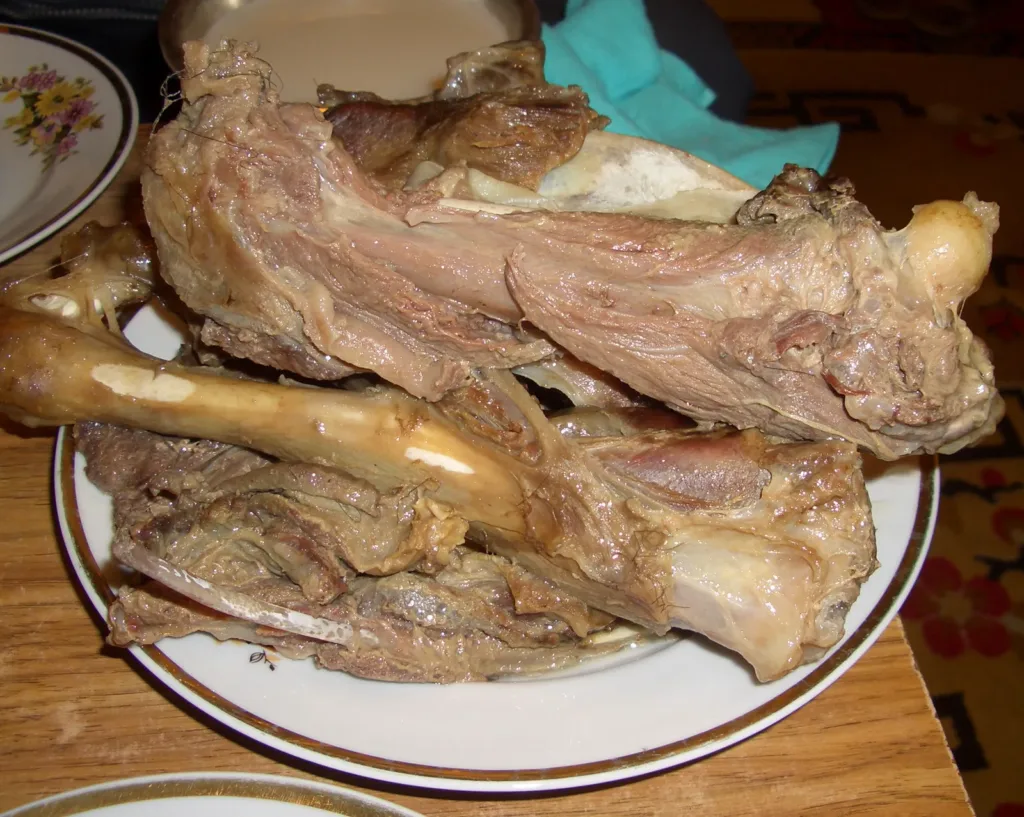
Shoubarou is Hulunbuir’s hand-held mutton: bone-in sheep meat simmered simply in water and eaten from the bone, with the meat itself kept at the centre of the meal. Local kitchens may serve a dipping condiment such as chive-flower paste.
Tap any red Chinese text to hear it in Mandarin.
Shoubarou is Hulunbuir’s hand-held mutton: bone-in sheep meat simmered simply in water and eaten from the bone, with the meat itself kept at the centre of the meal. Local kitchens may serve a dipping condiment such as chive-flower paste.
What arrives at the table
The defining preparation is plain rather than heavily seasoned. A Xinhua report on Hulunbuir describes sheep meat divided along the joints, placed in a large pot and cooked in its own juices without salt or other seasonings. The meat is then served with a prepared dipping condiment. An Inner Mongolia News account gives the same bone-in, joint-cut method and describes holding the bone in one hand while using a Mongolian knife to remove the meat.
This is not a thin skewer or a boneless stir-fry. Expect substantial pieces with bone, and possibly richer fatty sections. The cut and portion depend on the kitchen. A current guide from Eerguna, a city within Hulunbuir, describes a local version using rib and leg meat simmered in water, with chive-flower paste on the side; treat that as a local serving pattern, not a single rule for every restaurant.
Why it belongs on a Hulunbuir food list
Shoubarou is part of the region’s pastoral food culture rather than a dish invented by one urban restaurant. Xinhua calls it a traditional food of the Mongolian communities of Hulunbuir and describes it as a customary evening meal in pastoral life. A regional food account also places hand-held mutton among the long-standing foods of the Hulunbuir grasslands and neighbouring pastoral or hunting communities, including Ewenki, Daur and Oroqen communities.
The point of ordering it is therefore the combination of cut, simple cooking and communal handling. The dish name is often written 手把肉 Shǒubǎròu; you may also see the near-synonym 手扒肉 Shǒupáròu in Chinese descriptions. The two labels refer to the same broad hand-held mutton tradition here, but individual kitchens can still differ in cuts, broth and condiments.
How to order and eat it
Keep 手把肉 Shǒubǎròu ready to show staff. Ask which cuts are being served, whether the platter is bone-in, and what dipping sauce comes with it. At the table, hold the bone and strip the meat with the supplied knife; a salt-water dip or house condiment is common, but the seasoning is not a fixed recipe.
Shoubarou is not a single venue, so search for 手把肉 Shǒubǎròu on Meituan (美团) or Amap / Gaode Maps (高德地图) around your current location. Read the menu, recent reviews and opening information, then check whether the kitchen has it available that day. Do not treat search ranking as proof of quality, and do not assume that a restaurant listed under the name serves the same cuts or seasoning.
For a pastoral-host experience rather than a city restaurant, confirm the exact host, meal timing and return arrangement before setting out. A 2026 Hulunbuir government report describes visitors eating freshly made hand-held meat in a ranch-and-herder-household tourism setting in New Barag Right Banner, but it does not establish one universal venue, entrance or timetable.
Dietary notes
This is a mutton dish and is not vegetarian. Bone and fatty pieces may be part of the serving, while the dipping sauce can vary. If you have allergies or avoid particular meats, ask about the cuts, cooking liquid and condiment before ordering. There is no single address or transport route for the dish: your return journey is from the restaurant or host you actually choose, so confirm that venue’s map pin and closing time on the day.
More dishes to compare
Explore related local specialties and compare their names, preparation notes and ordering guidance.
Tuoketuo stewed fish 托县炖鱼 →
Freshwater fish is cut or cooked whole in a seasoned stew, allowing its flesh and bones to flavor the cooking liquid. Local kitchens choose different combinations of aromatics and chili. The fish is tender, with a rich broth that can be spooned over bread or rice. Bone structure depends on the species and cannot be assumed away.
Xilingol stone-cooked lamb 石头烤肉 →
Lamb pieces are cooked in a covered vessel with heated stones, using the stones to transmit heat through the meat. The exact arrangement and accompanying vegetables depend on the restaurant. The meat becomes moist and concentrated in flavor, with fatty juices coating the other ingredients. It is not the same texture as a thin grilled skewer.
Sources & reading
Recipes and servings vary between kitchens.
Image credits & notes (1)
- Chanasan makh (boiled bone-in mutton) at a family meal in Ulaanbaatar, Mongolia; a regional reference for Hulunbuir shoubarou, not a Hulunbuir photograph. Photo: Mizu_BasyoPhoto: CC BY-SA 3.0