

Explore the region
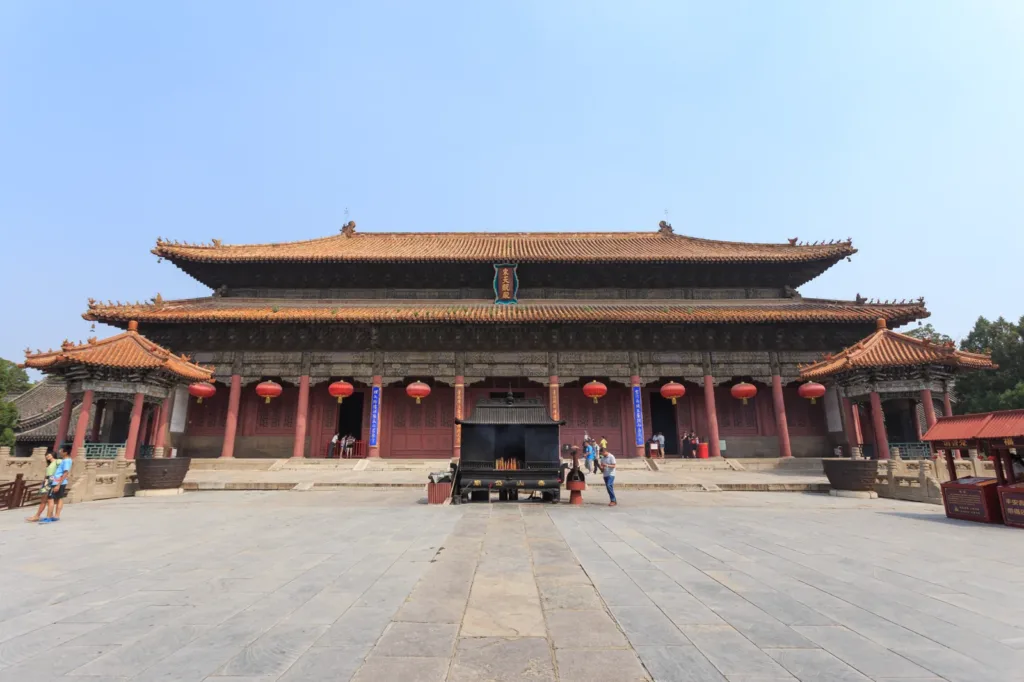
Dai Temple is not the summit area of Mount Tai. It is the urban ritual counterpart of the mountain: a walled complex laid out like an imperial palace, where emperors and officials once prepared for or performed ceremonies to the God of Mount Tai. UNESCO places this temple within Mount Tai’s nearly two-thousand-year imperial cult and identifies the 1009 painting in the Temple to the God of Taishan as a major artistic work.
Begin at the southern ceremonial approach. Yaocan Pavilion and the Dai Temple archway lead towards Zhengyang Gate (正阳门), then the central courtyards open onto the main hall. The side courts are quieter and more varied: one contains old Han cypresses, another holds stone inscriptions and the East Imperial Seat, while the museum displays add objects and texts to the outdoor architecture. The result is a visit that moves between ritual space, a tree-filled garden and a compact history of Mount Tai rather than a single hall viewed in isolation.
What to look for
Tiankuang Hall and its mural
The main building is Tiankuang Hall (天贶殿), a Northern Song hall built in 1009 and covered by a yellow glazed roof. On its east, north and west walls is the large mural usually translated as The God of Mount Tai Making a Journey, showing the deity’s departure and return. The mural is more than three metres high and about 62 metres long; UNESCO dates the work to 1009. Stand back where permitted so that the procession reads as a continuous wall rather than a collection of isolated figures.
Gates, inscriptions and old trees
Read the complex from south to north: the reconstructed Zhengyang Gate, the formal courtyards and then the raised terrace of Tiankuang Hall. In the East Imperial Seat area, look for the Qin Taishan Stone, a heavily surviving but fragmentary early inscription. The temple’s stele forest preserves inscriptions from different periods, and the old Han cypresses and Tang locust trees show how the sacred landscape was carried into the living grounds.
The site is also associated with Tai’an Museum. Museum galleries and historic buildings do not always share the same access arrangements, so check the current notice if an indoor collection is a main reason for your visit.
Tickets and timing
A 2026 local visitor notice attributed to Tai’an’s culture and tourism authorities reports a Dai Temple ticket of CNY 20, with a student concession and free entry for visitors aged 60 or over; it gives 08:00–18:00 as the current reference opening span and 17:30 as the last entry time. The operator’s published service guide is older, lists seasonal hours and explicitly says that the times are for reference. Treat both as planning information and confirm the day’s notice before setting out.
Do not assume that a Mount Tai mountain ticket, a mountain reservation or a cable-car product is automatically the same as a Dai Temple admission. The official service guide says that its Mount Tai ticket could include Dai Temple, while the same guide lists a separate Dai Temple ticket; the product and conditions should be checked at the time of purchase. A 2024 mountain notice requiring timed entry with a resident identity card concerns Mount Tai’s mountain routes and is not evidence of a passport-specific Dai Temple procedure.
Location and getting there
Use the Chinese destination 岱庙(正阳门), at 山东省泰安市泰山区东岳大街191号. Zhengyang Gate is the southern ceremonial entrance; the complex also has a northern gate, so make the gate clear when arranging a car or asking for directions.
Tai’an has two separate railway gateways. 泰山站 (Taishan Railway Station) is the conventional railway station near the older urban area. An official Tai’an travel guide says that buses 4 and 15 run from Taishan Station to Dai Temple’s south gate; a newer city tourism guide lists K3, K4 and K39 among the buses serving Dai Temple. Check the live stop name and direction before boarding because route labels and stopping patterns can change.
泰安站 (Tai’an Station) is the high-speed railway station and is not the same station as Taishan Station. The transport authority says tourist routes link the high-speed station, Dai Temple and the Taishan historic axis. A 2026 Tai’an Bus notice records 游2路 running from 高铁泰安站 via Taohua Valley and Tianwai Village to 岱庙广场, then returning to 高铁泰安站; confirm that the normal service is running on your date rather than relying on the event-day notice.
The same transport authority identifies 游4路 as a link between 岱庙 and 泰山火车站, while 游5路 also serves 岱庙广场 as part of a wider tourist route. For the return journey, use the signed stop in the reverse direction; the 游2 notice explicitly states the return to 高铁泰安站, but other tourist routes should be checked at the stop. If taking a taxi or ride-hailing car, show 岱庙,泰安市泰山区东岳大街191号,正阳门 rather than just “Mount Tai”.
There is no need to combine this urban visit with the mountain ascent. If you are continuing to Mount Tai, confirm the chosen mountain entrance separately: the historic pilgrimage route begins from the city-side Dai Temple area, but the mountain’s timed entry, shuttle buses and cable cars are different services.
Combine your visit
A suggested sequence linking the specific features of this visit.
-
Zhengyang Gate and central courtyards
Follow the formal approach into the temple complex.
-
Tiankuang Hall
Focus on the principal hall and its Taoist mural.
-
Stele and ancient-tree courts
Read the inscriptions and examine the older landscape around the halls.
This order is editorial. Confirm access and any transfers between stops; it does not establish a walking route, same-day connection or common admission ticket.
Find Dai Temple
岱庙 · 泰安市东岳大街191号岱庙正阳门
The pin marks the area, not the entrance.
More places nearby
Approximate straight-line distances between map pins, not travel distances.
Mount Tai 泰山
7 km awayMount Tai’s ascent is layered with gateways, inscriptions and shrines reflecting its long role in imperial and popular worship. Near the upper mountain, Nantianmen marks a dramatic transition into the summit precinct. Bixia…
View guide →Lingyan Temple 济南灵岩寺
23 km awayLingyan Temple lies in the hills of Changqing, where a major Buddhist complex survives around halls, a pagoda and a burial stupa forest. The Thousand Buddha Hall is especially known for its painted arhat figures, whose varied…
View guide →Thousand Buddha Mountain 千佛山
50 km awayThousand Buddha Mountain rises above southern Jinan with Buddhist carvings cut into its northern slopes. Xingguochan Temple stands partway up the hill, and the cliff behind it retains Sui-period images and small caves. Nearby…
View guide →Sources & visit information
Sources checked on 25 October 2026. Hours, tickets, reservations and transport can change; confirm with the operator before you go.
Image credits & notes (1)
- Tiankuang Hall (天贶殿), the main hall of Dai Temple in Tai'an, Shandong Photo: ZhangzhugangPhoto: CC BY-SA 4.0