

Explore the region
Tap any red Chinese text to hear it in Mandarin.
Why this place matters
Temple of Mencius is in southern Zoucheng, a county-level city administered by Jining—not in Qufu. Jining’s administrative division page lists Zoucheng among the county-level cities it administers, while the city’s culture bureau places the temple in the southern part of the Zoucheng urban area. That distinction matters when choosing a railway station and when planning a day around Qufu’s separate Three Confucian Sites.
The temple is a place of commemoration for Mencius, the Confucian thinker known as the “Second Sage” after Confucius. It belongs to the wider Three Meng landscape with the Meng family mansion and Meng Forest, but those are different places: the mansion presents the household and official life of Mencius’s descendants, while the forest is the family cemetery outside the urban core.
What to look for
Walk slowly through the five courtyards rather than treating the site as a single hall. The central axis leads toward the Hall of the Second Sage (亚圣殿), a seven-bay, double-eaved xieshan-style building with a green glazed-tile roof. The hall is the visual and ritual focus of the complex. The surrounding buildings, gate towers and side halls make the layout legible as a ceremonial institution, not simply a historic residence.
The stonework is part of the visit. The Jining culture bureau records more than 280 stelae and stone inscriptions, whose subjects include imperial honours, the Meng genealogy, rebuilding accounts and poems. Nearly 300 old trees—many planted in the Song and Yuan periods—give the courtyards a shaded, uneven rhythm that is easy to miss if you hurry from gate to hall.
The temple’s chronology is layered. The World Bank’s heritage account dates the Mencius Temple tradition to 1037 and describes a major Qing reconstruction around 1672; the Jining culture bureau says that the temple moved to its present site in 1121 and reached its present scale by 1715. Read the dates as stages in a long ritual and architectural history, not as a claim that every surviving building belongs to one period.
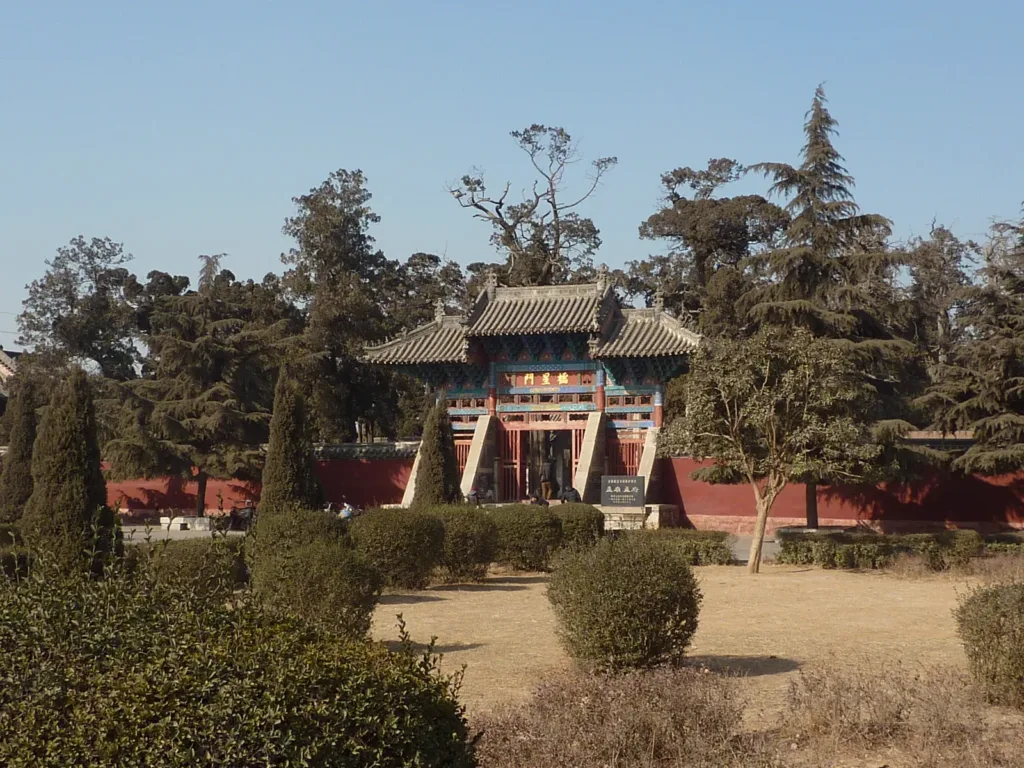
A published educational route for the wider complex starts at 棂星门 and continues to 亚圣殿 before crossing to the Meng Mansion. This is a useful set of Chinese names to keep on your phone, but it is an educational itinerary rather than a guarantee that every gate, building or activity is open on your date.
Planning the visit
For a taxi or ride-hail, show 孟庙孟府景区,山东省邹城市亚圣路1498号. That address is listed by China’s national student research-education platform for the combined site. The exact vehicle drop-off point and which gate is being used for general visitors were not confirmed in the current sources read here, so follow the on-site signs for the separate temple entry rather than assuming that a map pin marks the gate.
Current opening hours, ticket products, reservation steps and passport-specific entry arrangements should be checked with the venue before setting out. A historical notice about special free admission is not a current general ticket rule. Allow time for the temple itself; add the Meng Mansion only if both spaces are open and your ticket or reservation covers them. Do not describe Meng Forest as an extension of the same courtyard visit: it is a separate cemetery site outside the urban temple area.
Getting there and back
The most directly documented local connection is Zoucheng Bus 2, reported in September 2026 as a trial tourism loop linking 邹城火车站 (Zoucheng Railway Station) and 邹城汽车站 (Zoucheng Coach Station) with the Meng Temple–Meng Mansion stop and Mount Yi. Use the Chinese stop name 孟庙孟府 Mèng Miào Mèng Fǔ and check the current direction and last departure with the operator before boarding. The operator’s public consultation page lists 0537-5257518 and the 邹城公交 Zōuchéng Gōngjiāo website for route enquiries. Because the published route was still described as trial service, confirm the return direction to the same railway or coach hub rather than assuming a late service.
If your ticket says 曲阜东站 (Qufu East Railway Station), do not confuse it with 邹城站 Zōuchéng Zhàn. The current source set read for this guide did not verify a routine Qufu East–Meng Temple shuttle; a 2026 report mentions a free connection tied to a specific music-festival event, not a permanent visitor route. Check an onward coach or taxi before leaving the high-speed station, and give the driver the Chinese destination and full address above. There is no metro service documented for this suburban city visit.
Combine your visit
A suggested sequence through the named features described in the source.
-
Temple of Mencius
The temple commemorates the Confucian philosopher Mencius.
-
Meng family mansion
The Meng family mansion adds the household dimension to the ceremonial site.
The order is an editorial suggestion. Internal opening arrangements and transfers between sectors need checking; no walking duration or access entitlement is implied.
Find Temple of Mencius
孟庙 · 济宁市
The pin marks the area, not the entrance.
More places nearby
Approximate straight-line distances between map pins, not travel distances.
Confucius Temple, Qufu 曲阜孔庙
23 km awayQufu’s Temple of Confucius develops through a long sequence of gates and courtyards toward Dacheng Hall. Its carved dragon columns provide a close-up counterpoint to the scale of the ceremonial buildings. Earlier in the…
View guide →Kong Family Mansion 孔府
23 km awayThe Kong Family Mansion reveals the household and official life of Confucius’s descendants beside the temple they served. Its layout moves from formal administrative halls in front to domestic quarters and a garden behind. This…
View guide →Cemetery of Confucius 孔林
25 km awayThe Cemetery of Confucius is a wooded family burial ground north of Qufu, containing the sage’s grave and those of generations of descendants. Stone animals, officials and turtle-supported steles mark individual approaches among…
View guide →Sources & visit information
Sources checked on 25 October 2026. Hours, tickets, reservations and transport can change; confirm with the operator before you go.
- 行政区划 ↗
- 济宁市全国重点文物保护单位之六孟府、孟庙和孟林 ↗
- China: Heritage Sites of Confucius and Mencius Restored to Glory, Better Life for Local Communities ↗
- 山东省邹城市孟庙孟府孟林景区 ↗
- 邹城“孟庙孟府—峄山”旅游公交(试运行)正式开通 ↗
- 邹城市国运公共交通有限公司信息咨询 ↗
- 山东邹城:推动文旅“流量”向城市“留量”转化 ↗
- 关于孟庙孟府景区面向孟氏后裔免费开放的公告 ↗
- Gallery: Visiting Mencius Family Mansion and Temple to Achieve Qi and Erudition ↗
Image credits & notes (1)
- Lingxing Gate, the outer southern gate of the Temple of Mencius / Mencius Mansion complex in Zoucheng. Photo: Vmenkov (Wikimedia Commons)Photo: CC BY-SA 3.0