

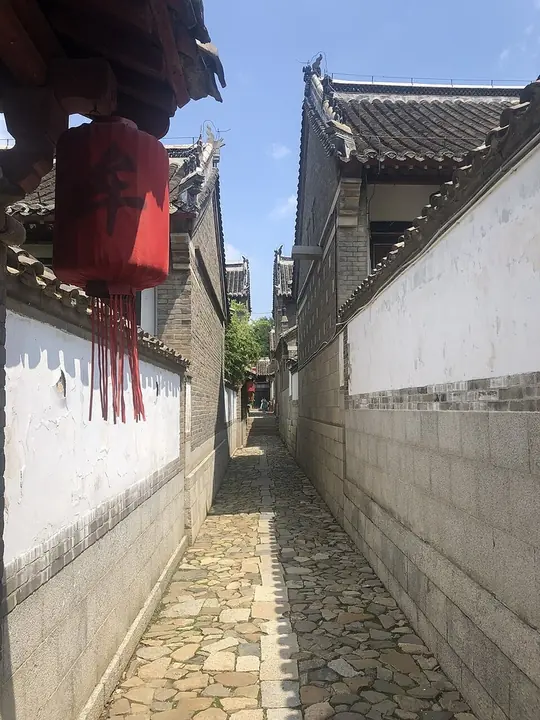
Photo adjustments
Full frame retained; proportionally resized and converted to WebP. No retouching or changes to the photographed subject. Card displays may crop the view.
Explore the region
About Mou Family Manor
Its surviving buildings form three groups and six named compounds. Rather than a single mansion around one yard, each compound extends through several successive courtyards, giving the visit a rhythm of gateways, enclosed spaces and domestic buildings. Comparing these repeated layouts makes the scale of an extended family estate tangible.
The Mou family originally came from Gong'an County in Hubei; the first-generation ancestor, Mou Jingzu (牟敬祖), settled in Guzhendu village after being appointed registrar of Qixia County in the third year of the Ming Hongwu era (1370). The tenth-generation Mou Guolong (牟国珑), a jinshi (进士) of the Kangxi era, began acquiring land and building the family residence after being dismissed from office on false charges, and he established 'farming and reading' (耕读) as the family's guiding ethic. By the fourteenth generation, Mou Molin (牟墨林, styled Songye, 1789-1870) had amassed extensive landholdings and wealth, and local people nicknamed the estate the 'Mou Erheizi Manor' (牟二黑子庄园) after him.
Construction of the manor began in the first year of the Yongzheng era (1723) and was essentially complete by 1935, with a total floor area of more than 20,000 square meters. Built in the courtyard-cluster style characteristic of Jiaodong housing, it forms three groups of six named compounds, each made up of several nested traditional courtyard houses (四合院) four to six courtyards deep, and it is described as the largest and most completely preserved feudal landlord estate in northern China.
What to look for
- Dong Zhonglai, one of the named compounds within the manor’s three-group arrangement.
- Rixintang and the nested courtyard layout, with several successive yards forming each residential compound.
Location & getting there
Getting to Mou Family Manor
Travel to Guzhendu Village at the northern end of Xiaguang Third Road in Qixia. The manor is in Qixia’s town area, separate from coastal Yantai; use the Mou Family Manor destination rather than the unrelated Yantai MixC shopping-centre address found in some older listings.
Combine your visit
A suggested sequence linking the specific features of this visit.
-
Dong Zhonglai
Begin by following the sequence from the outer entrance into the residential courtyards.
-
Rixintang
Compare another named family compound and the repetition of enclosed courtyard spaces.
This order is editorial. Confirm access and any transfers between stops; it does not establish a walking route, same-day connection or common admission ticket.
Find Mou Family Manor
牟氏庄园 · 山东省烟台市栖霞市牟氏庄园(定位锚点为景区同名公交站)
The pin marks the area, not the entrance.
More places nearby
Approximate straight-line distances between map pins, not travel distances.
Changyu Wine Culture Museum 张裕酒文化博物馆
56 km awayThe Changyu Wine Culture Museum occupies the company’s historic Yantai site, connecting the story of its 1892 founding with the physical spaces of wine production. Its underground cellar is the strongest architectural feature…
View guide →Yantai Hill Park 烟台山
56 km awayYantai Hill forms a small coastal headland above the old waterfront, with a lighthouse rising among trees and former consular buildings. The buildings reflect the city’s period as a treaty port, while the paths connect them with…
View guide →Penglai Pavilion 蓬莱阁
57 km awayPenglai Pavilion crowns Danya Hill above the coast, within a cluster of shrines and halls rather than standing alone as a single tower. Tianhou Palace, Lüzu Hall and other religious buildings link maritime worship with Taoist…
View guide →Sources & visit information
The sources below support the place-specific description and arrival information. Suggested combinations are editorial planning ideas; confirm current opening, entry arrangements and transport services for your date.
Visitor information adapted and edited from Wikipedia contributors, “牟氏莊園” · CC BY-SA 4.0. Source revision 92194450.
Background paragraphs translated and condensed from Wikipedia contributors, "牟氏莊園", Chinese Wikipedia · CC BY-SA 4.0. Source revision 92194450.