

Photo adjustments
Proportionally resized and converted to WebP without cropping, retouching or changing the photographed subject.
Explore the region
About Penglai Pavilion
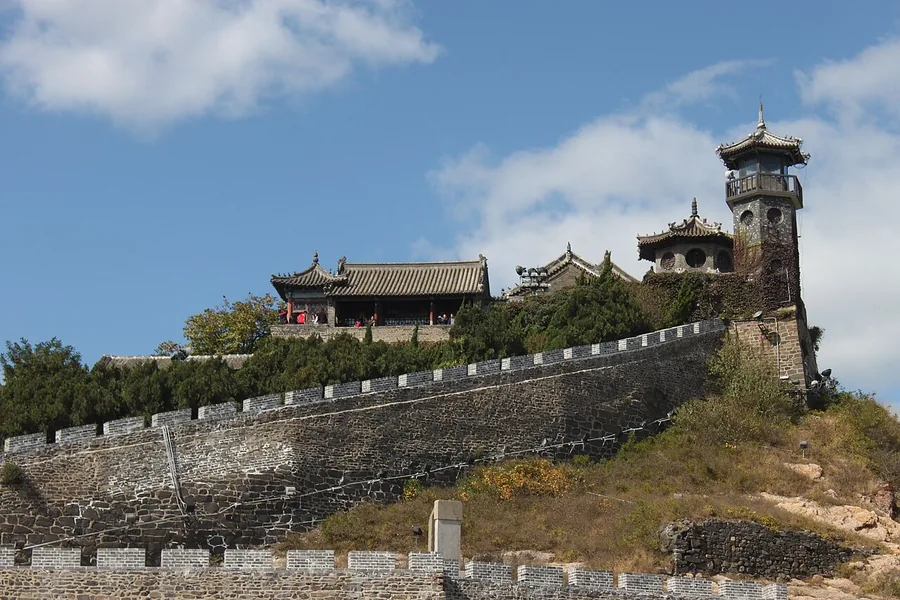
Tianhou Palace, Lüzu Hall and other religious buildings link maritime worship with Taoist stories. Inscriptions and carved couplets reward a closer look between the sea views. The Eight Immortals legend is part of the site’s cultural appeal; the pavilion’s coastal setting is tangible even when the celebrated mirages do not appear.
Penglai Pavilion was first built in 1061, the sixth year of the Jiayou era (嘉佑六年) of the Northern Song dynasty. It is counted, together with Yellow Crane Tower (黄鹤楼), Yueyang Tower (岳阳楼) and Tengwang Pavilion (滕王阁), among the 'Four Great Towers of China', although an alternative listing replaces it with Stork Tower (鹳雀楼), since the pavilion is sometimes excluded because it lacks an associated literary work.
The scenic area combines the pavilion with five further structures, including Sanqing Hall (三清殿) and Mituo Temple (弥陀寺), together with their subsidiary buildings, covering 18,900 square meters on Danya Hill above the coast. The dividing line between the Yellow Sea and the Bohai Sea is marked and visible from the site, and the surrounding tourism area is classified as a AAAAA scenic area by the China National Tourism Administration.
What to look for
- The pavilion and inscribed architectural details on coastal Danya Hill.
- Tianhou Palace and the surrounding temple courtyards dedicated to different traditions.
Location & getting there
Getting to Penglai Pavilion
Approach the Penglai Pavilion scenic area on the Danya Hill waterfront, using its signed east entrance or the Zhenyang Gate approach through Penglai Water City. Arrange vehicle drop-off outside the pedestrian approach; local traffic rules restrict cars within the east-gate-to-gate section.
Combine your visit
A suggested sequence linking the specific features of this visit.
-
Tianhou Palace
Begin with the maritime devotional tradition represented in the complex.
-
Penglai Pavilion
Climb to the principal building and examine its inscriptions.
-
Danya Hill sea viewpoints
Finish with the coastal setting behind the pavilion’s legends.
This order is editorial. Confirm access and any transfers between stops; it does not establish a walking route, same-day connection or common admission ticket.
Find Penglai Pavilion
蓬莱阁 · 烟台市
The pin marks the area, not the entrance.
More places nearby
Approximate straight-line distances between map pins, not travel distances.
Changdao Islands 长岛
10 km awayChangdao is an island group off Penglai, with South and North Changshan forming a practical base for a first visit. The two main islands are joined by a bridge, but reaching them from the mainland still involves a sea crossing…
View guide →Yantai Hill Park 烟台山
65 km awayYantai Hill forms a small coastal headland above the old waterfront, with a lighthouse rising among trees and former consular buildings. The buildings reflect the city’s period as a treaty port, while the paths connect them with…
View guide →Changyu Wine Culture Museum 张裕酒文化博物馆
66 km awayThe Changyu Wine Culture Museum occupies the company’s historic Yantai site, connecting the story of its 1892 founding with the physical spaces of wine production. Its underground cellar is the strongest architectural feature…
View guide →Sources & visit information
The sources below support the place-specific description and arrival information. Suggested combinations are editorial planning ideas; confirm current opening, entry arrangements and transport services for your date.
- en.wikipedia.org ↗
- www.plgvr.com ↗
- www.penglai.gov.cn ↗
- 蓬莱阁 ↗
- Chinese Wikipedia: 蓬莱阁 (revision 85702301, 2025-01-16) ↗
- English Wikipedia: Penglai Pavilion (revision 1321361520, 2025-11-10) ↗
Visitor information adapted and edited from Wikipedia contributors, “蓬莱阁” · CC BY-SA 4.0. Source revision 85702301.
Background paragraphs translated and condensed from Wikipedia contributors, "蓬莱阁", Chinese Wikipedia · CC BY-SA 4.0. Source revision 85702301.
Background paragraphs condensed from Wikipedia contributors, "Penglai Pavilion", English Wikipedia · CC BY-SA 4.0. Source revision 1321361520.