

Photo adjustments
Wikimedia thumbnail; fitted to the ranking-card frame.
Explore the region
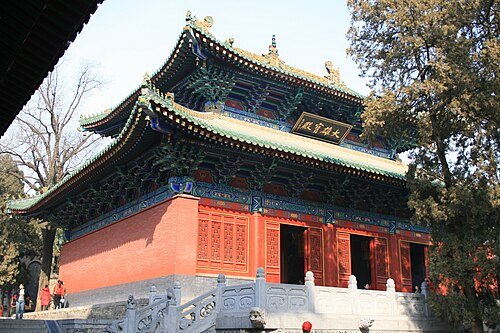
About Shaolin Temple
Beyond its martial-arts reputation, the visit follows a monastic axis of gates and halls, with buildings from different periods and later reconstructions. Lixue Pavilion and the Thousand Buddha Hall add historical depth to the sequence. The neighbouring Pagoda Forest extends the visit into the monastery’s funerary landscape, where individual monks are commemorated by towers of different shapes and ages.
The temple was founded in the nineteenth year of the Taihe era (太和) of the Northern Wei dynasty (495), taking its name from its setting in the forest (林) of Mount Shaoshi (少室山). It is considered the ancestral court of Chan Buddhism (禅宗祖庭) and now belongs to the Caodong sect (曹洞宗). Generations of monks there developed Shaolin martial arts (少林功夫), and the temple became a point of exchange for visitors and monks from within China and abroad.
The Pagoda Forest (塔林), on a hillside about 280 metres southwest of the main temple, covers nearly 20,000 square metres and holds 246 stupas and memorial pagodas. Chuzu'an (初祖庵), 1.3 kilometres to the north, is a Song-dynasty hall commemorating Bodhidharma (菩提达摩), the founding patriarch of Chan, also known as the Hut of Bodhidharma's Wall-Facing (达摩面壁之庵) after his reputed nine years of meditation in the nearby Damo Cave (达摩洞).
Shaolin Temple is part of the Historic Monuments of Dengfeng in 'The Centre of Heaven and Earth' (天地之中建筑群), inscribed on the UNESCO World Heritage List in August 2010. It is a national 5A tourist attraction, and was listed among the seventh batch of Major Historical and Cultural Sites Protected at the National Level (全国重点文物保护单位) in March 2013. Its Sutra Library (藏经阁) was designated a national key ancient-book protection unit in April 2013, holding the country's largest collection of martial-arts manuals.
What to look for
- The main monastic axis, including Lixue Pavilion and the Thousand Buddha Hall.
- The Pagoda Forest west of the monastery, with memorial towers for successive generations of monks.
The surrounding area
Provincial capital base for Henan Museum and regional transfers; urban sightseeing is distinct from Dengfeng.
Location & getting there
Getting to Shaolin Temple
Approach from Dengfeng along the road toward Shaolin, west of town near G207. The municipal guide identifies Dengfeng West Coach Station as a departure point for the Shaolin direction; check the day’s services and allow the final approach from the scenic entrance to the monastery.
Combine your visit
A suggested sequence linking the specific features of this visit.
-
Mountain gate and main halls
Follow the temple’s central sequence and distinguish historic structures from later rebuilding.
-
Lixue Pavilion and Thousand Buddha Hall
Continue to the older rear buildings within the monastic compound.
-
Pagoda Forest少林寺塔林
Compare the temple architecture with its separate memorial landscape.
This order is editorial. Confirm access and any transfers between stops; it does not establish a walking route, same-day connection or common admission ticket.
Find Shaolin Temple
少林寺 · 郑州市
The pin marks the area, not the entrance.
More places nearby
Approximate straight-line distances between map pins, not travel distances.
Pagoda Forest at Shaolin Temple 少林寺塔林
Less than 1 km awayShaolin’s Pagoda Forest is a cemetery of memorial towers west of the monastery. Brick and stone structures from successive dynasties vary in plan, height, tiers and carved detail. Their inscriptions preserve the names and…
View guide →Mount Song 嵩山
4 km awaySongshan is a mountain range with distinct Taishi and Shaoshi sectors, rather than one summit path. Its exposed rock sequences are important to geology, while temples and academies occupy the lower slopes. Shaolin belongs to the…
View guide →Zhongyue Temple 中岳庙
13 km awayZhongyue Temple lies below the eastern side of Taishi Mountain at Dengfeng. It is a Taoist temple associated with the sacred Central Mountain and imperial mountain worship.
View guide →Sources & visit information
The sources below support the place-specific description and arrival information. Suggested combinations are editorial planning ideas; confirm current opening, entry arrangements and transport services for your date.
- en.wikipedia.org ↗
- www.zhengzhou.gov.cn ↗
- 少林寺 ↗
- Chinese Wikipedia: 少林寺 (revision 93618672, 2026-07-23) ↗
- English Wikipedia: Shaolin Monastery (revision 1371461782, 2026-08-26) ↗
Visitor information adapted and edited from Wikipedia contributors, “少林寺” · CC BY-SA 4.0. Source revision 93618672.
Background paragraphs translated and condensed from Wikipedia contributors, "少林寺", Chinese Wikipedia · CC BY-SA 4.0. Source revision 93618672.
Background paragraphs condensed from Wikipedia contributors, "Shaolin Monastery", English Wikipedia · CC BY-SA 4.0. Source revision 1371461782.