

Explore the region
Tap any red Chinese text to hear it in Mandarin.
Why this place is different
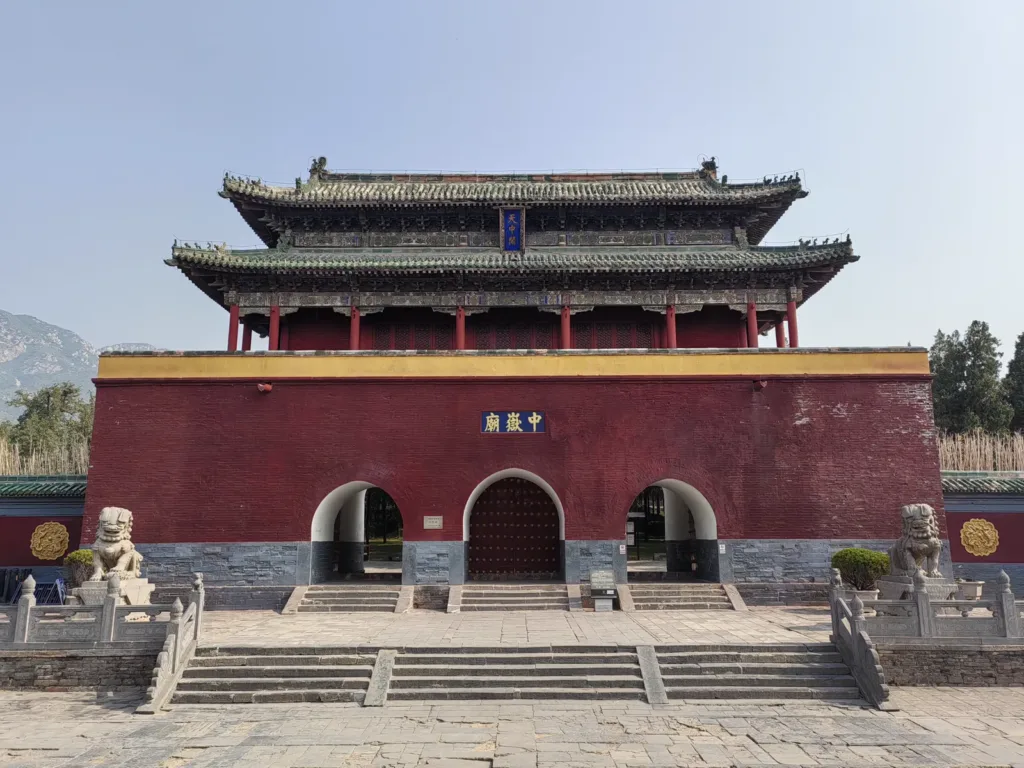
Zhongyue Temple stands below the southern side of Taishi Mountain, at the foot of Huanggaifeng in Dengfeng, the county-level city administered by Zhengzhou. It is not in Zhengzhou’s urban centre, and it is not the same entrance or experience as Shaolin Temple or the wider Mount Song scenic area. The temple and the nearby Taishi Que are part of the UNESCO-listed Historic Monuments of Dengfeng in “The Centre of Heaven and Earth”, inscribed in 2010.
The site is best understood as a ceremonial landscape. Worship of Mount Song’s Central Peak was connected with imperial ritual and with the idea of Dengfeng as a centre between heaven and earth. UNESCO describes Zhongyue Temple and Taishi Que as monuments closely related to the mountain, rather than isolated buildings detached from their setting.
What to see
Walk the main north–south sequence rather than treating the temple as a single photo stop. The Zhengzhou heritage authority lists Taishi Que, Zhonghuamen, Yaocan Pavilion, Tianzhong Pavilion, Chongsheng Gate, Huasamen, Junji Gate, Zhongyue Hall, the sleeping hall and the Imperial Library along the principal axis. The changing gates and thresholds are the point: they make the complex’s ritual order legible before you reach the central halls.
Look for the contrast between formal Qing-period buildings and the older landscape they occupy. The heritage authority records more than 400 Ming and Qing buildings, over 300 ancient cypresses from the Han through Qing periods, and an area of nearly 110,000 square metres. It also identifies the present architectural appearance as largely the result of Qing rebuilding within a layout established in the Ming period. In practical terms, the compound is more than 650 metres from north to south, so allow time for a continuous walk and for returning through the entrance area.
The site’s long history is useful as a framework, not as a reason to rush through a list of dates. The temple’s predecessor was built in the Qin period; Emperor Wu of Han ordered major rebuilding in 110 BCE, and later dynasties repeatedly moved, enlarged or rebuilt the complex. Read the halls together with the mountain-facing axis and the Taishi Que approach: that relationship is what distinguishes Zhongyue Temple from a generic old temple.
Tickets, opening and entry checks
Do not carry an old ticket price or an old opening schedule forward. A July 29, 2026 response from the Dengfeng culture and tourism authority says that the 漫游嵩山 Màn Yóu Sōng Shān mini-program can be used to reserve a Shaolin Temple–Zhongyue Temple–Songyang Academy joint ticket, and that it provides live tourism-service information. The official pages read for this guide do not state a current daily opening time, ticket price, visitor quota, or a passport-specific booking and inspection procedure.
Before setting out, check the current notice in 嵩山旅游 Sōng Shān Lǚ Yóu or 漫游嵩山 Màn Yóu Sōng Shān, then confirm that the booking flow accepts your passport rather than assuming that a mainland ID-card process also works for foreign visitors. Confirm the visitor gate, any repair closure, and the final admission time on the date you intend to go. A future season, holiday arrangement or old reopening notice should not be treated as a current rule.
Getting there and getting back
Use the full Chinese name 中岳庙 Zhōng Yuè Miào when searching. A map marker commonly gives the locator as 河南省郑州市登封市少林大道818号; the marker identifies the area, not proof that every gate is open, so compare it with the day’s visitor notice before leaving.
From Zhengzhou, the Dengfeng government’s travel guide lists the Zhengzhou–Shaoluo Expressway or S316 as the road approaches to Dengfeng. This is a useful driving orientation, not a promise about travel time. Once in Dengfeng city, the same official guide says to take city bus route 2 to the 中岳庙 Zhōng Yuè Miào stop. The guide does not publish a current timetable, stop-side detail or last return service, so check the live route in Amap on the day and note the return stop before entering. If route 2 is not running when you leave, use a taxi or ride-hailing car to the same Chinese destination and confirm the gate with the driver; do not rely on a generic “Mount Song” destination.
The sources read for this guide do not establish a rail service to the temple entrance. If you arrive in the Zhengzhou area by train or plane, treat Dengfeng as the road-transfer point, then use the verified city-bus or taxi leg above. Keep the return leg separate from the visit itself: the temple’s long axis, ticket checks and any queue at the gate can all consume time, and nearby Mount Song sites are not automatically connected by a walkable route.
A respectful visit
This remains a historic religious site as well as a heritage attraction. Follow signs around worship areas, do not cross barriers to inspect fragile fabric, and ask before photographing active devotional activity. The most rewarding visit is slow: read the gates in sequence, look back toward Taishi Mountain, and leave enough daylight for the return journey.
Combine your visit
A suggested sequence through the named features described in the source.
-
Temple approach and gates
The temple’s Taoist setting complements the wider Dengfeng historic-monument landscape.
-
Ceremonial hall axis
The ceremonial halls belong to worship of the sacred Central Mountain.
The order is an editorial suggestion. Internal opening arrangements and transfers between sectors need checking; no walking duration or access entitlement is implied.
Find Zhongyue Temple
中岳庙 · 郑州市
The pin marks the area, not the entrance.
More places nearby
Approximate straight-line distances between map pins, not travel distances.
Gaocheng Astronomical Observatory 观星台
9 km awayGaocheng Observatory makes astronomical measurement visible in brick and stone. Its Yuan-period platform supported a horizontal bar whose shadow fell along a long stone measuring scale extending northward. Water channels helped…
View guide →Mount Song 嵩山
12 km awaySongshan is a mountain range with distinct Taishi and Shaoshi sectors, rather than one summit path. Its exposed rock sequences are important to geology, while temples and academies occupy the lower slopes. Shaolin belongs to the…
View guide →Pagoda Forest at Shaolin Temple 少林寺塔林
13 km awayShaolin’s Pagoda Forest is a cemetery of memorial towers west of the monastery. Brick and stone structures from successive dynasties vary in plan, height, tiers and carved detail. Their inscriptions preserve the names and…
View guide →Sources & visit information
Sources checked on 31 October 2026. Hours, tickets, reservations and transport can change; confirm with the operator before you go.
Image credits & notes (1)
- Zhongyue Temple's central entrance gate in Dengfeng, with its three arched openings, stone lions and Taishi Mountain visible at left. Photo: YumetoPhoto: CC BY-SA 4.0