

Explore the region
Tap any red Chinese text to hear it in Mandarin.
Why this temple matters
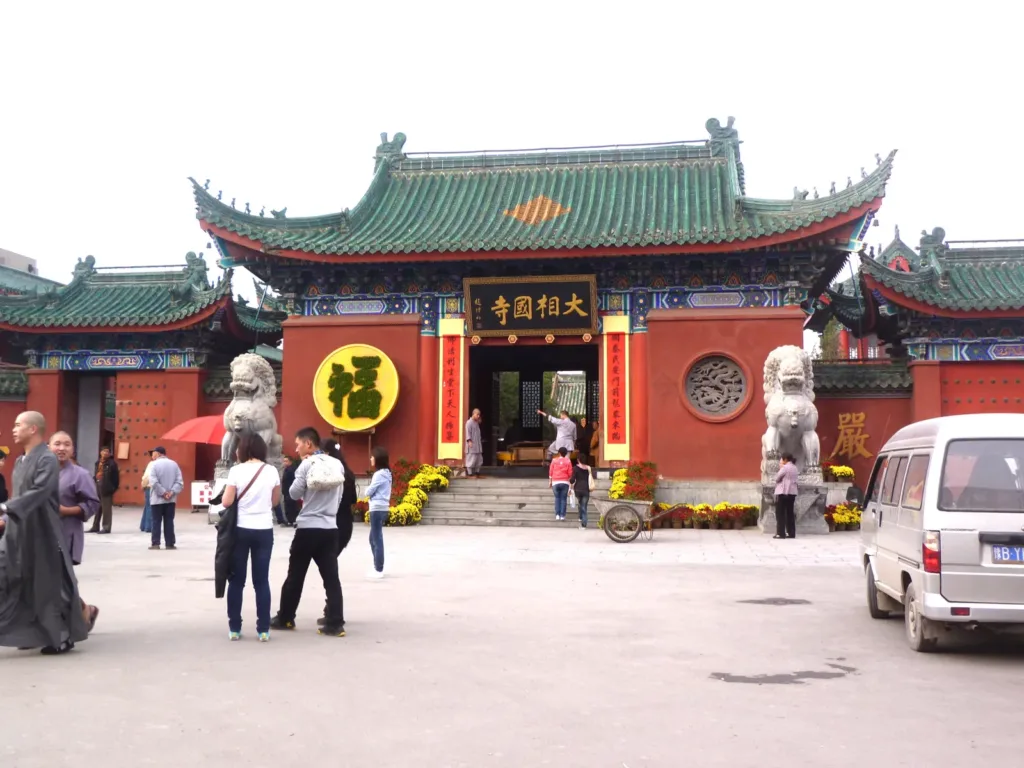
Daxiangguo Temple is not a remote mountain monastery. It stands in central Kaifeng, at the edge of the city’s everyday street life, and its importance comes from the way a functioning Buddhist site carries several layers of Kaifeng’s history. The temple was founded in 555 as Jianguo Temple, rebuilt in the early Tang, and received the name Daxiangguo Temple in 712 in connection with Emperor Ruizong’s former title as Prince of Xiang. It became a major royal temple and commercial-cultural centre in the Northern Song, before the complex was destroyed by the Yellow River flood of 1642. Most of the buildings visitors see today are later reconstructions, especially from the Qing period.
Enter from Ziyou Road and read the complex as an architectural sequence rather than as one isolated hall. The main buildings are arranged along an axis from the mountain gate through the Hall of the Heavenly Kings and the Daxiongbao Hall to the Octagonal Glazed Hall and the Sutra Library. That progression makes the visit more rewarding than a quick photograph at the gate: compare the rooflines, painted timberwork and changing scale of the images as you move inward. The official Henan cultural account describes this surviving sequence and the temple’s central-city setting.
What to look for
The Octagonal Glazed Hall, also called the Luohan Hall, is the visual focus. Its eight-sided form is unusual, and inside is a four-sided, many-armed Guanyin carved from a single ginkgo trunk according to the temple’s long-standing account. Stand where you can see how the sculpture’s radiating arms work against the enclosing geometry of the hall, then look back toward the broader, more frontal arrangement of the main Buddha hall. The point is not to count every figure quickly, but to notice how building shape directs attention.
The Sutra Library closes the main axial sequence at the rear. Its position helps explain the temple as a planned Buddhist complex, not merely a collection of decorated rooms. Do not assume that every interior, exhibition or worship area will be open on every date; follow staff directions and posted photography rules. This remains a religious site: keep voices low, do not touch images or ritual objects, and ask before photographing services or worshippers.
The temple also gives Kaifeng a living musical connection. “Buddhist music, Daxiangguo Temple Buddhist Music” is a national-level representative intangible cultural heritage project announced in 2008, with the temple listed as its protecting institution. The heritage record traces the tradition to the Tang–Song period and describes its blend of court, temple and local music. That status does not establish a daily performance timetable, so treat any music or ceremony as something to observe only when the temple announces or permits it.
Plan the visit
Location: 36 West Section, Ziyou Road, Gulou District, Kaifeng — 河南省开封市鼓楼区自由路西段36号. Amap lists this street address for 大相国寺. Use the Chinese name and number when setting a destination; an approximate map pin is not a substitute for the visitor entrance.
Opening and tickets: Visitor-service pages published on 28 January 2026 list summer hours of 08:00–18:30 from 11 March to 31 October and winter hours of 08:00–18:00 from 1 November to 10 March. The same pages list a full ticket at RMB 40 and a half ticket at RMB 20. They also say that buying a ticket is enough for entry without a separate reservation, with online purchase routed through the Daxiangguo Temple WeChat account. These are dated visitor-service listings, not a promise that a temporary closure or policy change cannot occur; check the official channel or call before travelling.
The published purchase instructions describe entry by a QR code or Chinese ID card but do not explain passport-holder eligibility, foreign-ID input, payment, or refund handling. International visitors should ask the temple directly before relying on the online flow. Do not treat a Chinese-ID option as confirmation that a passport will be accepted. The January 2026 opening and booking pages print 0371-22733098; another local listing shows additional numbers, so use the official account or confirm the current number if a call does not connect.
By bus or taxi: A January 2026 local transport listing directs visitors to 相国寺站 Xiàngguó Sì Zhàn and lists routes 4, 2, 5, 16 and 29. Route numbers and directions can change, so check the live itinerary in Amap on the day and confirm that the bus is travelling toward the stop you need. From the stop, walk to the Ziyou Road address. For a taxi or ride-hailing car, show 开封市鼓楼区自由路西段36号 and confirm the drop-off against the temple entrance; no fixed fare or travel time is assumed here. For the return, plan from the same stop or use a fresh Amap route rather than assuming the inbound bus runs in the opposite direction.
Combine your visit
A suggested sequence linking the specific features of this visit.
-
Main Buddha hall
Begin with the principal statues and the hall’s broad interior arrangement.
-
Octagonal glazed hall
Compare the four-sided Guanyin and the building designed around it.
-
Sutra-library building
Complete the axial sequence at the rear of the temple.
This order is editorial. Confirm access and any transfers between stops; it does not establish a walking route, same-day connection or common admission ticket.
Find Daxiangguo Temple
大相国寺 · 开封市
The pin marks the area, not the entrance.
More places nearby
Approximate straight-line distances between map pins, not travel distances.
Kaifeng 开封
Less than 1 km awayKaifeng’s former capital status is visible through a mixture of surviving monuments and later recreations. The Song-period Iron Pagoda provides an architectural anchor, while Daxiangguo Temple and the raised Dragon Pavilion…
View guide →Dragon Pavilion 龙亭
2 km awayDragon Pavilion stands on a high brick platform above the lakes of northern central Kaifeng. The visible hall belongs to the later history of a site occupied by earlier palaces; it should not be read as an intact Northern Song…
View guide →Millennium City Park 清明上河园
2 km awayQingming Riverside Garden is a modern recreation inspired by Zhang Zeduan’s painting of urban life along a river. The artificial waterway links market streets, bridges and performance areas, with Rainbow Bridge forming a central…
View guide →Sources & visit information
Sources checked on 31 October 2026. Hours, tickets, reservations and transport can change; confirm with the operator before you go.
Image credits & notes (1)
- The main gate of Daxiangguo Temple in Kaifeng, with the Chinese temple plaque, guardian lions and the entrance passage visible. Photo: GislingPhoto: CC BY-SA 3.0