

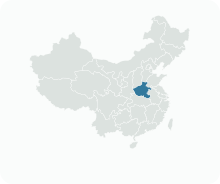
Get to know Gulou District

- Administrative area
- District · 市辖区
- Part of
- Kaifeng
- Chinese name
- 鼓楼区
- Local areas
- District guide
Area & population
- Area
- 58.00 km²
- Population · 2019
- 157,000
Source: English Wikipedia, as of the dates shown.
Why this district matters
Gulou is one of Kaifeng’s municipal districts (the official administrative code is 410204). The district government describes it as an old and central urban district, named after the bell-and-drum tower tradition of the Ming and Qing period. Its strongest travel quality is the way major heritage sites and ordinary city life overlap: a temple or former government precinct can be followed by a lake edge, a historic street and a busy evening market without leaving the old city.
This is a place to walk slowly rather than to “complete” a list. Kaifeng’s repeated rebuilding after floods left a layered city beneath the present streets; recent heritage reporting describes archaeological strata and the continuing role of the old waterways in the city’s identity. In Gulou, that long history is easiest to read through buildings, water and street activity together.
What to see and how to read it
Start with Daxiangguo Temple (大相国寺) on the west section of Ziyou Road. The Kaifeng cultural-heritage register lists Xiangguo Temple at 36 Ziyou Road West Section as a national-level protected site, and the district’s 2025 A-grade scenic-area list records Daxiangguo Temple as a 4A attraction. Treat the temple as a working Buddhist site as well as a historic complex: observe the sequence of halls and sculpture quietly, dress respectfully, and follow any on-site rules rather than treating religious activity as a performance.
Around the central old city, Kaifeng Prefectural Government Office (开封府) is a reconstructed cultural attraction based on the Northern Song administrative office, not the surviving original government compound. Its official site places it on the north bank of Bao Gong East Lake and currently lists daytime and night visits, a 17:30 daytime admission cut-off, and scheduled performances; hours, prices and programmes can change, so check the official page before setting out. The useful way to visit is to look at the axis of the gate, court and halls, then separate the historical setting from the modern staging.
The lake setting links Kaifeng Prefectural Government Office with Bao Gong Shrine (包公祠) on the west lake and with waterside walking. The district government identifies Bao Gong Lake, Bao Gong Shrine, Yanqing Taoist Temple (延庆观), the ancient State Bridge site (州桥遗址), Bookstore Street (书店街) and four night markets among Gulou’s cultural and visitor resources. The city heritage register records Yanqing Taoist Temple at 53 Guanqian Street as a national-level protected site and the ancient State Bridge site on the middle section of Zhongshan Road as a city-level protected site. These are better understood as a connected old-city landscape than as a single theme park.
One boundary correction matters for planning: the old district guide listed Shanxi-Shaanxi-Gansu Guild Hall (山陕甘会馆) among places around Gulou, but the city’s official heritage register places it at 105 Xufu Street in Longting District. It is therefore not counted here as a Gulou stop.
Street life and food
Gulou is also a practical place to notice Kaifeng’s evening rhythm. The district government identifies Gulou Night Market (鼓楼夜市) and Xisi Night Market (西司夜市) as local night-market areas. Look for dishes rather than a particular shop: Kaifeng soup-filled buns (开封灌汤包), mutton flatbread (羊肉炕馍), barrel-cooked chicken (桶子鸡) and fried-liangfen noodles (炒凉粉) are useful Chinese search terms and dish names in the city’s official visitor-facing material.
For a current choice near where you are staying, search the Chinese dish name in Meituan (美团) or Amap/Gaode Maps (高德地图). Check the menu, recent reviews, opening status and whether the dish is actually being served that day. This is a way to find nearby options, not an endorsement of platform rankings or a claim that any one shop is the definitive version.
Getting there and moving around
Gulou District has no single visitor gate. Put the exact destination—such as 大相国寺 Dà Xiàngguó Sì, 开封府 Kāi Fēng Fǔ, 包公祠 Bāo Gōng Cí or 鼓楼夜市 Gǔ Lóu Yè Shì—into Amap/Gaode Maps rather than entering only “Gulou District”; the correct stop and walking approach depend on the site. No verified metro station is used in the sources for this district, so do not plan around an unconfirmed metro connection.
Kaifeng’s official public-transport notices have documented bus links from Kaifeng Railway Station (开封火车站), Songcheng Road Station (宋城路站) and Kaifeng North Station (开封北站) to the central attractions. A 2024 Chrysanthemum Culture Festival notice, for example, listed a festival line from Kaifeng Railway Station via Jiefang Road–Daxiangguo Temple and Jiefang Road–Gulou Square, and tourist loops from Songcheng Road Station or Kaifeng North Station via State Bridge (Xiangguo Temple) and Yanqing Taoist Temple (Kaifeng Prefectural Government Office). Those were event-period services, not a promise of a current daily timetable.
For a normal arrival, use the railway or coach station as your gateway, then check the live bus or taxi result for the exact venue. If taking a taxi or ride-hailing car, show the Chinese destination and confirm the visitor entrance; “Gulou District” alone is too broad. Keep the return route visible before entering an evening market or a venue with a late programme.
Practical limits
District-level identity does not establish venue-level admission for an overseas visitor. I found no district-wide source that confirms passport booking, foreign-visitor ticketing or a single reservation rule for all sites. Check each venue’s current official instructions, and do not treat a domestic-ID reservation flow as proof that a passport holder can use the same process. The 2024 festival transport notice is likewise historical: verify the bus, stop, operating period and return service on the day of travel.
Explore Gulou District
Core places to explore, with English and Chinese names.
Places to explore around Gulou District
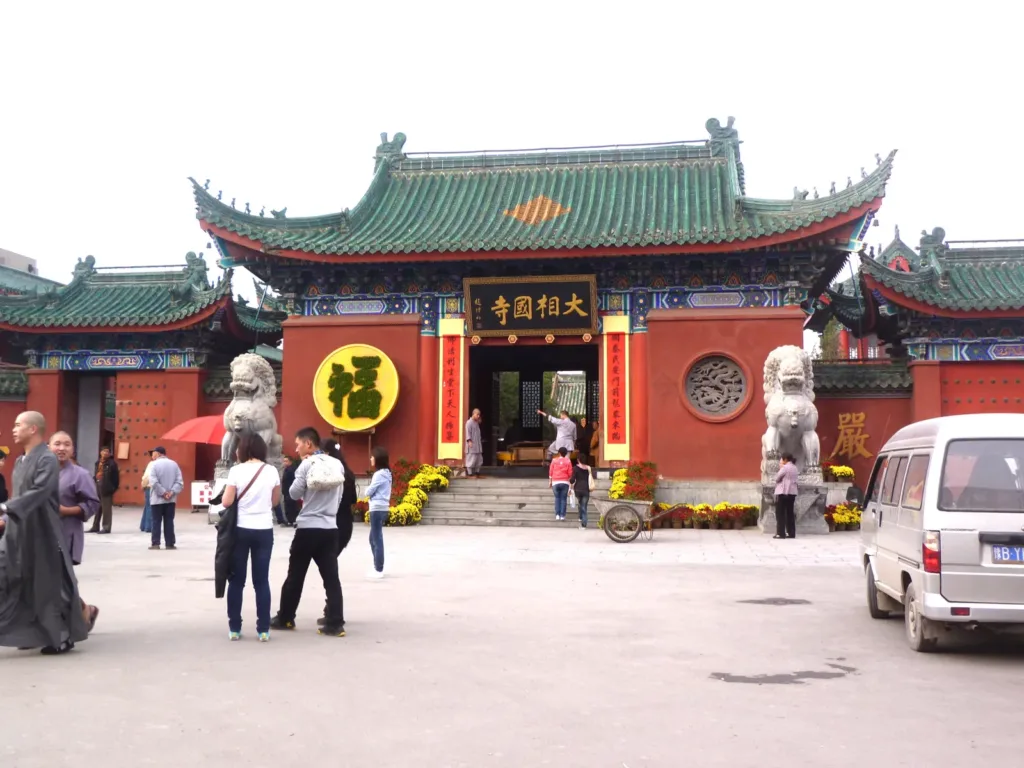 The main gate of Daxiangguo Temple in Kaifeng, with the Chinese temple plaque, guardian lions and the entrance passage visible. Photo: Gisling · CC BY-SA 3.0
Daxiangguo Temple大相国寺
A central Kaifeng Buddhist temple where a surviving axial layout, Qing-period halls and a distinctive four-sided Guanyin make the city's religious and architectural history visible in a compact visit.
Read the place guide →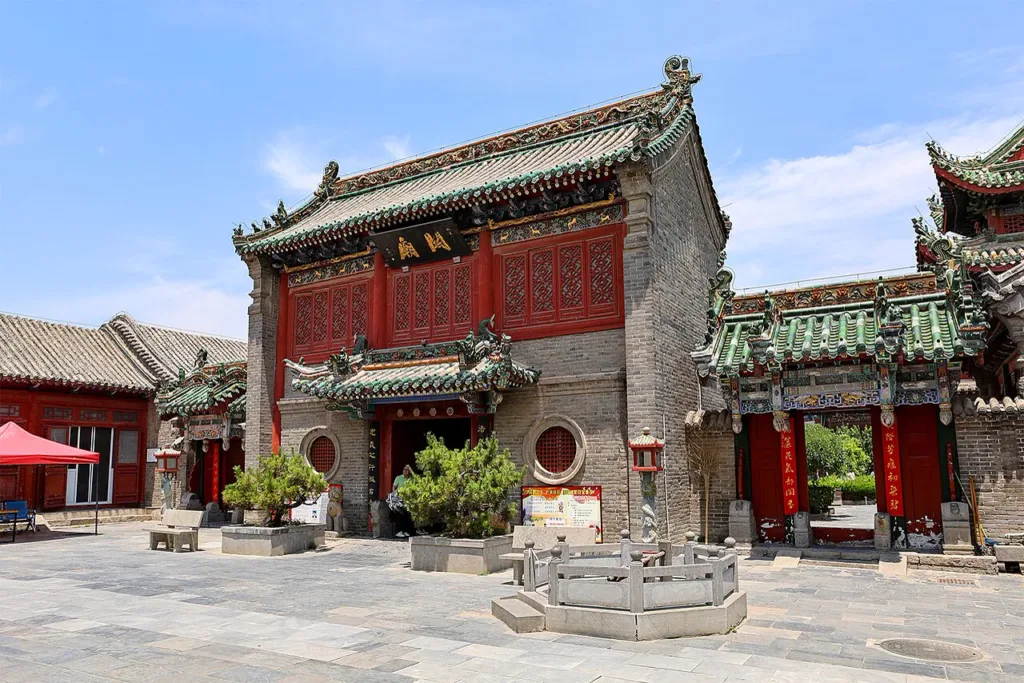 An inner courtyard of Kaifeng’s Shanxi-Shaanxi-Gansu Guild Hall, showing the historic brick-and-wood hall and an adjoining gateway. Photo: Windmemories · CC BY-SA 4.0
Shanxi-Shaanxi-Gansu Guild Hall山陕甘会馆
A surviving Qing merchants’ guild hall in Kaifeng, where a south-facing courtyard leads from a carved screen wall and historic opera stage to a Guan Yu hall rich in brick, stone and wood carving.
Read the place guide →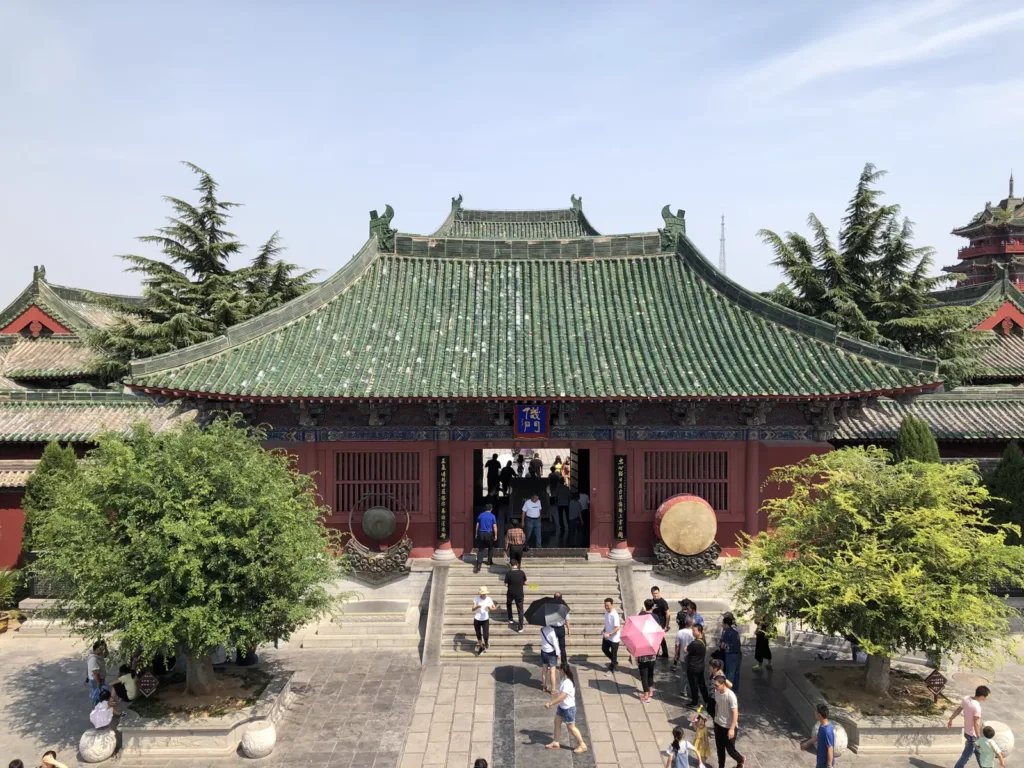 The ceremonial gate (Yimen) inside Kaifeng Fu, showing the reconstructed visitor compound's central entrance sequence. Photo: David290 · CC BY-SA 4.0
Kaifeng Prefectural Government Office开封府
Kaifeng Fu is a Song-inspired cultural theme park on the north shore of East Baogong Lake. Its reconstructed government-office axis, Bao Zheng associations, historical displays and scheduled court-style performances show how Kaifeng remembers its Northern Song capital past—through a visitor complex rather than surviving Song government buildings.
Read the place guide →Plan your visit
Getting there
Gulou District covers the centre of Kaifeng. Search for 鼓楼区 in a map app to find stations and your accommodation.
Where to stay →Build your route
Daxiangguo Temple and Shanxi-Shaanxi-Gansu Guild Hall are less than 1 km apart. The linked place guides have entrance and visit details.
Continue with Kaifeng →More in Kaifeng
Sources & geographic information
Administrative names and parent areas: Official geographic directory (dmfw.mca.gov.cn) · Reference date 2026-09-06.
Sources and licences for the original area background:
Sights and heritage
Chinese Wikipedia: 鼓楼区 (开封市) (revision 93143564, 2026-06-20)
Adapted from Wikipedia contributors, "鼓楼区 (开封市)", Chinese Wikipedia · CC BY-SA 4.0. Translated into English and condensed from the cited revision; figures and dates as stated there. Not independently verified.
Background text adapted from Gulou, Kaifeng — Wikipedia contributors, under CC BY-SA 4.0. Text has been shortened and reorganized; source revision 1331081992.
Map data © OpenStreetMap contributors. Pins mark approximate centres, not entrances or boundaries.
