

Photo adjustments
Full frame retained; proportionally resized and converted to WebP. No retouching or changes to the photographed subject. Card displays may crop the view.
Explore the region
About Dragon Pavilion
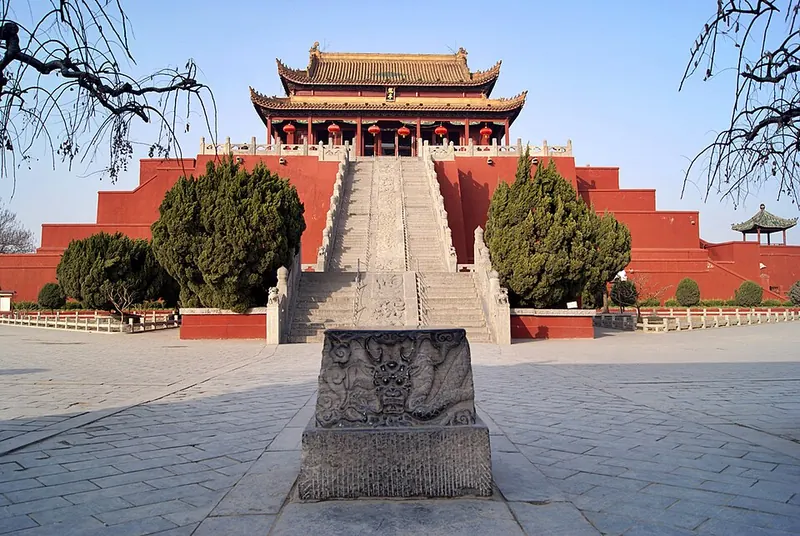
The visible hall belongs to the later history of a site occupied by earlier palaces; it should not be read as an intact Northern Song palace. The long approach between Pan and Yang lakes reinforces its ceremonial position. From below, the stairway and platform dominate the view; closer up, the double eaves and hall structure become the focus.
A princely mansion was built here in 1378 and destroyed by a Yellow River (黄河) flood in 1642. The site became an examination compound in 1659. In 1692, a pavilion containing an imperial tablet was built on an artificial hill retained from the earlier garden. In 1743, the pavilion became Wanshou Palace (万寿宫). The hall was blown down in 1845 and replaced by a hexagonal pavilion, which was removed when the hall was rebuilt in 1856.
Following repairs, the site opened as Longting Park (龙亭公园) in 1953. Reconstruction of approach buildings, including Wu Men (午门), began in 1985. After the rear wall of the base failed in July 1994, repairs involved dismantling the hall, stabilising the foundations and reassembling the timber structure, with 90 percent of the timber-frame material coming from the dismantled wooden components. Work finished on 25 October 1994. The site became a Henan Provincial Cultural Relics Protection Unit (河南省文物保护单位) in June 1963, and the main hall entered the eighth group of Major Historical and Cultural Sites Protected at the National Level (全国重点文物保护单位) in October 2019.
What to look for
- The elevated pavilion hall and its substantial brick platform and stairway.
- The approach between Pan and Yang lakes, aligned with the ceremonial site.
Background & history
The Dragon Pavilion (simplified Chinese: 龙亭; traditional Chinese: 龍亭; pinyin: lóngtíng) or Wanshou pavilion is located in Kaifeng in the eastern part of Henan province, People's Republic of China. During the Northern Song (960–1127) and Jin (1115–1234) dynasties, Kaifeng was an imperial capital city. The imperial palace of that time is largely lost to time, but a few parts, such as the Dragon Pavilion, remain visible today.
Excerpt from Wikipedia: Dragon Pavilion · Wikipedia contributors · CC BY-SA 4.0. Selected introductory sentences; formatting simplified. Background information, not current visitor-service advice.
The surrounding area
A provincial city base for food traditions and a Gulou-area evening.
Location & getting there
Getting to Dragon Pavilion
Approach the park from the northern end of Zhongshan Road in Kaifeng, beyond the recreated Song Imperial Street. The hall is reached within the park; consider the platform stairs when planning for limited mobility.
Combine your visit
A suggested sequence linking the specific features of this visit.
-
Lake-side approach
Read the long axis between the two lakes before approaching the hall.
-
Pavilion platform
See how the raised base establishes the landmark’s commanding position.
-
Dragon Pavilion hall
Study the later building and its roof rather than assuming it survives from the Song palace.
This order is editorial. Confirm access and any transfers between stops; it does not establish a walking route, same-day connection or common admission ticket.
Find Dragon Pavilion
龙亭 · 开封市
The pin marks the area, not the entrance.
More places nearby
Approximate straight-line distances between map pins, not travel distances.
Millennium City Park 清明上河园
1 km awayQingming Riverside Garden is a modern recreation inspired by Zhang Zeduan’s painting of urban life along a river. The artificial waterway links market streets, bridges and performance areas, with Rainbow Bridge forming a central…
View guide →Kaifeng 开封
2 km awayKaifeng’s former capital status is visible through a mixture of surviving monuments and later recreations. The Song-period Iron Pagoda provides an architectural anchor, while Daxiangguo Temple and the raised Dragon Pavilion…
View guide →Iron Pagoda 铁塔
2 km awayKaifeng’s Iron Pagoda is built of brick faced with dark glazed decoration, whose colour explains its name. The thirteen-storey octagonal tower dates to the Northern Song and rewards close viewing as much as a distant photograph…
View guide →Sources & visit information
The sources below support the place-specific description and arrival information. Suggested combinations are editorial planning ideas; confirm current opening, entry arrangements and transport services for your date.
- en.wikipedia.org ↗
- 龙亭 ↗
- Kaifeng ↗
- Chinese Wikipedia: 龙亭 (revision 92235750, 2026-04-10) ↗
- English Wikipedia: Dragon Pavilion (revision 1265327307, 2024-12-26) ↗
Visitor information adapted and edited from Wikipedia contributors, “龙亭” · CC BY-SA 4.0. Source revision 92235750.
Visitor information adapted and edited from Wikivoyage contributors, listing “Dragon Pavilion” · CC BY-SA 4.0.
Background paragraphs translated and condensed from Wikipedia contributors, "龙亭", Chinese Wikipedia · CC BY-SA 4.0. Source revision 92235750.
Background paragraphs condensed from Wikipedia contributors, "Dragon Pavilion", English Wikipedia · CC BY-SA 4.0. Source revision 1265327307.