

Photo adjustments
Full frame retained; proportionally resized and converted to WebP. No retouching or changes to the photographed subject. Card displays may crop the view.
Explore the region
About Mausoleum of Cao Cao
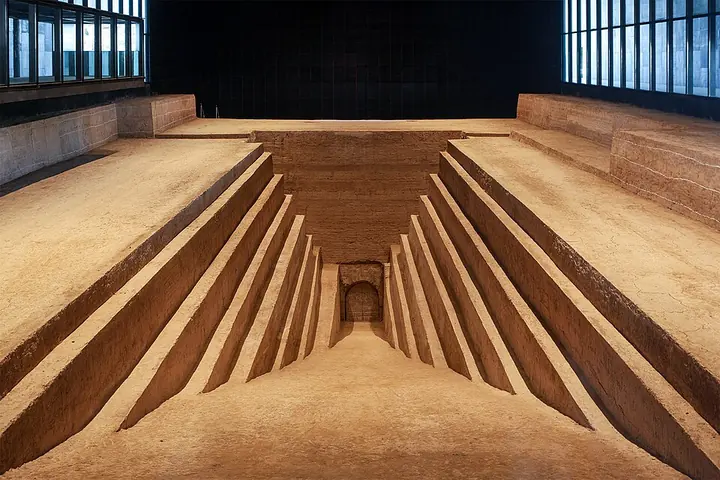
The burial has front and rear chambers with side rooms, allowing visitors to understand its layout as a designed underground space. Inscribed stone labels, including references to the King Wu of Wei, were important to the archaeological identification. The museum therefore brings together the physical tomb and the evidence used to interpret its occupant.
Cao Cao died in Luoyang on 15 March 220 CE at the age of 66, and, following his own directives and deathbed testament, was buried west of the city of Ye in a tomb called Gaoling (高陵). Its location remained unknown for centuries until archaeologists identified it at Xigaoxue village, Anyang, after a rescue excavation begun in 2008; the identification was announced on 27 December 2009, and confirmed by China's State Administration of Cultural Heritage on 29 January 2010.
The tomb faces east and is trapezoidal in plan, about 18 meters east-west and 19.5 to 22 meters wide, reaching some 15 meters below the surface and covering roughly 740 square meters, with a sloping entrance ramp 39.5 meters long. Excavators recovered 59 inscribed stone plaques, including eight naming weapons 'habitually used by the King Wu of Wei,' used as evidence to identify the occupant.
Three stone bi discs and a stone gui found in the tomb are considered an important indicator of imperial-level burial, since a gui appears only in emperors' tombs. The tomb had no earthen mound, matching historical descriptions of Cao Cao's mausoleum as built on high ground without a mound or trees. It was listed in the seventh batch of Major Historical and Cultural Sites Protected at the National Level (全国重点文物保护单位) in 2013.
What to look for
- The sloping tomb passage and the preserved multi-chamber brick burial.
- Inscribed stone labels and the explanation of how archaeologists identified the tomb.
The surrounding area
Northern provincial base for the Yin Xu archaeological landscape and nearby regional food traditions.
Location & getting there
Getting to Mausoleum of Cao Cao
Travel to the Cao Cao Mausoleum Site Museum at Xigaoxue Village in the Anfeng area of Anyang. Arrange a dedicated road transfer to the museum entrance; this site is separate from the Yinxu palace and royal-cemetery areas.
Combine your visit
A suggested sequence linking the specific features of this visit.
-
Discovery and identification displays
Read the evidence before approaching the burial.
-
Tomb passage and chambers
Examine the form and scale of the preserved structure from the authorised viewing route.
-
Inscribed-object displays
Revisit the labels in light of the tomb’s archaeological setting.
This order is editorial. Confirm access and any transfers between stops; it does not establish a walking route, same-day connection or common admission ticket.
Find Mausoleum of Cao Cao
曹操高陵遗址博物馆 · 安阳市
The pin marks the area, not the entrance.
More places nearby
Approximate straight-line distances between map pins, not travel distances.
Yinxu Ruins 殷墟
14 km awayYinxu is the archaeological landscape of the late Shang capital around Xiaotun beside the Huan River. Rammed-earth palace and ancestral-temple foundations show the scale of the former city, while Fu Hao’s tomb gives the royal…
View guide →National Museum of Chinese Writing 中国文字博物馆
18 km awayThe National Museum of Chinese Writing makes scripts its central subject, beginning with early evidence such as oracle bones and following changes in written form. The architecture extends that theme outdoors: the…
View guide →Youli 羑里城
33 km awayYouli combines a much older archaeological site with later buildings commemorating King Wen of Zhou. The traditional account of his imprisonment and work on the Book of Changes gives the place its meaning, but the visible…
View guide →Sources & visit information
The sources below support the place-specific description and arrival information. Suggested combinations are editorial planning ideas; confirm current opening, entry arrangements and transport services for your date.
Visitor information adapted and edited from Wikipedia contributors, “曹操高陵” · CC BY-SA 4.0. Source revision 94072422.
Visitor information adapted and edited from Wikivoyage contributors, listing “Mausoleum of Cao Cao” · CC BY-SA 4.0.
Background paragraphs translated and condensed from Wikipedia contributors, "曹操高陵", Chinese Wikipedia · CC BY-SA 4.0. Source revision 94072422.