

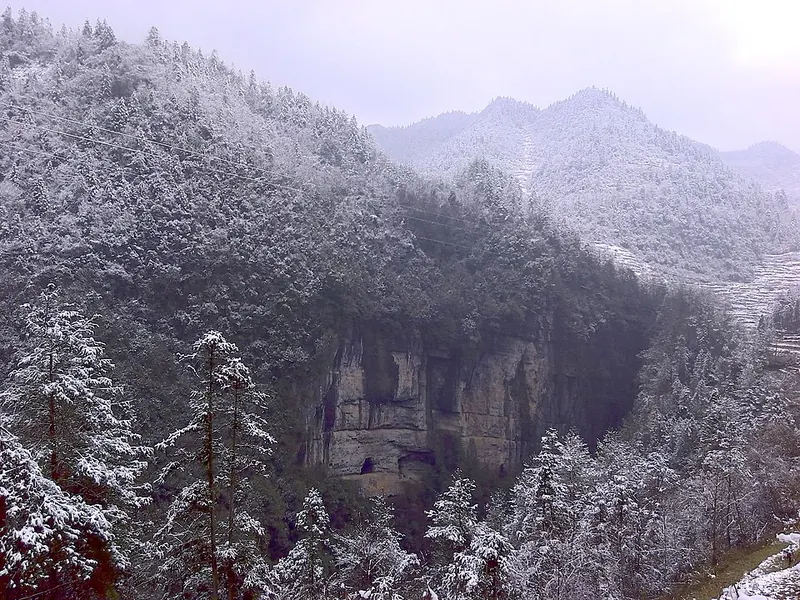
Photo adjustments
Full frame retained; proportionally resized and converted to WebP. No retouching or changes to the photographed subject. Card displays may crop the view.
Explore the region
About Wulong Karst
The Three Natural Bridges show limestone on a monumental outdoor scale, while Furong Cave reveals mineral formations inside the rock. The protected Houping sinkhole system adds a further geological component but should not be assumed to offer the same public visitor access. A practical first itinerary pairs the managed bridge route with Furong Cave on separate transfers.
Furong Cave (芙蓉洞) is 2,700 meters long and is known for its numerous vertical shafts and the full range of cave-sediment types it contains, with more than 70 kinds of deposits covering nearly every type of stalactite formation. The shaft cluster around the cave is described as the largest yet found in China or elsewhere.
Furong Cave lies in Jiangkou Town (江口镇), about 20 kilometers from the Wulong district center, near the confluence of the Furong and Wu rivers; its protected area covers a 3,941-hectare core zone and a 24,024-hectare buffer zone. The Qingkou Tiankeng Scenic Area, also known as the Houping mechanical-erosion karst tiankeng system, covers a 7,134-hectare core zone and 46,781-hectare buffer zone, and is considered the only known tiankeng cluster in the world hypothesized to have formed through surface-water erosion.
The scenic areas within Wulong Karst are respectively designated as national- and municipal-level scenic areas (风景名胜区) and are together protected as the Wulong Karst National Geology Park (重庆武隆岩溶国家地质公园). In June 2007, the karst was inscribed on the UNESCO World Heritage List as part of the South China Karst.
What to look for
- The Three Natural Bridges expose large natural arches and steep karst walls.
- Furong Cave contains stalactites and other mineral deposits within broad chambers.
Background & history
The Wulong Karst (Chinese: 武隆喀斯特) is a karst landscape located within the borders of Wulong District, Chongqing Municipality, People's Republic of China. It is divided into three areas containing the Three Natural Bridges, the Qingkou Tiankeng (箐口天坑) and Furong Cave respectively. It is a part of the Wulong Karst National Geology Park as well as part of the South China Karst, a UNESCO World Heritage Site.
Excerpt from Wikipedia: Wulong Karst · Wikipedia contributors · CC BY-SA 4.0. Selected introductory sentences; formatting simplified. Background information, not current visitor-service advice.
Location & getting there
Getting to Wulong Karst
For the bridges, use the Fairy Mountain Tourist Centre in the Xiannüshan area. Furong Cave has a separate visitor centre at Jiangkou Town, so arrange a road transfer between the two parts of Wulong.
Combine your visit
Suggested order for the visit:
-
Three Natural Bridges
Explore the outdoor limestone forms.
-
Furong Cave芙蓉洞
Make a separate transfer to compare the underground landscape.
This is an editorial sequence of named spaces or places. It does not imply a verified walking connection or promise opening, ticket availability or a journey time.
Find Wulong Karst
武隆喀斯特 · 武隆
The pin marks the area, not the entrance.
More places nearby
Approximate straight-line distances between map pins, not travel distances.
Furong Cave 芙蓉洞
13 km awayFurong Cave opens above the Furong River in Wulong, with large chambers and mineral formations ranging from a broad stone waterfall to coral-like projections. The contrast between smooth draped deposits and finer clustered…
View guide →Ayi River 阿依河
20 km awayThe Ayi River cuts a wooded limestone canyon outside Pengshui, with cliff paths, caves and water-based excursions offering different ways to explore it. Qinglong Valley is the place to focus on the rock walls and vegetation from…
View guide →Wulong Three Natural Bridges 武隆天生三桥
24 km awayThe Three Natural Bridges form a sequence of large limestone arches within Wulong’s karst landscape. Named Tianlong, Qinglong and Heilong, the bridges span spaces cut into the rock by water and collapse. Their different shapes…
View guide →Sources & visit information
The sources below support the place-specific description and arrival information. Suggested combinations are editorial planning ideas; confirm current opening, entry arrangements and transport services for your date.
- Wulong Karst ↗
- Wikivoyage: Wulong ↗
- Chinese Wikipedia: 武隆喀斯特 (revision 91061672, 2026-01-10) ↗
- English Wikipedia: Wulong Karst (revision 1367875533, 2026-08-05) ↗
Visitor information adapted and edited from Wikipedia contributors, “Wulong Karst” · CC BY-SA 4.0. Source revision 1367875533.
Visitor information adapted and edited from Wikivoyage contributors, Wulong · CC BY-SA 4.0. Source revision 5340122.
Background paragraphs translated and condensed from Wikipedia contributors, "武隆喀斯特", Chinese Wikipedia · CC BY-SA 4.0. Source revision 91061672.
Background paragraphs condensed from Wikipedia contributors, "Wulong Karst", English Wikipedia · CC BY-SA 4.0. Source revision 1367875533.