

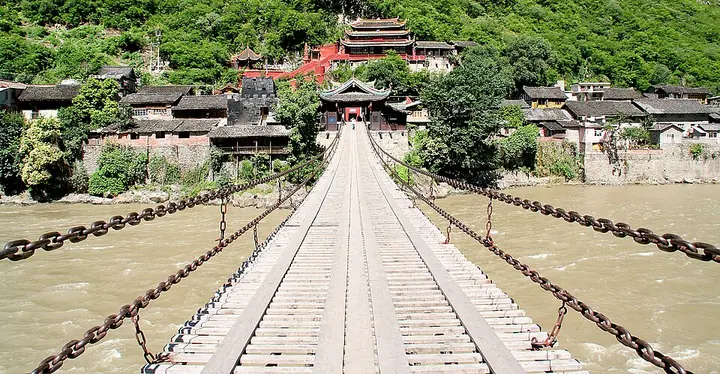
Photo adjustments
Full frame retained; proportionally resized and converted to WebP. No retouching or changes to the photographed subject. Card displays may crop the view.
Explore the region
About Luding Bridge
Nine chains support the deck and four form the side rails, so the structure is easy to understand from the riverbank before stepping onto it. Qing-style bridgehead pavilions mark the ends, and an inscribed stone at the eastern end records its imperial name. The bridge’s later Long March association is interpreted separately in the local memorial museum.
Construction began in the 44th year of the Kangxi era (1705) and finished in the 45th year (1706). The bridge was built to strengthen the route linking Sichuan with the Kangqu (康区) and Weizang (卫藏) regions, replacing bamboo and rattan cable crossings and three nearby ferries used to cross the fast-flowing Dadu River (大渡河). Because it was commissioned by the Kangxi Emperor, it was also called the “imperial bridge” (皇桥), known locally as the “iron chain bridge” (铁索桥).
The bridge has a span of 101.6 meters and a width of 2.8 meters, with its deck about 14.5 meters above the river at low water. Each chain is 127.45 meters long, weighs about 2.5 tons and is made of 800 to 900 flat iron rings. The stone piers at each end stand 20 meters high, anchored behind by cast-iron piles set in 6-meter-deep wells.
The site was declared a first-batch Sichuan historical and revolutionary cultural relic protection unit on 16 August 1956 and listed among the first batch of Major Historical and Cultural Sites Protected at the National Level (全国重点文物保护单位) on 4 March 1961. In 1950 a new steel-cable bridge was built north of the town, as part of the Sichuan-Tibet highway, ending its role as the area's key crossing; the structure was renovated in 1977.
What to look for
- The iron-chain structure and wooden deck can be seen from the riverbank.
- Bridgehead pavilions and the eastern inscribed stone add architectural detail to the crossing.
Location & getting there
Getting to Luding Bridge
Approach the bridge in Luqiao town, central Luding, on the Dadu River. The eastern bridgehead is a useful town-side arrival point; follow the controlled visitor access for the bridge itself.
Combine your visit
Suggested order for the visit:
-
Eastern bridgehead
Look at the pavilion and inscribed stone.
-
Riverbank view of the chains
Understand the suspension structure.
-
Bridge crossing, when admitted
Use the designated visitor route across the wooden deck.
This is an editorial sequence of named spaces or places. It does not imply a verified walking connection or promise opening, ticket availability or a journey time.
Find Luding Bridge
泸定桥 · 甘孜州
The pin marks the area, not the entrance.
More places nearby
Approximate straight-line distances between map pins, not travel distances.
Hailuogou 海螺沟
47 km awayHailuogou is the glacier-and-forest landscape on the eastern side of Mount Gongga, approached from Moxi. Its visitor route combines scenic buses, forest viewpoints and the cable-car area at Camp Four, now also called Gongga…
View guide →Wawu Mountain 瓦屋山
75 km awayWawu Mountain has a broad, wooded summit plateau, with firs, bamboo and rhododendrons around the raised visitor paths. Yuanyang Pool provides a quiet water-level scene on top, while the Lanxi waterfall area exposes the abrupt…
View guide →Bifengxia 碧峰峡
75 km awayBifengxia combines a forested gorge landscape with a separate panda-research visitor area. The gorge paths pass beneath steep rock walls and through a setting of streams and waterfalls; the rebuilt Qingyun Elevator makes the…
View guide →Sources & visit information
The sources below support the place-specific description and arrival information. Suggested combinations are editorial planning ideas; confirm current opening, entry arrangements and transport services for your date.
- Luding Bridge ↗
- Luding Bridge Scenic Area: introduction ↗
- Luding County: Luding Bridge ↗
- Chinese Wikipedia: 泸定桥 (revision 93086015, 2026-06-16) ↗
Visitor information adapted and edited from Wikipedia contributors, “Luding Bridge” · CC BY-SA 4.0. Source revision 1369934769.
Background paragraphs translated and condensed from Wikipedia contributors, "泸定桥", Chinese Wikipedia · CC BY-SA 4.0. Source revision 93086015.