

Explore the region
What to see
Yongling is the tomb of Wang Jian, founder of Former Shu, one of the regional kingdoms of the Five Dynasties and Ten Kingdoms period. The site is in Jinniu District at 10 Yongling Road (永陵路10号). The museum and district authority describe its burial chamber as a rare above-ground imperial tomb; the district’s visitor description gives the earthen mound as about 15 metres high and more than 80 metres across. The tomb was identified through archaeological excavation in 1942 and designated a National Key Cultural Relics Protection Unit in 1961.
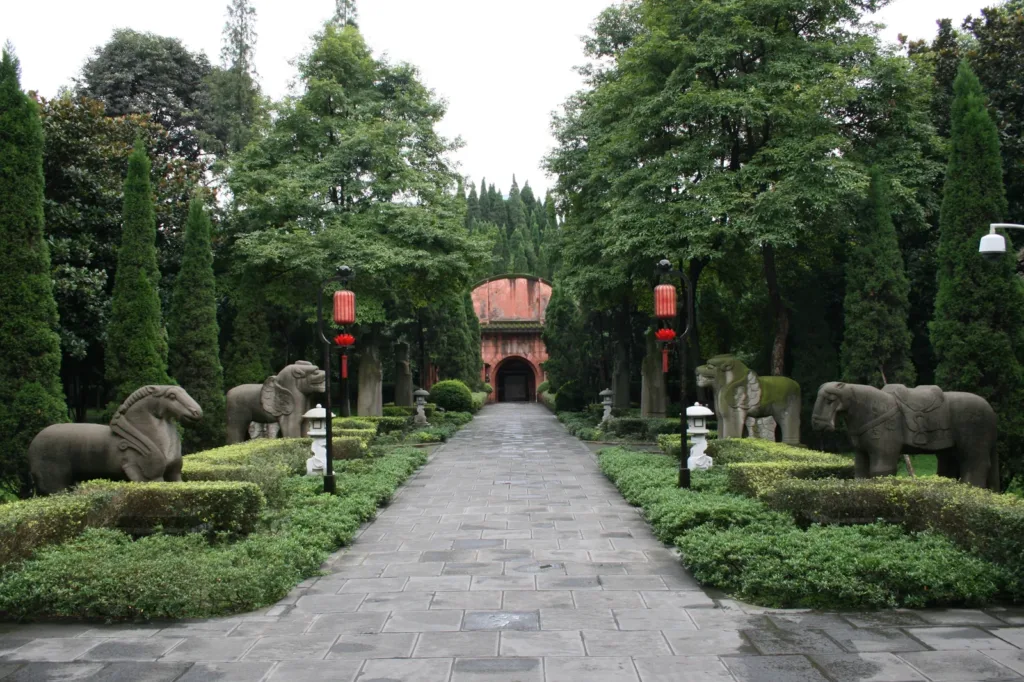
The visit combines three different settings: the protected mausoleum, the museum’s comprehensive exhibition hall and the surrounding garden precinct. Start outdoors to understand the scale of the mound, then enter the protected tomb if it is open. Inside, look at how red-sandstone vault ribs and heavy brickwork form the chamber, and at the carved stone coffin bed. The celebrated “Twenty-Four Musicians” reliefs show a court ensemble; the Palace Museum’s account notes the musicians’ varied instruments and the cultural connections represented in the carving. The Wang Jian stone image and guardian figures are other close-looking subjects. The exhibition hall provides the broader Former Shu and Later Shu context and interprets objects recovered from the tomb.
The garden is also a public park rather than simply a forecourt to a monument. A 2025 report describes residents exercising, families spending time outdoors and older people talking in the grounds. These are ordinary, changing park activities, not scheduled performances; observe without intruding or photographing identifiable people without consent. The garden’s posted hours are longer than those of the museum spaces, so do not assume that being in the park means the tomb or exhibition hall is open.
Tickets and opening
The museum’s current visitor page lists the protected mausoleum at RMB 20 per ticket, with entry and ticket sales ending at 17:30; the comprehensive exhibition hall is free, with entry ending at 17:30. Both are listed as open 08:30–18:00. The garden is listed as free and open 07:00–22:00. These are the museum’s published hours and fees, not a guarantee against temporary closures or holiday changes.
The official page links to a “Reservation Instructions” notice, but its current reservation requirements were not readable in the page content reviewed for this guide. Do not assume that advance booking is or is not required. Check the museum’s official notice before travelling; its listed telephone number is 028-87789003.
Getting there
Use Fuqin (抚琴) Station on Chengdu Metro Line 5 as the local metro approach. A published visitor guide names this station and the museum’s address is 10 Yongling Road. The sources reviewed do not establish a dependable exit number or a sufficiently precise station-to-gate walking route; follow on-site pedestrian signs toward 永陵路10号 rather than relying on an unverified exit claim. The metro operator confirms Line 5 is an operating Chengdu line.
For a taxi or ride-hail, enter 成都永陵博物馆,成都市金牛区永陵路10号. Ask to be set down legally at the public entrance frontage on Yongling Road; no dedicated ride-hail bay was confirmed, so do not request a stop in a traffic lane or assume a car can enter the museum grounds.
No current bus route and stop were verified from an authoritative, up-to-date transit source, so this guide does not recommend a bus number. The older visitor-guide listings should not be treated as current service information.
Combine your visit
Suggested order for the visit:
-
Burial chamber
Begin with the original tomb space.
-
Museum displays
Connect the recovered objects with their funerary setting.
-
Mausoleum grounds
Finish around the preserved monument.
This is an editorial sequence of named spaces or places. It does not imply a verified walking connection or promise opening, ticket availability or a journey time.
Find Yongling Mausoleum
永陵 · 金牛区
The pin marks the area, not the entrance.
More places nearby
Approximate straight-line distances between map pins, not travel distances.
Kuanzhai Alleys 宽窄巷子
1 km awayKuanzhai Alleys is a restored and rebuilt Qing-style lane district filled with teahouses, restaurants and small shops. The contrast between wider and narrower passages gives the area its structure, while courtyard entrances and…
View guide →Qingyang Palace 青羊宫
2 km awayQingyang Palace is a Daoist temple beside the Jin River in western central Chengdu. The complex includes Doumu Hall and the Eight Trigrams Pavilion, with bronze goat figures among its best-known objects. The contrast between the…
View guide →Pinganqiao Cathedral 平安桥天主堂
2 km awayPing’anqiao Cathedral combines a Catholic church complex with Chinese courtyard and timber-building traditions. Covered corridors and nanmu columns link the religious buildings with gardens and adjoining spaces, creating a…
View guide →Sources & visit information
Sources checked on 21 October 2026. Hours, tickets, reservations and transport can change; confirm with the operator before you go.
Image credits & notes (1)
- Tree-lined approach through Yongling’s garden toward the tomb precinct, with stone figures along the path; this is an outdoor view, not the burial chamber. Photo: AlexHe34Photo: CC BY-SA 3.0