

Explore the region
Tap any red Chinese text to hear it in Mandarin.
A temple shaped by its slope
Yuantong Temple (Yuantong Si, 圆通寺) stands on the south side of Yuantong Hill in central Kunming. The Wuhua District government lists it as a provincial-level protected cultural site, while the heritage record gives the address as 42 Yuantong Street, Huashan Subdistrict, Wuhua District.
The site began in the Nanzhao period as Putuoluo Temple and was rebuilt and enlarged through the Yuan, Ming and Qing periods. The complex you see today is therefore a layered historic place rather than one untouched building. Its setting is unusually legible: the street entrance is higher, and the route descends into the temple instead of climbing toward a rear hall.
What to look for
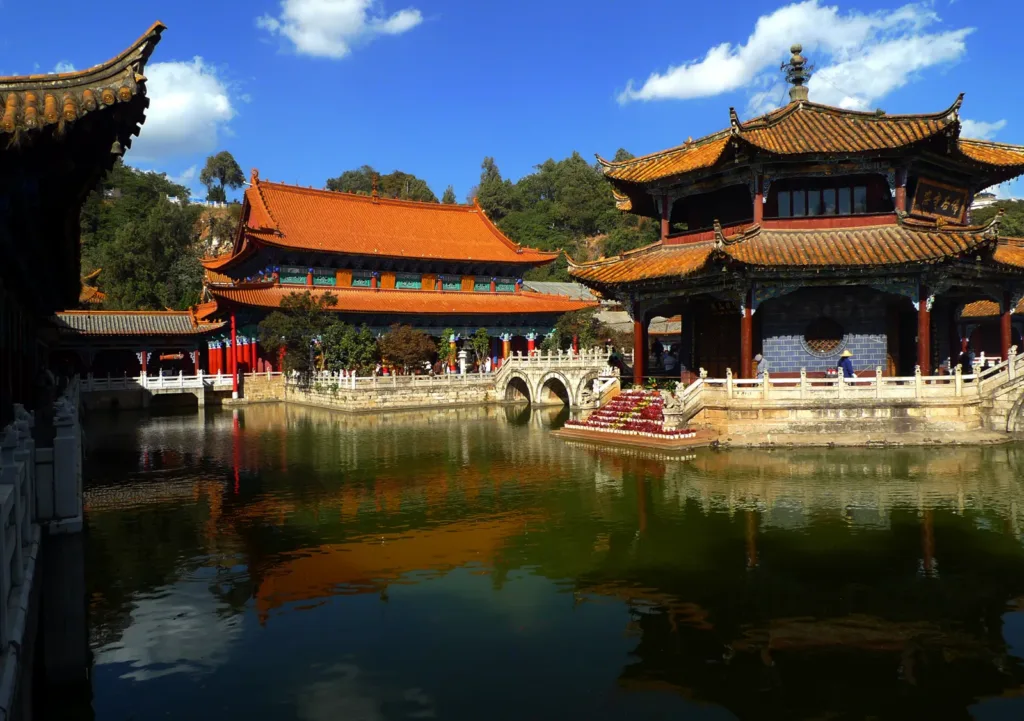
From the entrance, pause at the Yuantong Shengjing archway before going farther downhill. It gives a useful first reading of the whole garden. The central composition is a release pond, stone bridges and an octagonal pavilion, with Yuantong Hall beyond the water. The bridge-and-pavilion arrangement is the temple’s clearest visual idea: water is not a small decorative basin but the space around which the main religious buildings are organised.
Look closely at the details rather than treating the route as a quick photo stop. The hall contains carved Buddhist figures, and stone stairways on both sides climb toward the hillside with older inscriptions and carved work along the way. The Copper Buddha Hall adds a later Chinese–Thai layer to the complex. Sources also describe Mahayana, Theravada and Tibetan Buddhist spaces within the temple, so the buildings reflect Yunnan’s position at a meeting point of Buddhist traditions.
This is an active place of worship. Keep the central route clear, follow signs around shrines and upper paths, ask before photographing people or ritual activity, and do not treat devotional objects as exhibits. Dress with ordinary religious-site modesty and follow any same-day instructions from temple staff.
Location and getting there
The heritage address is 42 Yuantong Street, Huashan Subdistrict, Wuhua District, Kunming (昆明市五华区华山街道圆通街42号). One current booking listing displays 30 Yuantong Street instead, so keep the Chinese name 圆通寺 Yuántōng Sì with you and confirm the entrance on Yuantong Street rather than relying on an English pin alone.
- Metro Line 2: Get off at Chuanxin Gulou (穿心鼓楼), the Line 2 station at Beijing Road and Yuantong Street. A visitor transport guide describes the last leg as a westward walk of about 15 minutes; check the live walking route for the entrance you intend to use.
- Metro Line 5: Yuantong Hill (圆通山) is an operating Line 5 station. The same guide places the temple ticket centre about 1 km from the station.
- Bus: The visitor guide lists routes 85, 92, 100, 101, 119, 187, 235 and Z5 for Yuantongjie (圆通街), and routes 4, 83 and 129 for Yuantongshan (圆通山). Treat these as route leads, not a promise of current service; confirm the stop in Amap or the Kunming transit app on the day.
- Taxi or ride-hailing: Show the Chinese destination 圆通寺,昆明市五华区圆通街42号 and ask to be set down at the public street entrance. The map pin marks the temple area, not necessarily the gate.
Before you go
A visitor reference updated 7 August 2026 lists an entrance fee of CNY 6 and hours of 08:00–17:00. Other accessible listings give different figures, including CNY 4, 08:00–17:30 or 08:00–18:00. Treat the fee and closing time as date-specific and confirm them at the entrance before planning a late visit.
No domestic booking listing should be read as proof that a foreign passport is accepted, that advance reservation is available, or that every internal hall is open. If you are travelling on a foreign passport, ask the ticket counter about the current document and entry procedure; do not assume a listing intended for domestic visitors is a passport policy.
Combine your visit
Suggested order for the visit:
-
Pond and bridge
Read the water-centred layout.
-
Octagonal pavilion and Yuantong Hall
Look at the relationship between the two structures.
-
Accessible side paths
See the hillside setting where the visitor route permits.
This is an editorial sequence of named spaces or places. It does not imply a verified walking connection or promise opening, ticket availability or a journey time.
Find Yuantong Temple
圆通寺 · 昆明
The pin marks the area, not the entrance.
More places nearby
Approximate straight-line distances between map pins, not travel distances.
Green Lake 翠湖
Less than 1 km awayGreen Lake is a city park of water, causeways and pavilions in central Kunming. The north–south Ruan Causeway and east–west Tang Causeway help divide the water into smaller scenes, bringing changing views of willow-lined banks…
View guide →Yunnan Nationalities Museum 云南民族博物馆
11 km awayYunnan Nationalities Museum presents the region’s communities through dress, personal ornaments, craft, art and written material. The objects offer a useful foundation before visiting villages elsewhere in Yunnan, especially…
View guide →Western Hills 西山
13 km awayKunming’s Western Hills rise above Dianchi with forested slopes, temple gardens and a cliff-side religious landscape. Huating and Taihua temples offer courtyards and planting on the ascent, while Dragon Gate and Sanqing Pavilion…
View guide →Sources & visit information
Sources checked on 23 October 2026. Hours, tickets, reservations and transport can change; confirm with the operator before you go.
Image credits & notes (1)
- Yuantong Temple's release pond, stone bridges and octagonal pavilion in Kunming. Photo: GislingPhoto: CC BY 3.0